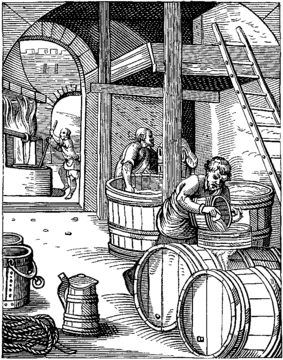
Wort
Liquid extracted from mashing, fermented to produce alcohol.

Wort is the sugary liquid produced during the mashing stage of brewing beer or whisky. Its main sugars—maltose and maltotriose—are what yeast ferments into alcohol. The liquid also supplies essential amino acids that feed the yeast with nitrogen, along with complex proteins that help beer hold its foam and contribute to its flavor.
To make wort, brewers start with malt, which comes from dried, sprouted cereal grains like barley. The malt is milled to crack the husks and expose the starch inside. This milled grain is then mixed with hot water and steeped, a process where enzymes convert the starch into sugars that dissolve in the water. Sometimes the mash is heated at specific intervals to control enzyme activity, and it’s often raised to 78 °C (172 °F) for mashout. Next comes lautering, where the solid grain remnants are separated from the liquid wort. Homebrewers can skip milling and mashing by simply dissolving malt extract in water.
The wort is then boiled to sanitize it, and in most beer production, hops are added during this boil to provide bitterness, flavor, and aroma. Before hops go in, the liquid is called “sweet wort”; after, it becomes “hopped” or “bitter wort.” Hops are usually added in three stages: bittering hops go in first and boil for about an hour to an hour and a half to extract resins for bitterness; flavoring hops follow, typically about 15 minutes before the boil ends; finishing hops go in near or after the end to release aromatic oils that evaporate quickly. Hops give the most flavor when boiled around 15 minutes and the most aroma when not boiled at all.
After boiling, the hot wort is quickly cooled—homebrewers often use an immersion chiller—to a temperature suitable for yeast. Once cooled, it’s moved to a fermentation vessel, oxygenated, and yeast is pitched to start fermentation.
Brewers can also add adjunct grains like oats, wheat, corn, rye, or rice to the mash. These may need to be gelatinized and cooked first. They’re used to make specialty beers like wheat beer or oatmeal stout, to produce grain whisky, or to lighten the body and reduce costs in mass-produced pale lagers.
- Mashout temperature
- 78 °C (172 °F)
- Bittering hop boil time
- approximately one hour to one and a half hours
- Flavouring hop boil time
- approximately 15 minutes from the end of the boil
- Finishing hop boil time
- toward the end of or after the boil
Lore & Background
Wort production begins with obtaining malt from dried, sprouted cereal grains, including barley. The malt is milled to crack the husk and expose the starch, then mashed with hot water and steeped to enable enzymes to convert starch into sugars. Sometimes the mash is heated at set intervals to alter enzyme activity, and the temperature is usually increased to 78 °C for mashout. Lautering then separates the sugar-extracted grist from the liquid wort. In homebrewing, malt extract can be added to water to skip milling and mashing.
Reader's Guide
After lautering, the wort is boiled to sanitize it and, in most beer production, to extract bittering, flavour, and aroma from hops. In beer making, the wort is called 'sweet wort' until hops are added, after which it becomes 'hopped or bitter wort'. Hops are added in three parts: bittering hops boiled for about one to one and a half hours, flavouring hops added 15 minutes from the end of the boil, and finishing hops added toward the end or after the boil. Hops provide the most flavouring when boiled for approximately 15 minutes and the most aroma when not boiled at all. After boiling, the hot wort is quickly cooled to a temperature favorable to yeast, then transferred to a fermentation vessel, oxygenated, and yeast is pitched to begin fermentation. Adjunct grains such as oats, wheat, corn, rye, and rice may be added to the mash, sometimes requiring gelatinization and cooking, to create varietal beers or lighten body.
Did You Know?
- Wort contains the sugars maltose and maltotriose, which are fermented by yeast to produce alcohol.
- The mashout temperature is usually increased to 78 °C (172 °F).
- Bittering hops are boiled in the wort for approximately one hour to one and a half hours.
- Adjunct grains that can be added to the mash include oats, wheat, corn, rye, and rice.
More in Brewing Processes, Part 2 1-24
Spotted an error? Know more?
Reader corrections go straight into our review queue. Suggest an edit · How this site is sourced