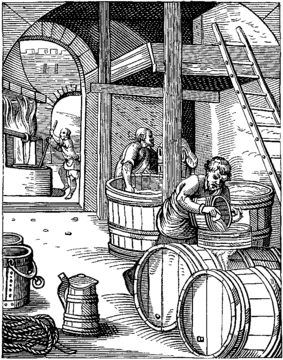
Shive
A cask fitting that adapts a large hole for cleaning and a small hole for gas control.

A shive is a wooden or plastic fitting used in ale casks, located on the curved side of the cask such that when the cask is on its side with the keystone at the lowest part of the rim, the shive is the highest point. It serves as an adaptor that reconciles the conflicting requirements of a large hole for cleaning and refilling the cask and a small hole for controlling carbon dioxide during serving.
- Hole size for washing and filling
- approximately 3 inches (7.5 cm) across
- Typical venting time before serving
- two or three days
- Material
- wooden or plastic
Lore & Background
The shive is a wooden disk, larger than a keystone, that fits into the hole in the cask and has a smaller hole in its centre. For washing and filling, the old shive is removed using a chisel or a special tool, revealing a hole around 3 inches (7.5 cm) across. Once the cask has been filled and fined, a new shive is hammered into place, and the hole in its centre is sealed with a small wooden or plastic peg. The cask is then transported to the pub.
Some time before the beer is to be served—two or three days is common, though especially strong beers may require more—the cask is opened or 'vented' by breaking the seal in the middle of the shive, punching it through into the cask with a mallet and a tool, usually just a hard spile. A spile is then placed in the hole to regulate gas flow. If the beer is particularly 'lively' (common in warm weather and with specific beers), the contents may spray out when the cask is vented.
During use, the hole in the centre of the shive can also be used (with the spile removed) to insert a marked dipstick to measure the quantity of beer remaining. As with keystones, it is considered good form to close up the hole in the shive when returning empty casks, both to prevent spillage and to reduce bacterial and fungal contamination.
Reader's Guide
The shive is notable as a simple yet essential adaptor that resolves the conflicting requirements of a large hole for cleaning and filling a cask and a small hole for controlling carbon dioxide during beer service. Its design—a wooden disk with a central hole—allows brewers to remove the old shive for washing and filling, then hammer in a new shive sealed with a peg for transport. At the pub, the seal is broken by punching it through with a mallet and hard spile, and a spile is inserted to regulate gas flow. The shive also enables measurement of remaining beer via a dipstick. Its legacy lies in its role in traditional ale cask handling, ensuring cleanliness during filling and controlled venting for proper carbonation. The practice of closing the shive hole when returning empty casks helps prevent spillage and contamination, reflecting careful stewardship of the cask. The shive's function is directly tied to the cask's lifecycle, from brewery to pub, and its use remains a standard part of cask ale management.
Did You Know?
- The shive is located at the highest point of the cask when the cask is on its side and the keystone is at the lowest part of the rim.
- The hole in the cask for the shive is about 3 inches (7.5 cm) across for washing and filling.
- The hole in the centre of the shive can be used with a dipstick to measure the quantity of beer remaining.
More in Brewing Processes, Part 2 1-24
Spotted an error? Know more?
Reader corrections go straight into our review queue. Suggest an edit · How this site is sourced