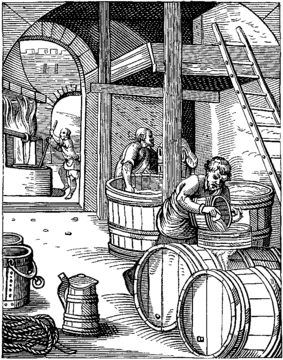
Maashaus
Maashaus could be translated as a 'beer house'.

A maashaus (German: Maßhaus) was a spacious room taking the whole front part of a ground floor of a multi-storied Gothic or Renaissance town house. It was unheated and primarily used for serving beer, as well as for other types of trade and craft. Architecturally, it served as a connecting hub: it contained a staircase leading up to the first floor (where the owner lived) and down to the basement, and it offered an archway or similar passage to the courtyard. Its ceiling was almost always vaulted, often supported by a single column placed off-center. A wall with a doorway and one or more windows separated the room from the street or arcade. The first maashauses appeared in the 13th century, reflecting a shift in burgher houses: living quarters moved upstairs, while the former main living space—once called the smoke abode—remained on the ground floor for public, trade, and craft functions. This arrangement kept these activities close to the cellar, courtyard, and street entrance. The trade often involved serving beer, linked to medieval brewing rights held by most burgher houses, but other crafts and commerce also took place there. In Bohemia, most maashauses were turned into private shops during the 19th century. Later, under socialist-era restoration projects, many were renovated in historic city centers. Today, maashauses can still be found in buildings in places like Český Krumlov and Slavonice. After 1989, many were again used for retail, pubs, or restaurants. The word “Maß” refers to an old unit of volume (roughly 1.4 liters), used mainly for measuring beer, while “haus” means “house” in German—though historically it could also denote the main living room. Thus, “maashaus” can be translated as “beer house.”
- First appearance
- 13th century
- Primary function
- serving beer, trade, and craft
- Heating
- not heated
- Ceiling type
- almost always vaulted, often supported by an asymmetrically placed central column
- Etymology
- Maß (old unit of volume, ~1.4 L) + haus (house or main living room); translates as 'beer house'
- Modern presence
- found in centers of Česky Krumlov, Slavonice, and other historic cities
Lore & Background
Maashauses began appearing in the 13th century as part of a trend to move burghers' living quarters to the first floor. The former main living room, the smoke abode, retained only its public, trade, and craft functions on the ground floor, because these required proximity to the cellar, courtyard, and street entrance. The trade activities mainly involved serving beer, linked to the widespread brewing rights granted to most burghers' houses in the Middle Ages, though other trades and crafts were also performed there. Architecturally, the maashaus was separated from the street or arcade by a wall with a doorway and one or more windows. Its ceiling was almost always vaulted and often supported by an asymmetrically placed central column. The room was not heated. It served as a hub linking other parts of the house, containing a staircase to the first floor (where the owner lived) and to the basement, as well as an archway or similar passage to the courtyard. In the 19th century, most maashauses were converted into private shops. Later, during the socialist period, they were renovated in many historic cities as part of restoration activities. After 1989, many maashauses were again employed for retail or by pubs and restaurants.
Reader's Guide
The maashaus holds significance as a distinctive architectural and social feature of medieval town houses, reflecting the shift of domestic life to upper floors while preserving ground-floor space for commerce and hospitality. Its primary association with beer serving ties directly to the widespread brewing rights of burghers' houses in the Middle Ages, making it a tangible link to urban brewing history. The room's design—vaulted ceiling, central column, and connections to cellar, courtyard, and street—illustrates how medieval buildings integrated public trade with private residence. Its legacy persists in modern times: after 19th-century conversions to shops and later socialist-era restorations, many maashauses in cities like Česky Krumlov and Slavonice have been returned to retail or pub use since 1989. This continuity underscores the maashaus's enduring role as a versatile public space, rooted in medieval brewing culture but adaptable to contemporary commerce.
More in Brewing Processes, Part 2 1-24
Spotted an error? Know more?
Reader corrections go straight into our review queue. Suggest an edit · How this site is sourced