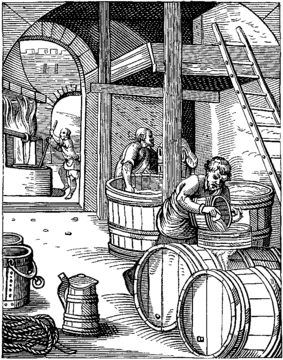
Mashing
Mashing converts grain starch into fermentable sugars via enzymatic action.

Mashing is the process of combining ground grain (the 'grain bill') with water and heating the mixture to allow enzymes in the malt to break down starch into sugars, producing a malty liquid called wort. It is a fundamental step in brewing and distilling, notable for its role in creating fermentable sugars and defining beer character.
- Temperature range
- 45–78 °C (113–172 °F)
- Mashing in temperature single step
- 62–67 °C (144–153 °F)
- Mashing in temperature general
- 35–45 °C (95–113 °F)
- Beta glucanase rest temperature
- 40 °C (104 °F)
- Alpha amylase peak temperature range
- 63–70 °C
- Beta amylase peak temperature range
- 55–65 °C
- Typical rest temperature pale ale or ger
- 66 °C (151 °F)
Lore & Background
The term 'mashing' probably originates from the Old English noun 'masc' (soft mixture) and verb 'mæscan' (to mix with hot water). Usage referring to 'anything reduced to a soft, pulpy consistency' is recorded as early as the late 16th century. The two main methods are infusion mashing, where grains are heated in one vessel, and decoction mashing, where a portion of grains is boiled and returned to raise temperature. Decoction is a traditional method common in German and Central European breweries, used out of necessity before thermometers allowed simpler step mashing, but still practiced for its unique malty flavor from Maillard reactions creating melanoidins.
Mashing takes place in a 'mash tun', which for large breweries is a dedicated vessel with a stirring mechanism (mash rake) and efficient heating, often steam-based, to maintain rest temperatures for up to one hour. Smaller breweries may use a boil kettle or lauter tun, though a lauter tun limits them to single-step infusion mashing. Mashing-in (doughing-in) is typically done between 35–45 °C, but for single-step infusion mashes must be between 62–67 °C for amylases to work. The weight-to-weight ratio of strike water to grain varies from one-half for dark beers in single-step infusions to one-quarter or one-fifth for light-colored beers and decoction mashing.
Reader's Guide
Mashing is significant because it determines the fermentable sugar profile and thus the final sweetness, body, and flavor of the beer. The article describes two main methods: infusion mashing, used by most breweries, where the mash is heated directly or by adding hot water, sometimes in a single step; and decoction mashing, which involves boiling a portion of grains to extract more starches and create rich, malty flavors via Maillard reactions. Decoction is classified into one-, two-, or three-step decoctions depending on how many times part of the mash is boiled. Enzymatic rests at specific temperatures allow different enzymes to work: β-glucanase at 40 °C breaks down cell walls for better extraction, protease rest produces free-amino nitrogen for yeast and affects foam and clarity, and amylase rests (α-amylase at 63–70 °C, β-amylase at 55–65 °C) produce fermentable and non-fermentable sugars. The time and temperature of the amylase rest determine the ratio of fermentable to non-fermentable sugars, with a hotter rest yielding a fuller-bodied, sweeter beer. The article notes contention in the industry about optimal enzyme temperatures, as they depend on pH and mash thickness. Decoction 'rests' involve boiling a thick portion of the mash for about 15 minutes to caramelize sugars and free starches, then returning it to raise the mash to the next rest temperature.
Did You Know?
- A β-glucanase rest at 40 °C breaks down cell walls to raise extraction efficiency, but if too long can cause a stuck mash.
- A hotter amylase rest (e.g., 67–68 °C) results in a fuller-bodied, sweeter beer due to more non-fermentable sugars.
More in Brewing Processes, Part 2 1-24
Spotted an error? Know more?
Reader corrections go straight into our review queue. Suggest an edit · How this site is sourced