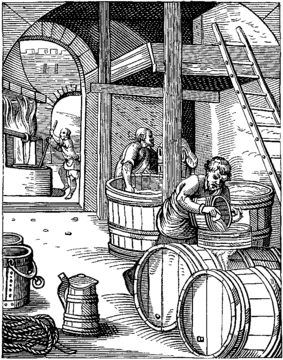
Mash rake
Traditional tool for mixing mash, now a brewer's symbol.

A mash rake—also called a mashing fork or mashing rake—is a tool historically used during the mashing stage of brewing and distilling. Its purpose is to mix the mash by hand, ensuring that the various grains are evenly blended and fully saturated, so that no starches go to waste. In modern usage, the term "rake" most often refers to mechanical blades that cut through the mash bed to improve runoff efficiency, while "fork" typically describes the older, largely obsolete hand tool.
Before industrialization, the mash fork was made of wood, with a long handle and a blade that resembled an oar but had large holes. This type of mash rake, frequently called a mash paddle, is still used by homebrewers today. Large-scale commercial brewers, however, rely on mechanical equipment to stir the mash rather than manual labor.
The traditional mash rake is often employed as a symbol for brewers, similar to how a scythe represents agriculture or the harvest. Saint Arnold of Soissons, the patron saint of Belgian brewers, is frequently shown holding a mash rake. Numerous breweries and master brewers—including Hoegaarden Brewery—feature the mash rake in their logos.
- Alternative names
- mashing fork, mashing rake, mash paddle
- Traditional material
- wood
- Traditional shape
- long handle, blade resembling an oar with large holes
- Modern usage
- mechanical knives to cut the mash bed for runoff efficiency
- Associated patron saint
- Saint Arnold of Soissons
- Associated brewery
- Hoegaarden Brewery
Lore & Background
Before the industrial age, the mash fork was an instrument made of wood with a long handle, somewhat resembling an oar with large holes in the blade. This type of mash rake, often called a mash paddle, is still used by homebrewers. Large modern brewers, however, use mechanical apparatus to mix the mash instead of manual labour.
In modern parlance, the term 'rake' is used most commonly to refer to mechanical knives used to cut the mash bed to optimize the efficiency of the runoff, while 'fork' is most commonly used to refer to the traditional, mostly archaic, tool. The traditional mash rake is often used as a symbol of brewers, in much the same way that the scythe is used as a symbol of agriculture or the harvest.
Reader's Guide
The mash rake holds significance both as a practical tool and as a cultural emblem. Historically, it was essential for manually mixing the mash to ensure proper homogenization and wetting of grains, preventing waste of starches. Its legacy continues among homebrewers, who still use the traditional wooden mash paddle. In large-scale modern brewing, the term 'rake' has shifted to refer to mechanical knives that cut the mash bed for improved runoff efficiency, while 'fork' denotes the archaic hand tool. Beyond function, the mash rake is a potent symbol of the brewing craft, akin to the scythe for agriculture. Saint Arnold of Soissons, patron saint of Belgian brewers, is often depicted with a mash rake, and breweries such as Hoegaarden Brewery incorporate it into their logos, cementing its iconic status.
Did You Know?
- The mash rake is also called a mashing fork or mash paddle.
- Traditional mash rakes were made of wood with a long handle and a blade resembling an oar with large holes.
- Hoegaarden Brewery incorporates the mash rake into its logo.
More in Brewing Processes, Part 2 1-24
Spotted an error? Know more?
Reader corrections go straight into our review queue. Suggest an edit · How this site is sourced