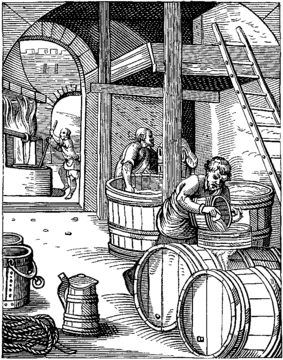
Women in brewing
Women were the primary brewers globally until industrialization.

Women have been active in brewing since ancient times, serving as the primary brewers on all inhabited continents from the earliest evidence of brewing in 7000 BCE until the commercialization of brewing during industrialization. In many cultures, the deities, goddesses, and protectors of brewers were female entities associated with fertility. From the middle of the 18th century, women held roles as barmaids, pub operators, bottlers, or secretaries for breweries, and in less industrialized areas they produced homebrews and traditional alcoholic beverages. From the mid-20th century, women began working as chemists for brewing establishments, and beginning in the 1960s and 1970s, they began re-entering the field as brewers.
- Earliest evidence of brewing
- 7000 BCE
- Earliest known recipe
- Hymn to Ninkasi, dating to 1800 BCE
- Female deities associated with brewing
- Ninkasi (Sumerian), Hathor (Egyptian), Tenenet (Egyptian), Nomkhubulwane (Zulu), Yasigi (Dogon), Mayahuel (Aztec), Raugutiene (Baltic and Slavic), Kamui Fuchi (Ainu)
- Women brewers in haarlem 1518 1663
- 97 brewsters among 536 brewers, three-quarters widows
- Elizabeth pease supplied beer to temple
- 1728-1758
Lore & Background
Ethnographic studies and archaeological records indicate that, until the industrialization of brewing began, brewing beer was primarily an activity engaged in by women. In ancient Sumeria, brewing was the only profession watched over by a female deity, Ninkasi, and a tablet from 1800 BCE contains the Hymn to Ninkasi, which is also a recipe for Mesopotamian beer. In ancient Egypt, brewing was considered the province of women, especially the steps of grinding grain and straining the mash, and the goddess Hathor was considered to have invented brewing. In the Wari Empire, archaeological evidence indicates that elite Wari women brewers ran the breweries, a tradition that carried forward into Incan society. Throughout the Andean region and Mesoamerica, women were the chief producers of alcoholic beverages. Traditional Germanic societies were reported by the Romans to drink ale produced by women, and until monasteries took over production in the 11th century, brewing was the domain of tribal Germanic women. In Finland, women brewsters created a beer called sahti for around a thousand years. In Denmark, women were the primary brewers until the establishment of guilds in the Middle Ages, and even within guilds, while higher positions were occupied by men, many of their wives held lower positions and evidence suggests the majority of brewing was carried out by the wives.
Reader's Guide
The significance of women in brewing lies in their foundational role across millennia and continents, from the earliest known brewing in 7000 BCE until the commercial shift during industrialization. The article shows that women were not merely occasional brewers but the primary producers in most societies, with female deities overseeing the craft in Sumeria, Egypt, Zulu, Dogon, Aztec, Baltic, Slavic, and Ainu cultures. This divine association underscores the cultural importance of women's brewing. The transition from home-based female brewing to male-dominated guilds and commercial operations is documented in Europe, where guilds often forced women out, though in Haarlem, inheritance allowed some widows to continue. In less industrialized areas, women maintained traditional roles, such as chewing maize for chicha in the Andes or chewing rice in Japan and Taiwan. The article also notes that from the mid-20th century, women began working as chemists, and from the 1960s–1970s, they re-entered the field as brewers, marking a return to their ancient heritage. The legacy is one of continuity and disruption: women were the original brewers, marginalized during industrialization, and are now reclaiming their place.
Did You Know?
- The Hymn to Ninkasi, dating to 1800 BCE, is both a hymn and a recipe for Mesopotamian beer.
- In the Wari Empire, elite women brewers ran the breweries, a tradition that continued into Incan society.
- In Haarlem between 1518 and 1663, 97 brewsters (three-quarters widows) operated among 536 brewers.
- Elizabeth Pease supplied beer to Temple Newsam, Yorkshire, for over thirty years (1728–1758).
More in Brewing Processes, Part 2 1-24
Spotted an error? Know more?
Reader corrections go straight into our review queue. Suggest an edit · How this site is sourced