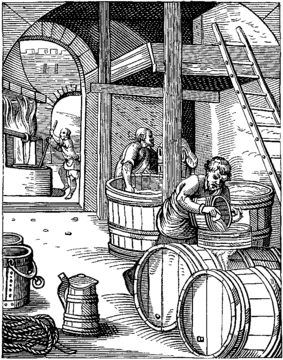
Brewery
A facility for commercial beer production, known since antiquity.

A brewery is a business dedicated to producing and selling beer. The facility where this commercial production happens is known as a brewery or beerhouse, and the collection of brewing equipment inside is called the plant. Breweries come in many sizes, use different processes and levels of automation, and produce a wide variety of beer styles. The facility is usually split into separate areas, each handling a specific stage of the brewing process.
Beer may have been brewed as far back as Neolithic Europe, mostly at home. Written records from Mesopotamia, dating back nearly 5,000 years, mention daily beer and bread rations for workers. Before large-scale breweries existed, beer was made in the home, and women handled both baking and brewing, as these tasks were considered women's work.
Dedicated production breweries emerged only after monasteries and Christian institutions began brewing beer not just for themselves but also as a form of payment. This shift toward industrial-scale brewing moved the responsibility from women to men. The world's oldest still-operating brewery is thought to be the Weihenstephan brewery in Freising, Bavaria, which traces its history to 1040 AD. The Weltenburg Abbey brewery, also in Bavaria, has a beer-brewing tradition dating to at least 1050 AD. The Žatec brewery in the Czech Republic claims evidence of paying a beer tax in 1004 AD.
Early breweries were usually built on multiple floors, with equipment for earlier stages placed on higher levels so gravity could move the product downward. Many breweries still use this layout, though mechanical pumps now allow more flexible designs. These early facilities often used large copper vats in the brewhouse, with fermentation and packaging done in wooden containers lined for protection. This setup was common until the Industrial Revolution, when better materials and scientific understanding improved the process. Today, almost all brewery equipment is made of stainless steel.
During the Industrial Revolution, beer production shifted from artisanal to industrial, and home brewing became insignificant by the late 19th century. The number of breweries also grew dramatically. In the United States, for instance, the count rose from 431 in 1850 to 4,131 by 1873.
Several key technological advances shaped the modern brewery and its ability to produce consistent beer.
- Earliest known commercial brewing
- at least 2500 BC
- Oldest functional brewery
- Weihenstephan brewery, Freising, Bavaria, traced to 1040 AD
- Number of breweries in america 1850
- 431
- Number of breweries in america 1873
- 4131
- Typical brewery workers 11th 12th centur
- eight to ten
Lore & Background
The commercial brewing of beer has taken place since at least 2500 BC; in ancient Mesopotamia, brewers derived social sanction and divine protection from the goddess Ninkasi. Brewing was initially a cottage industry, with production taking place at home. By the ninth century, monasteries and farms produced beer on a larger scale, selling the excess. By the eleventh and twelfth centuries, larger, dedicated breweries with eight to ten workers were being built. Early breweries were almost always built on multiple stories, using gravity to assist with transfer of product, and typically used large copper vats and lined wooden containers. During the Industrial Revolution, the production of beer moved from artisanal to industrial manufacture, and domestic manufacture ceased to be significant by the end of the 19th century. The number of breweries grew throughout industrialization; in America, the number rose from 431 to 4,131 between 1850 and 1873.
Reader's Guide
The modern brewery is predominantly made of stainless steel, which imparts no flavor and reacts with few chemicals. Heating in the brewhouse is usually achieved through pressurized steam, and cooling is typically done via cooling jackets on tanks. Major technological advances include the steam engine, which brought automatic stirring and pumps; the refrigeration machine, which allowed year-round production at consistent temperatures; and the discovery of microbes by Louis Pasteur, leading to pure yeast cultures. The hydrometer and thermometer gave brewers greater control. Brewing is divided into nine steps: milling, malting, mashing, lautering, boiling, fermenting, conditioning, filtering, and filling. Fermentation begins when yeast is added to cooled wort, at which point the product is first called beer. Most breweries today use cylindroconical vessels that can handle both fermenting and conditioning. Modern plants perform myriad analyses for quality control, testing ingredients and samples for oxygen content, microbial infections, and aging compounds.
Did You Know?
- The oldest still functional brewery is the German state-owned Weihenstephan brewery, tracing back to 1040 AD.
- The steam engine, vastly improved in 1775 by James Watt, brought automatic stirring mechanisms and pumps into the brewery.
- Carl von Linde is credited with developing the refrigeration machine in 1871, allowing year-round beer production.
- The discovery of microbes by Louis Pasteur was instrumental in the control of fermentation.
More in Brewing Processes, Part 2 1-24
Spotted an error? Know more?
Reader corrections go straight into our review queue. Suggest an edit · How this site is sourced