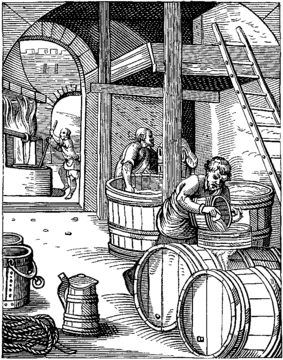
Beer chemistry
Chemical compounds from plants and yeast define beer's flavor and foam.

Beer chemistry is the study of the chemical compounds that give beer its distinctive taste, smell, and appearance. The majority of these compounds arise from the metabolic activities of plants and yeast, falling under biochemistry and organic chemistry; the main exception is that beer contains over 90% water, and the mineral ions in the water can significantly affect taste.
- Water content
- over 90%
- Hops essential oils
- over 440
- Chemical compounds discovered
- over 7,700
- Cobalt effective concentration
- 1–2 mg/L (ppm)
- Cobalt toxic threshold
- higher concentrations would be toxic
Lore & Background
The four main ingredients in brewing are carbohydrates from malt, hops, yeast, and water. Carbohydrates are essential because yeast converts them into energy, producing ethanol via fermentation. Malting and mashing break down long carbohydrate polymers like amylopectin and amylose into simpler sugars through hydrolysis, sped up by amylase enzymes activated by heating. Hops contribute over 440 essential oils for aroma, while alpha-acids (humulones) and beta-acids (lupulones) provide bitterness; alpha-acids isomerize during boiling, changing a six-member ring to a five-member ring, though how this affects bitterness is not commonly discussed.
Yeast metabolism differs under aerobic and anaerobic conditions. Aerobically, yeast converts sugars to pyruvate, then to carbon dioxide and water, which homebrewers use for carbonation. Anaerobically, yeast ferments pyruvate into ethanol via acetaldehyde. Water's ion species, such as calcium and iron, act as cofactors for yeast enzymes and affect taste. Beer carbonation in commercial production uses pressurized CO2, as anaerobic conditions do not produce CO2; bubbles grow via Ostwald ripening, leading to coarser foam. Nitro beer uses inert gases like nitrogen, which are less soluble, producing smaller bubbles and a creamy, smooth mouthfeel.
Foam stability depends on transition metal ions, macromolecules like polysaccharides and proteins, and isohumulone from hops. Cobalt salts at 1–2 ppm were used in the 1960s as foam stabilizers and anti-gushing agents, after Thorne and Helm discovered in 1957 that Co2+ stabilizes foam by forming coordination complexes with organic molecules. Cobalt can act as a bridge between polysaccharides or cause conformational changes. Rudin and Hudson (1958) found that nickel and iron promote gushing, but cobalt does not, and that cobalt concentrates in foam. Cobalt is an essential micronutrient for vitamin B12, but excess can cause poisoning, prompting analytical methods to assay cobalt in beer.
Reader's Guide
Beer chemistry is significant because it explains how the interplay of water, malt, hops, and yeast produces the sensory properties of beer. The article notes that over 7,700 chemical compounds have been identified, highlighting the complexity of beer's flavor and aroma. The role of water hardness and metal ions as enzyme cofactors underscores that even trace components can alter taste and yeast metabolism. The discovery of cobalt's foam-stabilizing properties in 1957 by Thorne and Helm led to its use as an additive in the 1960s, approved by the US FDA, but raised toxicity concerns that drove the development of analytical methods to prevent overdosage. The article also describes how foam stability is a key quality concern, with brewers and barmen carefully managing head retention and gushing. The distinction between aerobic and anaerobic yeast metabolism informs both homebrewing carbonation practices and industrial fermentation. The use of inert gases for nitro beer offers an alternative texture and mouthfeel, showing how chemistry directly influences consumer experience. Overall, beer chemistry provides a scientific foundation for understanding and controlling the brewing process, from ingredient selection to final presentation.
Did You Know?
- Hops contain over 440 essential oils, and alpha-acids isomerize during boiling from a six-member ring to a five-member ring.
- Cobalt salts at 1–2 ppm were used in the 1960s as a foam stabilizer and anti-gushing agent, after Thorne and Helm discovered their effect in 1957.
- Nitro beer uses inert gases like nitrogen, which are less soluble than CO2, producing smaller bubbles and a creamy mouthfeel.
More in Brewing Processes, Part 2 1-24
Spotted an error? Know more?
Reader corrections go straight into our review queue. Suggest an edit · How this site is sourced