AFGL 4106
Binary system with two supergiants in different evolutionary stages.

AFGL 4106 (also known as HD 302821) is a binary star system in the constellation Carina, notable for containing two supergiants in different evolutionary stages: an M-type red supergiant and a more evolved F-type post-red supergiant. The system is surrounded by a large circumstellar envelope of 208 AU and exhibits a complex nebular morphology influenced by its companion star.
- Constellation
- Carina
- Distance parallax
- 940±260 pc
- Distance probabilistic
- 1470+590−400 pc
- Distance dust map
- 3190+450−190 pc
- Separation
- 865±102 AU
- Orbital period
- ~4500 days
- Primary effective temperature
- 6723 K
- Secondary effective temperature
- 3394 K
- Primary initial mass
- 15 M☉
- Secondary initial mass
- 9 M☉
Lore & Background
AFGL 4106 was first observed in 1986 by IRAS. Its dust envelope was first characterized in 1999, when it was discovered to be a binary star; it was later characterized in 2025 by the Very Large Telescope. The system's distance is uncertain: a parallax-derived distance of 940±260 pc is considered unreliable due to astrometric noise, while a probabilistic method yields 1470+590−400 pc. Both conflict with the distance of the Carina Nebula (2610 pc), where the system was initially thought to have originated. However, comparing its E(B-V) of 1.07±0.2 to interstellar dust maps gives a distance of 3190+450−190 pc.
The primary is a post-red supergiant with an initial mass of about 15 M☉ and an effective temperature of 6723 K; the secondary is an active red supergiant with an initial mass of ~9 M☉ and an effective temperature of 3394 K. Their separation is 865±102 AU, and they complete an orbit every ~4500 days. The system's relative proximity and similar proper motion to Westerlund 2 suggest it could have formed there, though the respective ages of 13.8 Myr and 30 Myr for the primary and secondary are inconsistent with the 2–3 Myr age of that cluster. This age difference may indicate an unusual evolutionary pathway due to binary interaction, possibly involving a close third companion or a merger.
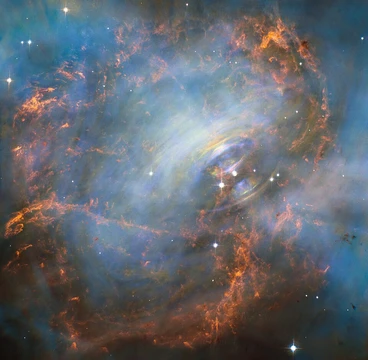
The surrounding nebula shows a highly complex morphology attributed to the companion star and a complex ejection mechanism. It is elliptical with an eccentricity of 0.5, and its semi-minor axis is aligned with the system's proper motion, indicating deceleration by the interstellar medium.
Reader's Guide
AFGL 4106 is significant as a binary system containing two supergiants in distinct evolutionary phases—a post-red supergiant primary and an active red supergiant secondary—offering a rare laboratory for studying stellar evolution after the red supergiant stage. The large discrepancy in the derived ages of the two stars (13.8 Myr and 30 Myr) and their inconsistency with the age of the nearby cluster Westerlund 2 (2–3 Myr) suggests that binary interaction or a possible third companion may have altered their evolutionary paths, challenging standard stellar models. The system's uncertain distance, with values ranging from 940 pc to 3190 pc depending on the method, highlights the difficulty of astrometric measurements in dusty regions. The complex, elliptical nebula with an eccentricity of 0.5 and alignment with proper motion provides evidence of interaction with the interstellar medium. The possibility of an undetected third companion, though requiring an implausible total system mass of 1700 M☉ to explain observed oscillations, remains an open question. AFGL 4106 thus serves as a key object for studying binary evolution, circumstellar envelopes, and the dynamics of evolved massive stars.
Did You Know?
- The system's two stars have a separation of 865±102 AU and an orbital period of about 4500 days.
- The surrounding nebula has an eccentricity of 0.5, with its semi-minor axis aligned with the system's proper motion.
- A possible third companion has not been detected but could explain the large age difference between the two stars.
More in Binary and Multiple Stars, Part 2 1-24
Spotted an error? Know more?
Reader corrections go straight into our review queue. Suggest an edit · How this site is sourced