40 Cancri
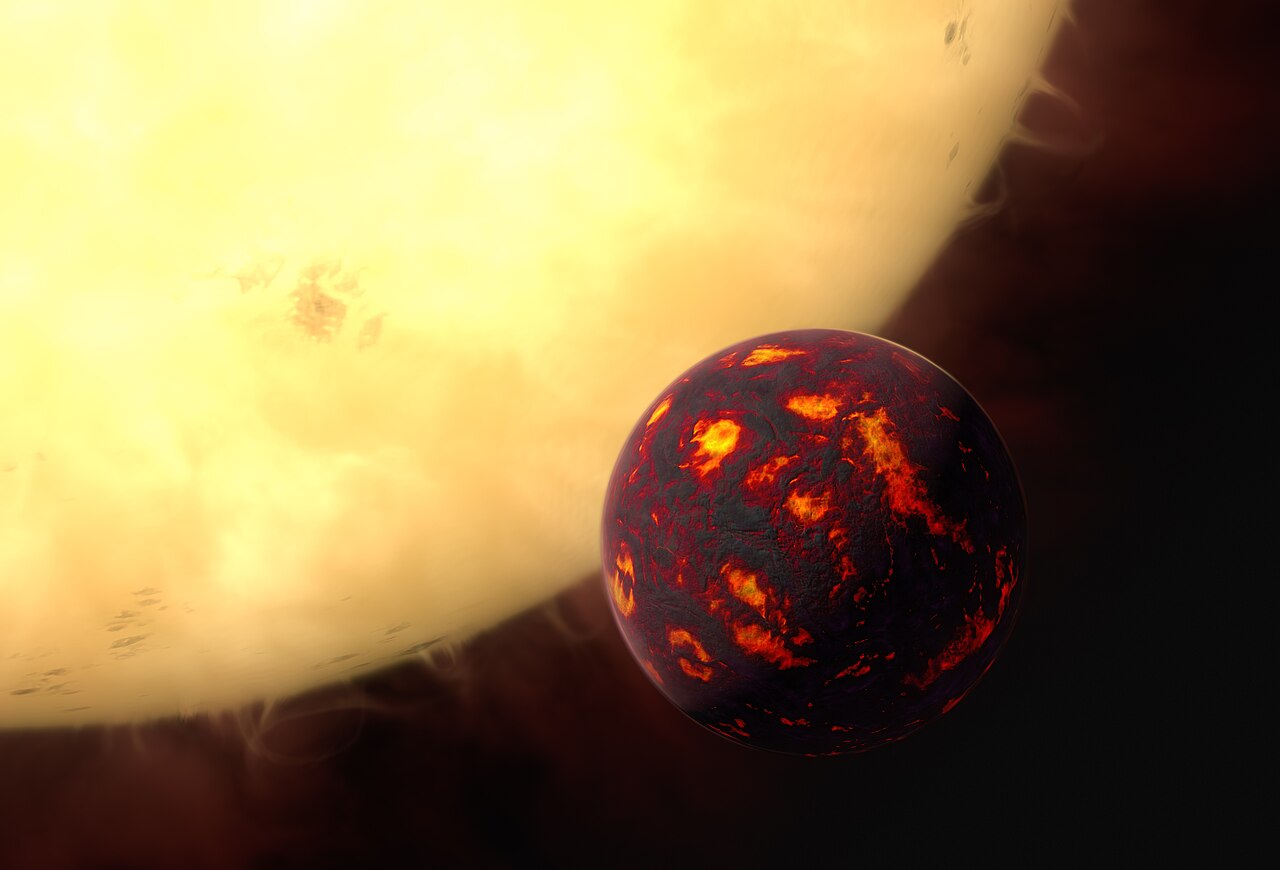
A blue straggler binary in the Beehive Cluster.

ESA/Hubble, M. Kornmesser · CC BY 4.0
40 Cancri sits roughly 605 light-years from our Sun, inside the Beehive Cluster (NGC 2632) in the constellation Cancer. With an apparent visual magnitude of 6.61, spotting it without a telescope is difficult. This binary system is drifting away from Earth at a heliocentric radial velocity of 34 km/s.
The main star is a normal A-type main-sequence star, classified A1 V—no organized magnetic field or chemical peculiarity has been detected. Yet it stands out as an extreme blue straggler, meaning it’s a second-generation star born from a collision of two low-mass stars sometime between 5 and 350 million years ago. That collision could have involved two separate cluster members or the merger of a binary pair.
At 9,382 K, this star is the hottest in the Beehive Cluster, beating the next hottest by about 1,200 K. It has 2.46 times the Sun’s mass and 2.72 times its radius, but rotates unusually slowly for an A1V star, with a projected rotational velocity of just 10 km/s. Its photosphere radiates 91 times the Sun’s luminosity.
A companion shares the system’s proper motion. As of 1983, it sat at an angular separation of 0.425″±0.009″ along a position angle of 127.6°±0.5°. This object is roughly 2.5±0.5 magnitudes fainter than the primary, likely an F-type star with a mass around 1.5 times that of the Sun. The projected distance between the two is about 80 AU, so their orbital period is at least 450 years.
- Apparent visual magnitude
- 6.61
- Distance
- 605 light years
- Spectral type
- A1 V
- Effective temperature
- 9,382 K
- Mass
- 2.46 M☉
- Radius
- 2.72 R☉
- Luminosity
- 91 L☉
- Projected rotational velocity
- 10 km/s
- Heliocentric radial velocity
- 34 km/s
- Angular separation
- 0.425″±0.009″
Lore & Background
The primary component of 40 Cancri is a normal A-type main-sequence star with a classification of A1 V, showing neither an organized magnetic field nor a chemical peculiarity. However, it is considered an extreme blue straggler, meaning it is a second-generation star formed through a collision of two low-mass stars some 5–350 million years ago. The collision may have been between two separate cluster members or the coalescence of a binary star system.
With an effective temperature of 9,382 K, it is the hottest star in the Beehive Cluster by about 1,200 K. It has 2.46 times the mass of the Sun and 2.72 times the Sun's radius, radiating 91 times the Sun's luminosity. The star has an unusually slow rotation for an A1V star, with a projected rotational velocity of 10 km/s.
The system has a common proper motion companion, located at an angular separation of 0.425″±0.009″ along a position angle of 127.6°±0.5° as of 1983. This object is about 2.5±0.5 magnitudes dimmer than the primary, and is most likely an F-type star with a mass of about 1.5 M☉. The projected separation between the pair is 80 AU, so their orbital period is 450 years or greater.
Reader's Guide
40 Cancri is significant as an extreme blue straggler in the Beehive Cluster, providing a clear example of stellar collision or binary coalescence as a formation mechanism. Its status as the hottest star in the cluster, about 1,200 K hotter than any other, underscores its unusual evolutionary path. The system's slow rotation for an A1V star is notable, as is the presence of a fainter F-type companion with a projected separation of 80 AU and an orbital period of at least 450 years. The uncertainty in the collision timescale (5–350 million years) and the two possible collision scenarios (two separate cluster members or binary coalescence) highlight the ongoing questions about blue straggler origins. The system's heliocentric radial velocity of 34 km/s indicates it is moving away from Earth. Its apparent visual magnitude of 6.61 makes it a challenge to view with the naked eye, but it remains a key object for studying stellar mergers in open clusters.
Did You Know?
- 40 Cancri is the hottest star in the Beehive Cluster, with an effective temperature of 9,382 K.
- The primary star is an extreme blue straggler formed by a collision of two low-mass stars 5–350 million years ago.
- The system has a common proper motion companion that is about 2.5 magnitudes dimmer and likely an F-type star.
- The projected separation between the two stars is 80 AU, giving an orbital period of 450 years or greater.
A Twin-Star Neighborhood in Cancer
The 55 Cancri system sits roughly 41 light-years from Earth, nestled within the zodiacal constellation of Cancer. It is a binary pair: a K-type primary, 55 Cancri A, and a faint red dwarf companion, 55 Cancri B. The primary, with an apparent magnitude of 5.95, can be glimpsed by the unaided eye on exceptionally dark nights, while the secondary glimmers at the 13th magnitude and demands a telescope for observation. The two stars are separated by about 85 arcseconds on the sky, corresponding to an estimated physical distance of roughly 1,065 astronomical units, or about 6.15 light-days. Despite this vast gap, they share a common proper motion, confirming they are gravitationally locked together. The primary is slightly smaller and less massive than the Sun, cooler and dimmer, with a spectral classification of K0IV-V that places it on or just above the main sequence. The red dwarf companion was first identified as a companion star by Adriaan van Maanen back in 1918, making it one of the earlier recognized binary pairs in the solar neighborhood.
Names from the Dutch Astronomical Tradition
The system carries multiple catalog designations: 55 Cancri in the Flamsteed system, ρ1 Cancri in the Bayer scheme, and HR 3522 in the Bright Star Catalogue. The two stars are labeled A and B, with the primary sometimes called simply 55 Cancri. The first planet found around the primary was initially tagged HR 3522b by its discoverers before settling into the more formal 55 Cancri Ab to distinguish it from the secondary star. In July 2014 the International Astronomical Union opened its NameExoWorlds campaign, inviting the public to nominate and vote on proper names for select exoplanets and their host stars. In December 2015 the winners were announced: Copernicus for the primary star, and Galileo, Brahe, Lipperhey, Janssen, and Harriot for the five confirmed planets. These names, submitted by the Royal Netherlands Association for Meteorology and Astronomy, honor figures from the early history of observational astronomy and telescope-making. A small correction followed in January 2016 when the IAU fixed the spelling of Lipperhey, replacing an erroneous 19th-century variant. The Working Group on Star Names formally entered all of these names into the IAU Catalog of Star Names in its July 2016 bulletin.
A Pioneering Exoplanet System
55 Cancri A holds a distinguished place in exoplanet history as the first star known to host four, and subsequently five, confirmed planets. The breakthrough came in 1997 when astronomers announced the detection of a 51 Pegasi-type world orbiting the star, found through radial-velocity measurements that revealed a periodicity of roughly 14.7 days and a minimum mass of at least 78 percent of Jupiter's. That same survey also uncovered the planets of Tau Boötis and the inner world of Upsilon Andromedae. The residual drift in the velocity data hinted at an additional, more distant companion, and subsequent discoveries filled out the family to five confirmed planets—Ab, Ac, Ae, Af, and Ad—plus a sixth candidate, Ag. The innermost member, Ae, is a transiting planet as seen from Earth, while Ab does not transit but shows tentative signs of an extended atmosphere that does cross the stellar disk. In 1998 a possible circumstellar dust disk was also announced. Meanwhile, the red dwarf companion 55 Cancri B hosts two planets of its own, designated Bb and Bc, making the full system a remarkable multi-star, multi-planet neighborhood.
The Super Metal-Rich Puzzle
One of the most striking features of 55 Cancri A is its unusual chemical composition. The star contains 186 percent of the Sun's iron abundance, earning it a classification as a rare super metal-rich dwarf. Its carbon-to-oxygen ratio stands at 0.78, well above the solar value of 0.55. This elevated metallicity creates a genuine headache for astrophysicists: standard stellar-evolution models are less well calibrated for such stars, so pinning down the star's true age and mass becomes considerably more uncertain. Published age estimates range from 7.4 to 8.7 billion years in some analyses, while others push the figure to 10.2 plus or minus 2.5 billion years. One working hypothesis suggests that heavy-element-rich material from a protoplanetary disk rained down onto the star's outer layers after formation, polluting the surface. Because the star lacks a deep convection zone, those outer layers can retain their enriched composition over billions of years. Observations in the submillimeter band have so far detected no significant dust, placing the total fine-dust mass below one-hundredth of one percent of Earth's mass, though an asteroid or Kuiper-belt analog cannot be ruled out.
Gallery
Frequently Asked Questions
What is 40 Cancri?
40 Cancri is a binary star system located inside the Beehive Cluster (NGC 2632) in the constellation Cancer, roughly 605 light-years from the Sun. Its primary component is an A1-type main-sequence star with an effective temperature of about 9,382 K.
What makes 40 Cancri a blue straggler?
The primary star is classified as an extreme blue straggler, meaning it most likely formed when two lower-mass stars collided and merged into a single, hotter, more massive object. That merger event is estimated to have taken place somewhere between 5 and 350 million years ago.
How can I observe 40 Cancri?
At an apparent visual magnitude of 6.61, the system is far too faint for reliable naked-eye viewing under typical conditions. A small telescope or a good pair of binoculars aimed at the Beehive Cluster region in Cancer would be needed to pick it out.
What are the key physical stats of 40 Cancri's primary star?
The A1 V component has a mass of about 2.46 solar masses and a radius of roughly 2.72 solar radii. No organized magnetic field or chemical peculiarities have been detected, so it behaves like a standard A-type star apart from its blue-straggler origin.
Is 40 Cancri moving toward or away from us?
The system is receding from the Sun at a heliocentric radial velocity of approximately 34 km/s. That outward drift is consistent with its membership in the slowly expanding Beehive Cluster.
More in Binary and Multiple Stars, Part 2 1-24
Spotted an error? Know more?
Reader corrections go straight into our review queue. Suggest an edit · How this site is sourced