
39 Leonis
F6 V star with a debris disk and an M1 red dwarf companion.

Department of Defense. Department of the Navy. Bureau of Naval Personnel. 9/18/1 · Public domain
39 Leonis is the Flamsteed designation for a star in the zodiac constellation of Leo. It is a main-sequence star of spectral type F6 V, with an apparent visual magnitude of 5.90, making it faintly visible from suburban skies under the Bortle scale. The star is notable for hosting an inner debris disk detected via infrared excess and for having a red dwarf companion.
- Apparent visual magnitude
- 5.90
- Distance
- 72.6 ly (22.3 pc)
- Stellar classification
- F6 V
- Age
- 6.3 billion years
- Effective temperature
- 6,118 K
- Companion classification
- M1
- Companion apparent visual magnitude
- 11.40
Lore & Background
39 Leonis is a mature, metal-poor star with an estimated age of 6.3 billion years. Its abundance of elements heavier than hydrogen and helium is about half that of the Sun. It has nearly the same mass and size as the Sun but shines with more than double the luminosity, and its effective temperature of 6,118 K gives it a yellow-white hue characteristic of F-type stars.
Observations with the Akari satellite at 18 μm revealed an excess of infrared emission, indicating the presence of an inner debris disk orbiting at a distance greater than four astronomical units. No significant excess was found at 22 μm.
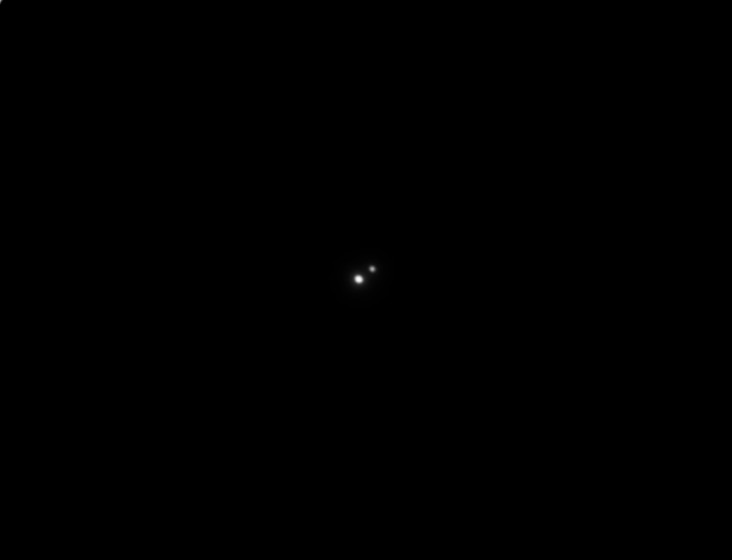
The star has a companion located at an angular separation of 7.72″ along a position angle of 302.7°, corresponding to a projected separation of 175 AU. This companion is a red dwarf with a classification of M1 and an apparent visual magnitude of 11.40.
Reader's Guide
39 Leonis is significant as a nearby example of a main-sequence star with a confirmed debris disk, detected via infrared excess at 18 μm by the Akari satellite. The disk's inner boundary lies beyond 4 AU, suggesting a system that may have undergone planetesimal formation. The star's metal-poor nature (about half the solar abundance) provides context for disk evolution in low-metallicity environments. Its companion, an M1 red dwarf at a projected separation of 175 AU, makes this a binary system. The combination of a mature, Sun-like primary with a debris disk and a distant red dwarf companion offers a case study for binary star system architecture and disk longevity. The star's faint visibility from suburban skies (magnitude 5.90) and its location in Leo make it accessible to amateur astronomers with modest equipment, though the companion requires larger telescopes to resolve.
Did You Know?
- 39 Leonis has an apparent visual magnitude of 5.90, faintly visible from suburban skies under the Bortle scale.
- The star's infrared excess at 18 μm suggests an inner debris disk beyond 4 AU.
- Its companion is an M1 red dwarf with an apparent visual magnitude of 11.40, at a projected separation of 175 AU.
- 39 Leonis is metal-poor, with an abundance of elements heavier than hydrogen and helium about half that of the Sun.
A Place in the Lion's Mane
Adhafera, known to astronomers as Zeta Leonis, occupies a distinctive spot in the night sky as a third-magnitude star within the constellation Leo. It holds the second position in the blade of the sickle, a well-known asterism that traces the outline of the lion's head, coming just after Gamma Leonis in that curved arrangement. Despite its prominent placement in one of the zodiac's most recognizable patterns, the star's apparent magnitude of +3.44 makes it one of the fainter objects still resolvable by the unaided eye. This relative dimness gives it a quiet, understated quality among the brighter stars of the summer sky, yet its position within the sickle ensures that stargazers tracing the lion's features will inevitably encounter it. The star's third-magnitude brightness, combined with its location in a familiar asterism, has made it a recognizable landmark for observers navigating the constellation, even if it never quite commands the same attention as its brighter neighbors.
A Name with a Checkered Past
The proper name Adhafera carries a history of confusion that spans centuries and cultures. The word derives from the Arabic aḍ-ḍafīrah, meaning "the lock of hair," and was originally applied to the constellation Coma Berenices rather than to any star in Leo. Sometime during the seventeenth century, this name was mistakenly transferred to Zeta Leonis, where it came to be understood as a reference to the star's position within the lion's mane. Alternative spellings such as Aldhafera and Adhafara appear in various historical sources, reflecting the fluidity with which Arabic astronomical terms were rendered into European languages. The star's Bayer designation, ζ Leonis, provides the systematic Greek-letter identifier that astronomers still use in catalogues. In a significant step toward resolving the tangle of informal star names, the International Astronomical Union established a Working Group on Star Names in 2016 to catalog and standardize proper names. The group's first bulletin, issued in July of that year, listed Adhafera among the initial batch of names formally approved, finally giving the star an officially recognized identity.
A Spectral Benchmark and Giant Star
Adhafera is classified as an F0 III giant star, a designation that places it in the yellow-white spectral range and identifies it as a star that has evolved beyond the main sequence. What elevates this star above a typical catalog entry is its role in stellar spectroscopy: since 1943, its spectral signature has been relied upon as a fixed reference against which the types of other stars are determined, making it a quiet but essential anchor in the taxonomy of stellar classifications. In terms of physical scale, the star is a substantial object, possessing roughly three times the mass of the Sun and a radius approximately 10.5 times larger. Its total energy output reaches about 220 times that of our Sun, a figure that underscores how a star of modest apparent brightness can still be extraordinarily powerful. Parallax measurements obtained from the Hipparcos satellite place Adhafera at an estimated distance of 274 light-years, or 84 parsecs, from the Solar System, situating it well beyond the nearby stellar neighborhood.
A Pair That Is Not a Pair
Through a telescope, Adhafera appears accompanied by a fainter star of apparent magnitude 5.90, catalogued as 35 Leonis. The two are separated on the sky by 325.9 arcseconds along a position angle of 340 degrees, creating the visual impression of a double star. However, this pairing is purely optical rather than gravitational. The companion 35 Leo sits at a distance of only about 100 light-years from Earth, while Adhafera itself lies roughly 274 light-years away. This means the two stars are actually separated by approximately 174 light-years, or 53 parsecs, in three-dimensional space. They share no physical connection and will not orbit one another; their alignment is simply a matter of perspective from our vantage point. Such optical doubles are common in star catalogues and serve as a reminder that the sky, as we perceive it, compresses vast distances into a two-dimensional plane, making unrelated objects appear as neighbors when they are, in reality, separated by hundreds of light-years.
Gallery



Frequently Asked Questions
What is 39 Leonis?
39 Leonis is a Flamsteed-designated star sitting in the zodiac constellation Leo, roughly 72.6 light-years from Earth. It is a main-sequence star of spectral type F6 V, about 6.3 billion years old, with an effective surface temperature near 6,118 K.
Is 39 Leonis a binary or multiple star system?
Yes — the F6 V primary is paired with a cooler M1 red dwarf companion, making it a binary system. The two stars differ substantially in mass, temperature, and luminosity, with the red dwarf being the dimmer, smaller member of the pair.
What is special about 39 Leonis that sets it apart from other Leo stars?
Astronomers detected an inner debris disk around the system through infrared excess emission, indicating a ring of dust and small bodies close to the primary. This makes 39 Leonis a useful target for studying how circumstellar material behaves around a relatively mature F-type star.
Can I see 39 Leonis with the naked eye?
At an apparent visual magnitude of about 5.90, it is just barely within naked-eye range under dark suburban skies (roughly Bortle 4–5 or better). From heavily light-polluted cities it will be lost in the glow, so a small pair of binoculars or a telescope makes it much easier to pick out.
How far is 39 Leonis and where exactly does it sit in the sky?
The system lies approximately 22.3 parsecs (72.6 light-years) from the Solar System. It occupies a position within the boundaries of Leo, one of the most recognizable zodiac constellations visible from both hemispheres during spring and early summer evenings.
More in Binary and Multiple Stars, Part 2 1-24
Spotted an error? Know more?
Reader corrections go straight into our review queue. Suggest an edit · How this site is sourced