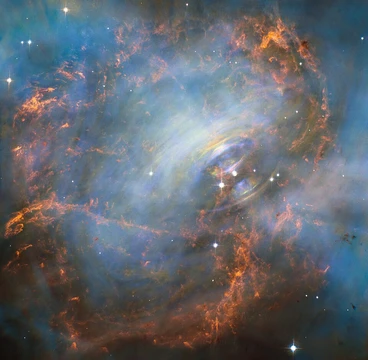
27 Canis Majoris
Binary system with a Be star and Gamma Cassiopeiae variable.

Stephen.G.McAteer · CC BY-SA 3.0
27 Canis Majoris, also known by its variable star designation EW Canis Majoris, is a binary star system in the northern part of the constellation Canis Major. It lies roughly 1,700 light-years from the Sun and is visible to the naked eye as a blue-white star of the 4th magnitude. The system is moving away from Earth at a heliocentric radial velocity of 16 km/s.
The two stars were first distinguished as separate objects by W. S. Finsen in 1953, and the gap between them has been increasing ever since. They orbit each other with a period of about 119 years, an eccentricity of 0.7, and a semimajor axis of 0.178 arcseconds. The primary star, component A, has a magnitude of 4.92 and is classified as a Be star of type B3 IIIpe. It spins rapidly, with a projected rotational velocity of 290 km/s, compared to a critical velocity of 389 km/s. This star is also a Beta Cephei variable, pulsating with a period of 0.0919 days and an amplitude of 0.0080 in magnitude. The secondary, component B, has a magnitude of 5.39 and is classified as a Gamma Cassiopeiae type variable star. Because of this variability, the overall brightness of the system fluctuates between magnitudes +4.42 and +4.82.
- Distance
- approximately 1,700 light years
- Apparent magnitude
- varies from +4.42 to +4.82
- Orbital period
- around 119 years
- Eccentricity
- 0.7
- Semimajor axis
- 0.178″
- Primary spectral type
- B3 IIIpe
- Primary projected rotational velocity
- 290 km/s
Lore & Background
The binary nature of 27 Canis Majoris was first resolved by W. S. Finsen in 1953, and the separation between the two stars has been widening since that time. The system has an orbital period of about 119 years with an eccentricity of 0.7 and a semimajor axis of 0.178 arcseconds. The primary, component A, has a magnitude of 4.92 and is classified as a Be star with stellar classification B3 IIIpe. It spins rapidly with a projected rotational velocity of 290 km/s, compared to a critical velocity of 389 km/s, and is a Beta Cephei variable with a pulsation period of 0.0919 days and an amplitude of 0.0080 in magnitude. The secondary, component B, has a magnitude of 5.39 and is classified as a Gamma Cassiopeiae type variable star. Due to the variable nature of the secondary, the overall brightness of the system varies from magnitude +4.42 to +4.82. The system is moving away from Earth with a heliocentric radial velocity of 16 km/s.
Reader's Guide
27 Canis Majoris holds significance as a binary system whose components were first resolved in 1953 by W. S. Finsen, with the separation continuing to widen. The primary is a Be star of type B3 IIIpe, notable for its rapid rotation at 290 km/s, approaching its critical velocity of 389 km/s, and for being a Beta Cephei variable with a short pulsation period of 0.0919 days and a small amplitude of 0.0080 magnitude. The secondary is a Gamma Cassiopeiae type variable, contributing to the system's overall brightness variation from magnitude +4.42 to +4.82. The system's orbital period of about 119 years and eccentricity of 0.7, along with a semimajor axis of 0.178 arcseconds, characterize its long-term dynamics. Located about 1,700 light years away and moving away at 16 km/s, the system is visible to the naked eye as a 4th-magnitude, blue-white hued star, making it an accessible target for studying binary interactions and variable star phenomena.
Colossal Proportions and Stellar Classification
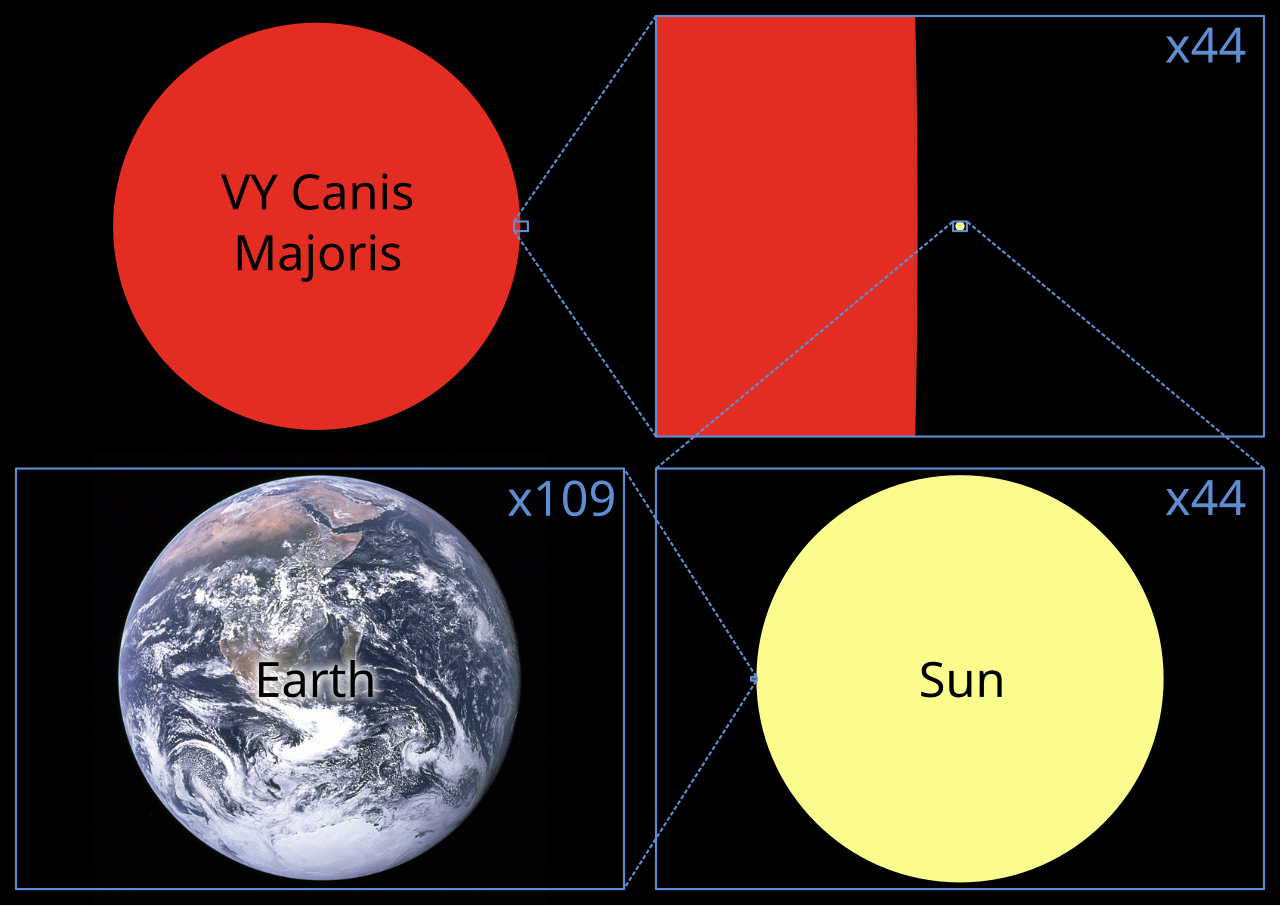
VY Canis Majoris stands among the most extraordinary objects in our galaxy. Classified as an extreme oxygen-rich red hypergiant or red supergiant, it ranks among the largest, most luminous, and most massive red supergiants known, and is one of the brightest stars in the entire Milky Way. Its mass is estimated at roughly seventeen solar masses, with an uncertainty of eight. The star's radius—approximately 1,420 times that of the Sun—sits tantalizingly close to the theoretical Hayashi limit, giving it a volume nearly three billion times larger than our own star. At that scale, light itself would need about six hours to trace the star's circumference, compared to just fourteen and a half seconds for the Sun. Were it to replace our Sun, its photosphere would swallow the orbit of Jupiter whole. Spectroscopically, it presents a high-luminosity M-type spectrum, with titanium-oxide bands pointing to an M5 classification, while vanadium-oxide features push it as late as M7.0—remarkably unusual for a supergiant. Its hydrogen lines display P Cygni profiles typically associated with luminous blue variables, adding another layer of complexity to its identity.
A Long and Layered Observational Record
The first documented sighting of VY Canis Majoris appears in Jérôme Lalande's 1801 star catalogue, where it was listed as a seventh-magnitude object. By 1847, observers had begun describing it as a crimson star, and throughout the nineteenth century they identified at least six discrete components, leading some to suspect a multiple system. Those components are now understood to be bright zones within the surrounding nebula rather than separate stars, a conclusion reinforced by observations in 1957 and high-resolution imaging in 1998 that effectively ruled out any companion. The star's variability was formally noted in 1931, when it was catalogued as a long-period variable with a magnitude range of 9.5 to 11.5. It received its variable-star designation in 1939, becoming the forty-third variable in the constellation. The star is also a landmark in radio astronomy: it was one of the first radio masers ever detected, emitting strongly at hydroxyl, water, and silicon-monoxide frequencies. A rich molecular inventory—hydrogen cyanide, sodium chloride, phosphorus nitride, carbon monoxide, methanol, and titanium oxides—has been identified in its vicinity. Frequent magnitude studies since 1850 suggest the star's apparent light has been dimming, possibly due to shifting emission or increasing extinction from its dense surroundings.
A Turbulent Envelope and Violent Mass Loss
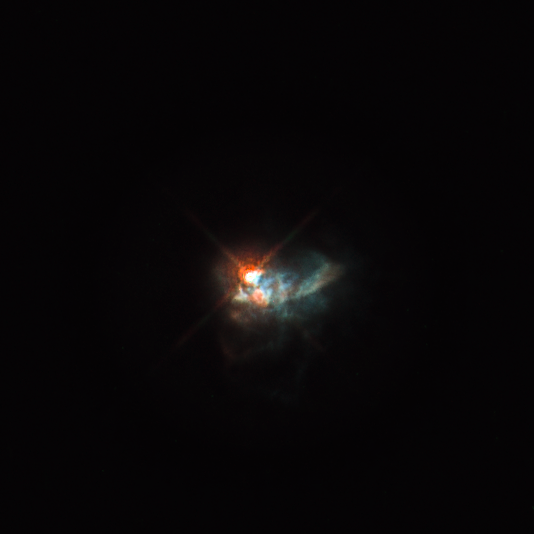
VY Canis Majoris is wrapped in a complex, asymmetric circumstellar envelope sculpted by ongoing mass loss, making it one of the brightest objects in the local Orion Arm at infrared wavelengths between five and twenty microns. This infrared excess points to a dust shell or heated disk surrounding the star. When data from multiple telescopes, including the Keck, were combined to build a three-dimensional reconstruction of the envelope, the picture that emerged was far more intricate than expected for any red supergiant or hypergiant. Bows and nodules appeared at different epochs, and jets fired in randomly oriented directions—suggesting they originate from explosions in active regions of the photosphere. Spectroscopic measurements confirmed that these jets travel at different speeds, consistent with multiple ejection events in varying directions, much like coronal mass ejections from the Sun but on a vastly larger scale. The outermost material is estimated to have been expelled within the last five hundred to one thousand years, while a knot closer to the star is less than a century old. The driving mechanism is believed to be strong convection in the star's tenuous outer layers, coupled with magnetic fields.
Pinpointing a Distant Neighbor
Determining the exact distance to VY Canis Majoris has proven notoriously difficult. Standard visual parallax measurements are hopelessly imprecise for a hypergiant with such an extended circumstellar envelope: the Hipparcos catalogue of 1997 returned a parallax of 1.78 ± 3.54 milliarcseconds, and Gaia DR2 gave −5.92 ± 0.83 milliarcseconds—both essentially notional values. The breakthrough came through radio parallax using long-baseline interferometry. In 2008, Japanese astronomers observed water masers with the VERA array, yielding a parallax of 0.88 ± 0.08 milliarcseconds and a distance of roughly 3,720 light-years. In 2012, independent silicon-monoxide maser observations with the Very Long Baseline Array produced a parallax of 0.83 ± 0.08 milliarcseconds, placing the star at about 3,910 light-years. The star is embedded in the bright-rimmed molecular cloud Sh 2-310, a star-forming H II region spanning roughly 681 light-years in diameter, and lies near the young open cluster NGC 2362, of which it is thought to be a member. Velocity vectors of the cloud closely match those of the star, cementing a near-certain physical association. These findings also imply that Sh 2-310 is less remote than previously assumed, or that VY Canis Majoris is a foreground object relative to the cloud.
Gallery
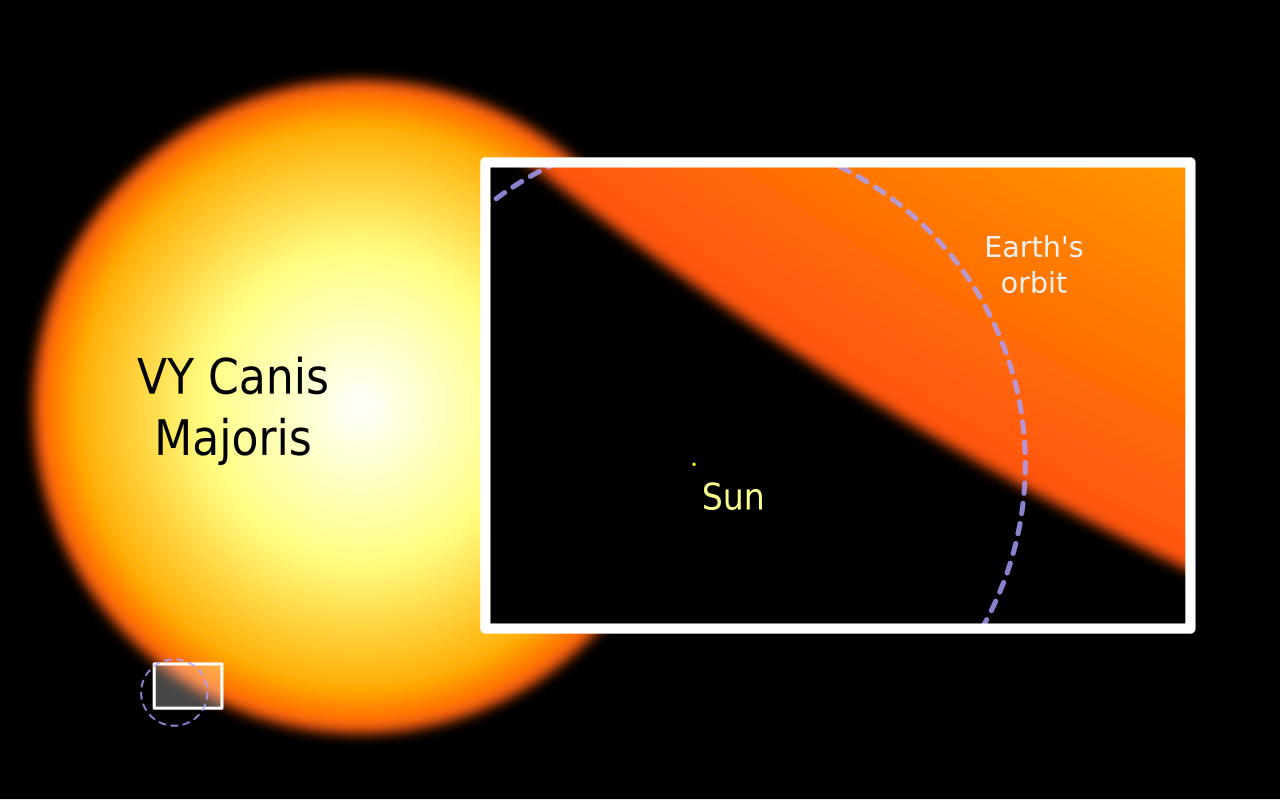
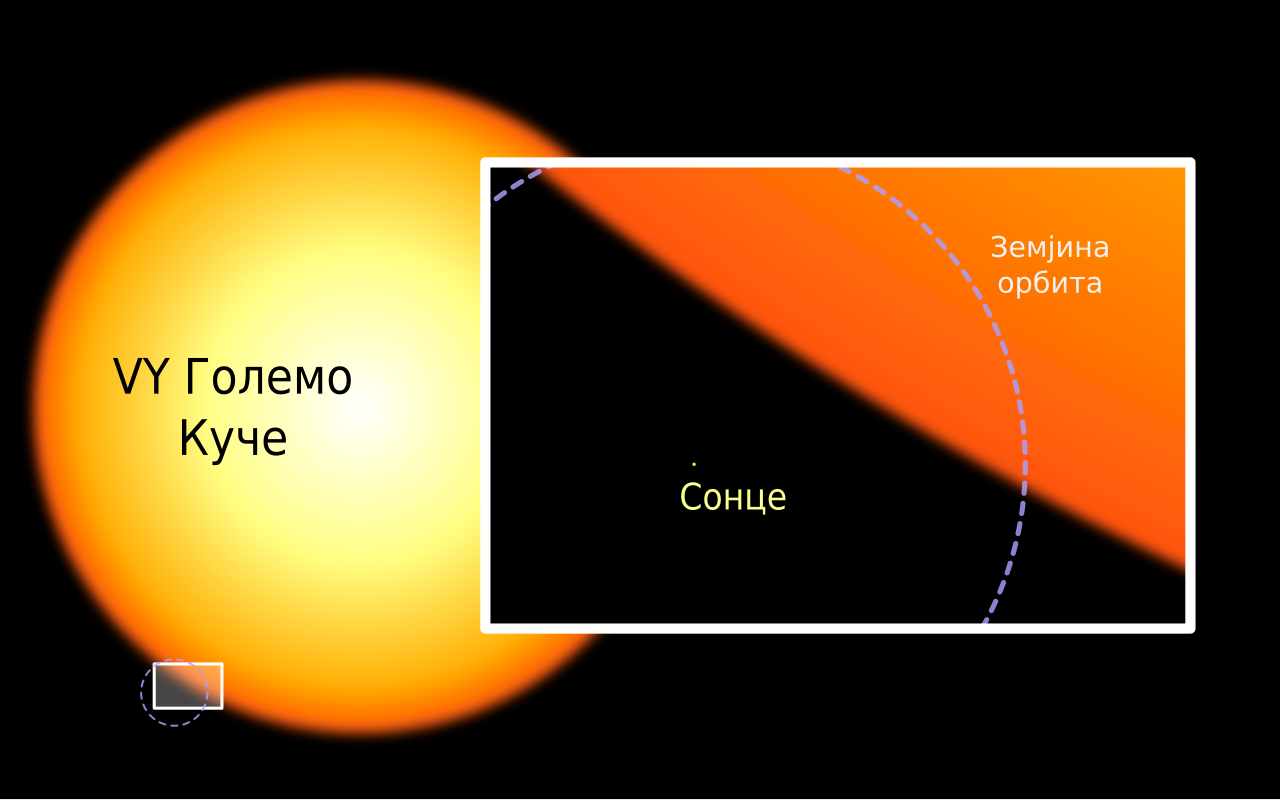
Frequently Asked Questions
What is 27 Canis Majoris?
It is a binary star system situated in the northern portion of the constellation Canis Major, roughly 1,700 light-years from the Sun. It also carries the variable-star designation EW Canis Majoris and is visible to the unaided eye as a faint blue-white point of light around 4th magnitude.
What kinds of stars make up the 27 Canis Majoris pair?
The primary is classified as a B3 IIIpe star, meaning it is a Be star with emission lines produced by a circumstellar disk. Its companion is a Gamma Cassiopeiae-type variable, so both members independently exhibit changes in brightness over time.
How do the two stars in 27 Canis Majoris orbit one another?
They trace a highly elongated path with an eccentricity of 0.7, completing a full revolution in approximately 119 years. The semimajor axis of that orbit measures about 0.178 arcseconds as projected on the sky.
When did astronomers first resolve the two stars in 27 Canis Majoris?
W. S. Finsen was the first to distinguish the system into its two individual components back in 1953. Since that initial separation, the angular gap between the pair has been steadily widening.
Why does 27 Canis Majoris vary in brightness?
The system's apparent magnitude swings between roughly +4.42 and +4.82 as the two components go through their variability cycles. The combined effect of the Be star's disk activity and the Gamma Cassiopeiae-type companion's pulsations drives the observed dimming and brightening.
More in Binary and Multiple Stars, Part 2 1-24
Spotted an error? Know more?
Reader corrections go straight into our review queue. Suggest an edit · How this site is sourced