
28 Cygni
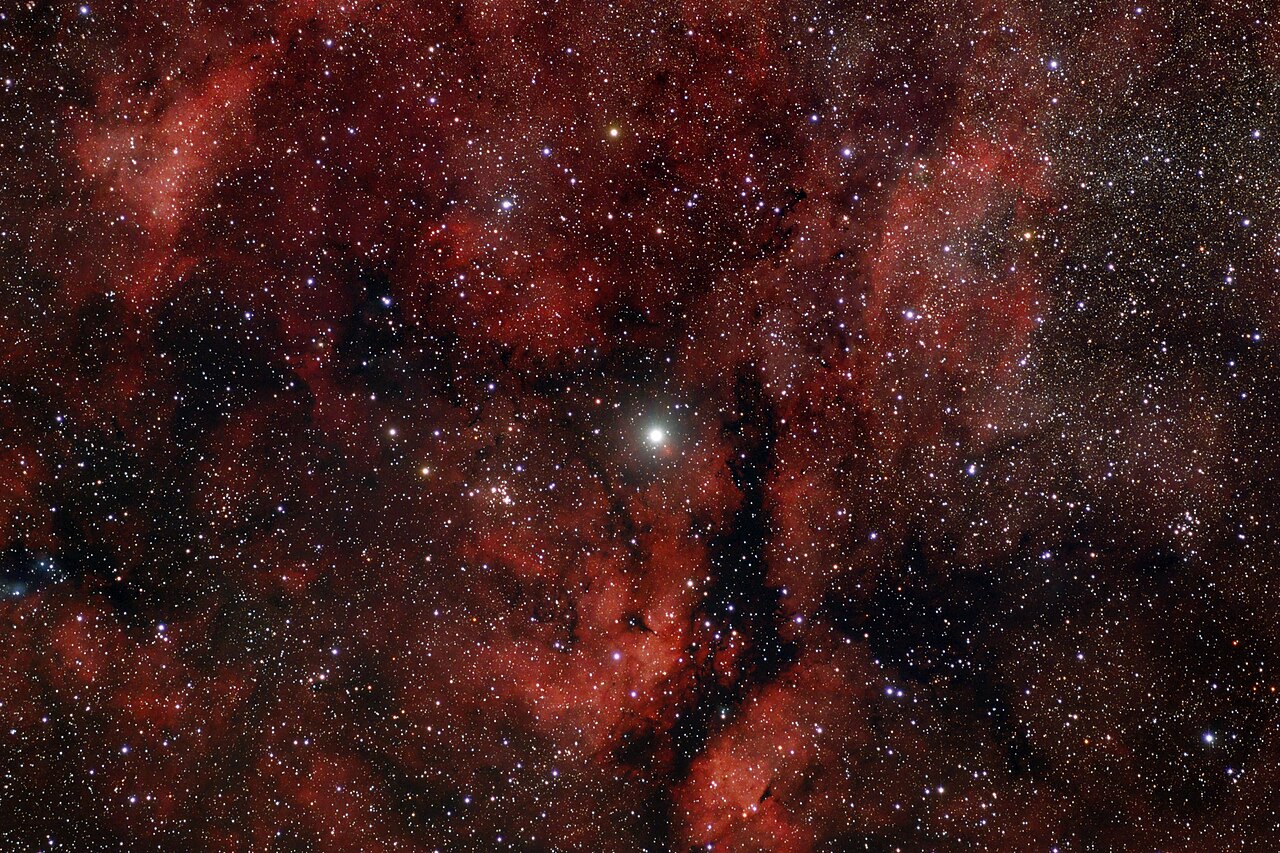
A Be binary with a rapidly spinning primary and a subdwarf O companion.

original by Д.Ильин derivative by B. Jankuloski · CC0
28 Cygni is a binary star system in the northern constellation of Cygnus. It is notable as a faint blue-white hued star visible to the naked eye, with an apparent visual magnitude of 4.93, and as a Be star whose spectrum shows emission lines from a disk of ejected gas. The primary is a rapidly rotating B-type star, while the companion is a subdwarf O star detected via interferometry.
- Apparent magnitude
- 4.93
- Distance
- 840 light years (parallax 3.9 mas)
- Absolute magnitude
- −2.56
- Spectral classification
- B2.5 V (Lesh 1968) or B2 IV(e) (Slettebak 1982)
- Projected rotational velocity
- 320 km/s
- Orbital period
- nearly a year
- Separation
- 1.9 astronomical units
Lore & Background
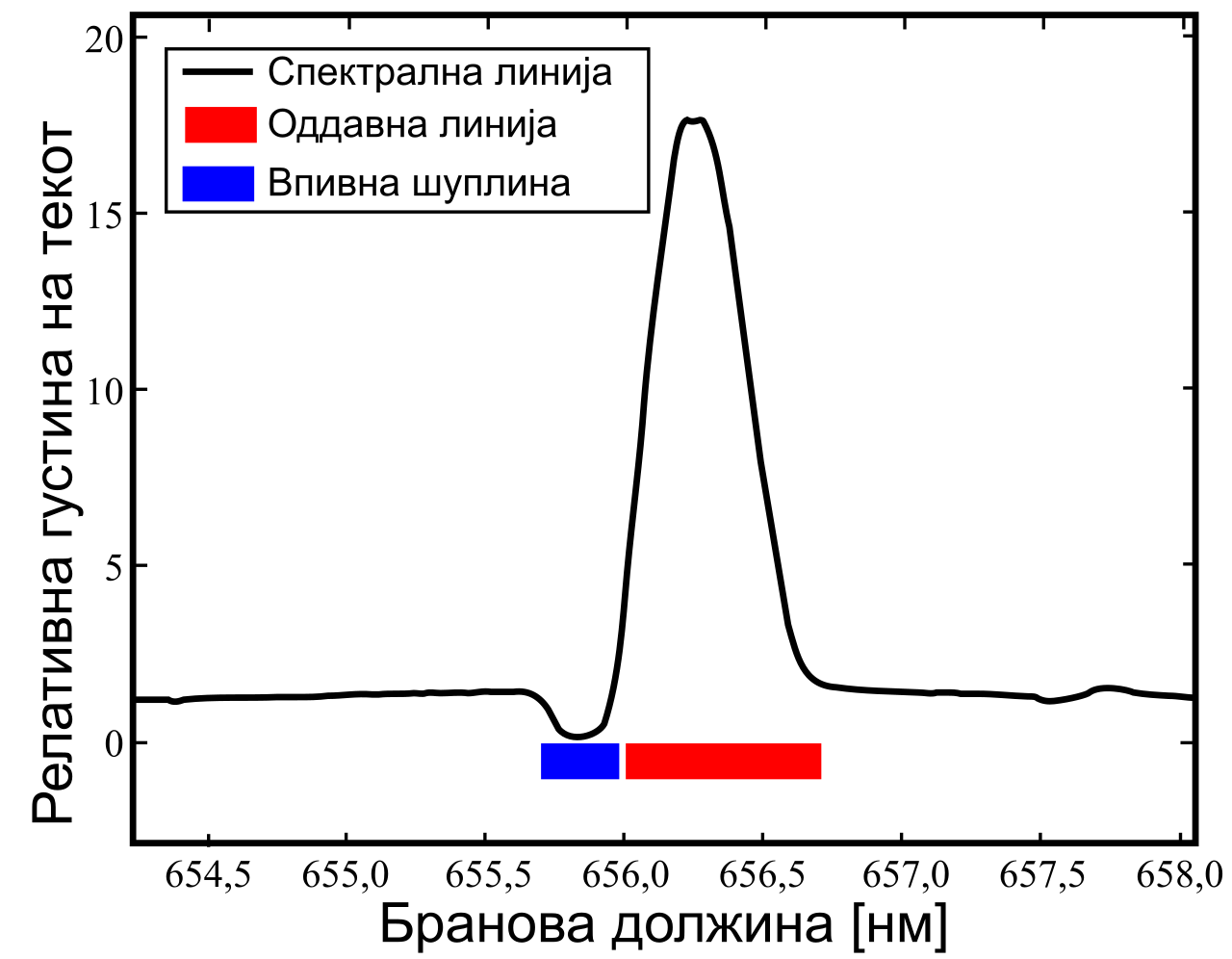
The primary star of 28 Cygni is a B-type main-sequence star with a stellar classification of B2.5 V per Lesh (1968), though Slettebak (1982) found a class of B2 IV(e), suggesting it may be a more evolved subgiant. It is a Be star, meaning its spectrum displays emission lines due to a disk of ejected gas in a Keplerian orbit around the star. The star displays short-term variability with two or more periods and is classified as an SX Arietis variable by Samus et al. (2017). It is spinning rapidly with a projected rotational velocity of 320 km/s, estimated at around 80% of the critical rotation rate, giving the star an oblate shape with an equatorial bulge out to 6.5 times the Sun's radius, compared to 5.7 at the poles. The companion is a subdwarf O star. After previous failed attempts to find the star, the companion was detected using interferometry. It has an orbital period of nearly a year and is separated by 1.9 astronomical units from its host.
Reader's Guide
28 Cygni is significant as a binary system that illustrates the complexities of Be stars and their rapid rotation. The primary's near-critical spin rate, estimated at 80% of the critical rotation, produces a pronounced oblate shape and likely drives the circumstellar disk responsible for the emission lines. The detection of the subdwarf O companion via interferometry, after earlier failed attempts, highlights the challenges of resolving close binaries. The system's classification as an SX Arietis variable, with short-term variability showing two or more periods, adds to its interest for studies of stellar pulsation and rotation. The distance of about 840 light years and absolute magnitude of −2.56 indicate that if placed at 10 parsecs, the primary would outshine Sirius, underscoring its intrinsic luminosity. The unresolved spectral classification—either a main-sequence B2.5 V or a more evolved subgiant B2 IV(e)—reflects ongoing debate about the star's evolutionary state. The companion's nature as a subdwarf O star, a rare and hot evolved object, makes the system a valuable laboratory for binary evolution and mass transfer.
Did You Know?
- The primary star rotates at about 80% of its critical rotation rate, giving it an equatorial radius 6.5 times the Sun's radius versus 5.7 at the poles.
- If placed 10 parsecs away, the primary would be brighter than Sirius, the brightest star in the night sky.
- The star is classified as an SX Arietis variable, displaying short-term variability with two or more periods.
The First Stellar Distance
For decades after Giuseppe Piazzi identified 61 Cygni's remarkable sideways drift, astronomers scrambled to pin down its true distance. Early attempts in the 1810s and 1820s by François Arago, Claude-Louis Mathieu, Christian Heinrich Friedrich Peters, and Bernhard von Lindenau produced parallax figures between 470 and 550 milliarcseconds, yet every one exceeded the precision of the instruments involved. Friedrich Wilhelm Bessel tried a different tack in 1812, estimating the stars' separation by assuming a 400-year orbital period and measuring the angular gap. His direct parallax runs of 1815–1816 gave 760 and 1320 milliarcseconds—still hopelessly imprecise. The breakthrough arrived when Joseph von Fraunhofer's new heliometer reached Königsberg. Between 1837 and 1838, Bessel used it to derive a parallax of 369.0 ± 19.1 milliarcseconds for star A, roughly 10.4 light-years. Published in 1838, this became the first reliable distance to any star beyond the Sun, announced just before von Struve measured Vega and Thomas Henderson measured Alpha Centauri. Bessel continued refining his numbers through 1868; his best 1849 run of 360.2 ± 12.1 milliarcseconds sits close to today's accepted 287.18 milliarcseconds, or 11.36 light-years.
The Flying Star and Its Name
Because 61 Cygni is relatively dim, it never appeared on ancient star charts and was never assigned a traditional name in either Western or Chinese star-naming systems. Its modern designation comes from John Flamsteed's cataloguing scheme, in which stars within a constellation are numbered by their right ascension rather than by Greek letters. Interestingly, the star does not actually appear under the number 61 in Flamsteed's Historia Coelestis Britannica; he referred to it as 85 Cygni in the 1712 edition. Over the centuries it has also been called "Bessel's Star" and "Piazzi's Flying Star." That last nickname was Piazzi's own, coined when he published his definitive proper-motion value in 1804 after comparing his measurements with James Bradley's observations from 1753. Piazzi recognized that such a large apparent drift implied the system was among the nearest stars and proposed it as a prime target for parallax work, alongside Delta Eridani and Mu Cassiopeiae. Today, 61 Cygni holds the distinction of the highest proper motion among all naked-eye visible stars, though it ranks only sixth among every stellar system in the latest Gaia catalogues, having been surpassed by Groombridge 1830, Kapteyn's Star, and Barnard's Star.
Two Stars in a Slow Dance
The first well-documented optical observation of 61 Cygni as a double star was made by James Bradley on 25 September 1753. William Herschel later undertook systematic observations as part of his broader study of binary systems, reasoning that the two components, being sufficiently separated, would exhibit different parallax shifts over the course of a year—a property he hoped could be exploited to gauge stellar distances. For a long time, however, it was genuinely uncertain whether the two K-type dwarfs were gravitationally bound or merely passing each other in projection. Friedrich Georg Wilhelm von Struve first argued in 1830 that the pair constituted a true binary, but the question lingered. The wide angular separation between the two stars and the correspondingly slow orbital motion made the case difficult to settle. Modern understanding places the orbital period at roughly 659 years. With apparent magnitudes of 5.20 and 6.05, the system is dim enough to require binoculars in a light-polluted city sky, yet bright enough for the unaided eye in a dark rural location.
The Phantom Planet
Throughout the twentieth century, 61 Cygni became an unlikely target in the search for worlds beyond the solar system. Several different astronomers, working at various times, reported what they interpreted as evidence of a massive planet orbiting one of the two stars. These claims generated considerable excitement and kept the system in the public imagination as a potential host of a distant world. However, the story ended in quiet disappointment. Recent high-precision radial velocity observations—measurements of the tiny Doppler shifts a companion would imprint on its host star's spectrum—demonstrated that none of the earlier signals could be attributed to a planetary companion. Every claim, it turned out, was unfounded, likely the product of stellar noise or instrumental artifacts. To date, no planet has been confirmed in the 61 Cygni system. The episode serves as a reminder of how difficult it is to detect and confirm exoplanets, and how even a star that once held the title of the first reliably measured distance can yield no worlds at all.
Gallery




Frequently Asked Questions
What is 28 Cygni?
It is a binary star system in the northern constellation Cygnus that appears as a faint blue-white point of light with an apparent visual magnitude of 4.93. The system lies roughly 840 light-years from Earth, with an absolute magnitude of about −2.56.
What makes 28 Cygni a Be star?
The primary component is a rapidly rotating B-type star that has flung off a disk of gas, which produces the hydrogen emission lines characteristic of the Be classification. This ejected material is visible in its spectrum and distinguishes it from ordinary B stars.
What are the two stars in the 28 Cygni system?
The primary is a hot B-type star, classified as B2.5 V or B2 IV(e), spinning at a projected rotational velocity of about 320 km/s. Its companion is a subdwarf O star, a compact and extremely hot object orbiting close by.
How was 28 Cygni's companion detected?
The subdwarf O companion was identified through interferometric observations, a technique that combines light from multiple telescopes to resolve very tight pairs. The two stars complete an orbit with a period of nearly one year.
Why is 28 Cygni interesting to astronomers?
It provides a natural laboratory for studying how a rapidly spinning B-type star sheds material into a circumstellar disk while gravitationally interacting with a compact O-type companion. This makes it a valuable case for understanding mass transfer and disk dynamics in close binary systems.
More in Binary and Multiple Stars, Part 2 1-24
Spotted an error? Know more?
Reader corrections go straight into our review queue. Suggest an edit · How this site is sourced