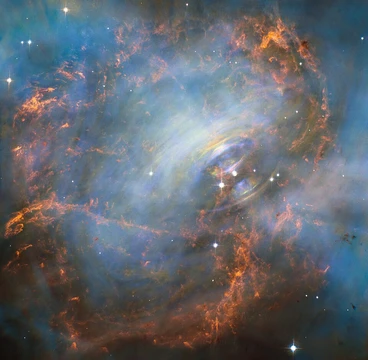
95 Herculis
A double star with a blue-white primary and yellow secondary.

95 Herculis, also called Bodu, is a binary star system in the constellation Hercules, about 432 light-years away. Its two stars show a clear color contrast: the primary shines blue-white, while the secondary appears yellow. The system was once part of the now-defunct constellation Cerberus, along with 93, 102, and 109 Herculis. In Chinese astronomy, 95 Herculis and 102 Herculis form the asterism Bó Dù, meaning "Textile Ruler." The name Bodu was officially assigned to 95 Herculis A by the IAU in June 2025.
To the naked eye, the system looks like a single star of magnitude 4.31. Through a telescope, it splits into two components separated by 6.3 arcseconds. The primary, 95 Herculis A, is a white giant or subgiant with magnitude 4.8. It has 3.1 times the Sun’s mass, six times its diameter, and shines with 156 times its luminosity. Its surface temperature of 8,211 K gives it a blue-white hue, and it spins fast, with a projected rotational velocity of 233 km/s. The secondary, 95 Herculis B, is a yellow giant of magnitude 5.1. It is more evolved than the primary, having reached the helium-burning stage, while the primary is still transitioning from hydrogen to helium burning. Although visually fainter, 95 Her B emits much of its energy in the infrared, giving it a bolometric luminosity 172 times that of the Sun. It has 3.2 solar masses and is 16.5 times wider than the Sun, with a temperature of 5,037 K.
The orbital details of the pair are poorly known, and no orbital motion has been detected. Their projected separation is about 900 astronomical units, implying an orbital period of at least 11,000 years.
- Flamsteed designation
- 95 Herculis
- Distance from earth
- 432 light-years
- Apparent magnitude (combined)
- 4.31
- Separation
- 6.3 arcseconds
- Projected separation
- 900 astronomical units
- Orbital period
- at least 11,000 years
- Component a spectral type
- A-type (white giant or subgiant)
- Component b spectral type
- yellow giant
Lore & Background
95 Herculis is the Flamsteed designation for this system. Together with 93 Herculis, 102 Herculis, and 109 Herculis, it formed the now obsolete constellation of Cerberus. In Chinese astronomy, 95 Herculis and 102 Herculis form the asterism Bó Dù (帛度, 'Textile Ruler'). The IAU Working Group on Star Names approved the name Bodu for 95 Herculis A on 17 June 2025, and it is now entered in the IAU Catalog of Star Names.
From the naked eye, 95 Herculis appears as a single star shining at apparent magnitude 4.31. When scrutinized with a telescope, it is revealed to be a double star with two components separated by 6.3 arcseconds. The brightest component, 95 Herculis A, is a white giant or subgiant with an apparent magnitude of 4.8. It has 3.1 times the Sun's mass, is six times wider, and is 156 times more luminous. Its effective temperature of 8,211 K gives it a blue-white hue, and it spins rapidly with a projected rotational velocity of 233 km/s.
The secondary, 95 Herculis B, is a yellow giant of apparent magnitude 5.1. It is the more evolved star, having reached the helium burning stage, while 95 Herculis A is still transitioning from hydrogen burning to helium burning. Although fainter visually, 95 Her B emits a significant part of its luminosity in the infrared, giving a bolometric luminosity of 172 times solar. It is 3.2 times more massive than the Sun and 16.5 times wider, with an effective temperature of 5,037 K.
Reader's Guide
95 Herculis is a double star system notable for its color contrast and evolutionary disparity. The primary, a blue-white A-type star, is still in the transition from hydrogen to helium burning, while the secondary, a yellow giant, has already reached the helium burning stage. This difference in evolutionary state makes the system a valuable object for studying stellar evolution in binary pairs. The orbital elements are not accurately known and no orbital motion has been detected, but the projected separation of 900 astronomical units implies an orbital period of at least 11,000 years. The system's historical significance includes its role in the now obsolete constellation Cerberus and its inclusion in Chinese astronomy as part of the asterism Bó Dù. The IAU officially named the primary component Bodu in 2025, cementing its place in modern nomenclature. The system's wide separation and contrasting colors also make it a popular target for amateur astronomers, similar to other colorful double stars like Albireo.
Did You Know?
- 95 Herculis is located 432 light-years from Earth.
- The system's two components are separated by 6.3 arcseconds.
- 95 Herculis A has a projected rotational velocity of 233 km/s.
- The secondary star, 95 Herculis B, has reached the helium burning stage.
More in Binary and Multiple Stars, Part 2 1-24
Spotted an error? Know more?
Reader corrections go straight into our review queue. Suggest an edit · How this site is sourced