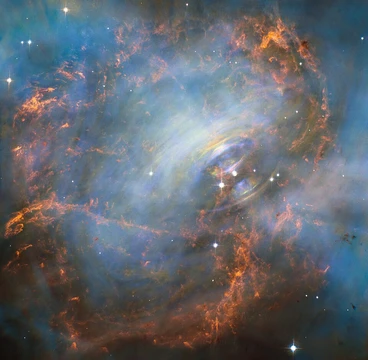
52 Sagittarii
Binary system with a peculiar B-type primary and X-ray-emitting K-type companion.

52 Sagittarii is a binary star system in the southern constellation of Sagittarius, also designated h2 Sagittarii (Bayer) and 52 Sagittarii (Flamsteed). It is notable as a faint, blue-white hued naked-eye star with a B-type primary and a cooler K-type companion that is believed to be the source of X-ray emissions from the system.
- Apparent visual magnitude
- 4.59
- Distance
- approximately 190 light years
- Radial velocity
- −19 km/s
- Spectral class primary
- B8/9V (with peculiarities: kB8 hB9 HeA0 Va (Sr Fe II))
- Mass primary
- 3 times the Sun
- Radius primary
- 2.1 times the Sun
- Luminosity primary
- 60.5 times the Sun
- Effective temperature primary
- 10,592 K
- Projected rotational velocity primary
- 48 km/s
- Age primary
- 57 million years
Lore & Background
52 Sagittarii is a binary star system in the southern constellation of Sagittarius. It has the Bayer designation h2 Sagittarii, while 52 Sagittarii is the Flamsteed designation. This system is visible to the naked eye as a faint, blue-white hued point of light with an apparent visual magnitude of 4.59. It is located approximately 190 light years away based on parallax, but is drifting closer with a radial velocity of −19 km/s.
The primary component is a B-type main-sequence star with a stellar classification of B8/9V. Garrison and Gray (1994) assigned it a class of kB8 hB9 HeA0 Va (Sr Fe II), displaying the calcium K line of a B8 class star, the hydrogen lines of a B9 star, and the helium lines of an A0 star, along with overabundances of strontium and iron. It is around 57 million years old with three times the mass of the Sun and about 2.1 times the Sun's radius. It is radiating 60.5 times the luminosity of the Sun from its photosphere at an effective temperature of 10,592 K. The star is spinning with a projected rotational velocity of 48 km/s.
52 Sagittarii has one companion at an angular separation of 2.4″. This object is magnitude 9.2 with a spectral class in the K2V-K4V range, and is believed to be the source of X-ray emissions from the system.
Reader's Guide
The significance of 52 Sagittarii lies in its binary nature and the peculiar spectral classification of its primary star. The primary is a B-type main-sequence star with a complex classification that shows mismatched line strengths for calcium, hydrogen, and helium, along with overabundances of strontium and iron, making it a chemically peculiar star. The companion, a K-type dwarf, is believed to be the source of X-ray emissions from the system, which is typical for late-type stars with active coronae. The system's proximity (about 190 light years) and brightness (magnitude 4.59) allow detailed study of both components. The radial velocity of −19 km/s indicates the system is moving closer to the Sun. The age of the primary, 57 million years, places it in a relatively young evolutionary stage. The projected rotational velocity of 48 km/s provides information on the star's spin. The angular separation of 2.4″ between the components makes this a resolvable binary for moderate-sized telescopes, contributing to studies of binary star formation and evolution.
Did You Know?
- The primary star has a peculiar spectral classification of kB8 hB9 HeA0 Va (Sr Fe II), showing mismatched line strengths for calcium, hydrogen, and helium.
- The system is drifting closer to Earth with a radial velocity of −19 km/s.
- The primary star is about 57 million years old and has three times the mass of the Sun.
Frequently Asked Questions
What is 52 Sagittarii?
It is a binary star system in the southern constellation Sagittarius, known by both the Bayer label h2 Sagittarii and the Flamsteed number 52. To a stargazer it shows up as a dim blue-white point of light with an apparent visual magnitude near 4.59, just barely within naked-eye range.
What do the two components of 52 Sagittarii look like?
The primary is a B8/9V star about three solar masses and 2.1 solar radii, while the companion is a much cooler K-type star. The primary's spectrum also carries unusual helium and iron-line peculiarities that set it apart from a textbook B-type star.
Why does 52 Sagittarii emit X-rays?
The X-ray output is traced to the cooler K-type companion rather than the hot B-type primary, which is counterintuitive since the more massive star would normally dominate high-energy emission. This makes the system a useful case study for understanding how a lower-mass companion can still be an active X-ray source.
How far away is 52 Sagittarii and is it moving toward or away from us?
The system lies at roughly 190 light-years from Earth. Its radial velocity of about −19 km/s indicates a slow drift in our direction.
What makes 52 Sagittarii interesting to binary-star enthusiasts?
It pairs a spectroscopically peculiar B-type primary with an X-ray-emitting K-type companion, giving observers both a visually faint naked-eye target and a rich set of spectral anomalies to study. The contrast between the two components—mass, temperature, and emission behavior—makes it a compact showcase of how diverse a single binary can be.
More in Binary and Multiple Stars, Part 2 1-24
Spotted an error? Know more?
Reader corrections go straight into our review queue. Suggest an edit · How this site is sourced