Lithium-ion battery
Rechargeable battery using lithium-ion intercalation for energy storage.
Last updated

RCraig09 · CC BY-SA 4.0
A lithium-ion battery (Li-ion battery) is a rechargeable power source that works by reversibly moving lithium ions in and out of solid, electrically conductive materials. These batteries are most often grouped by what their positive electrode (cathode) is made of. When compared to other rechargeable types, they generally perform better in terms of energy per weight, energy per volume, and efficiency, and they also tend to last longer in both charge cycles and overall lifespan.
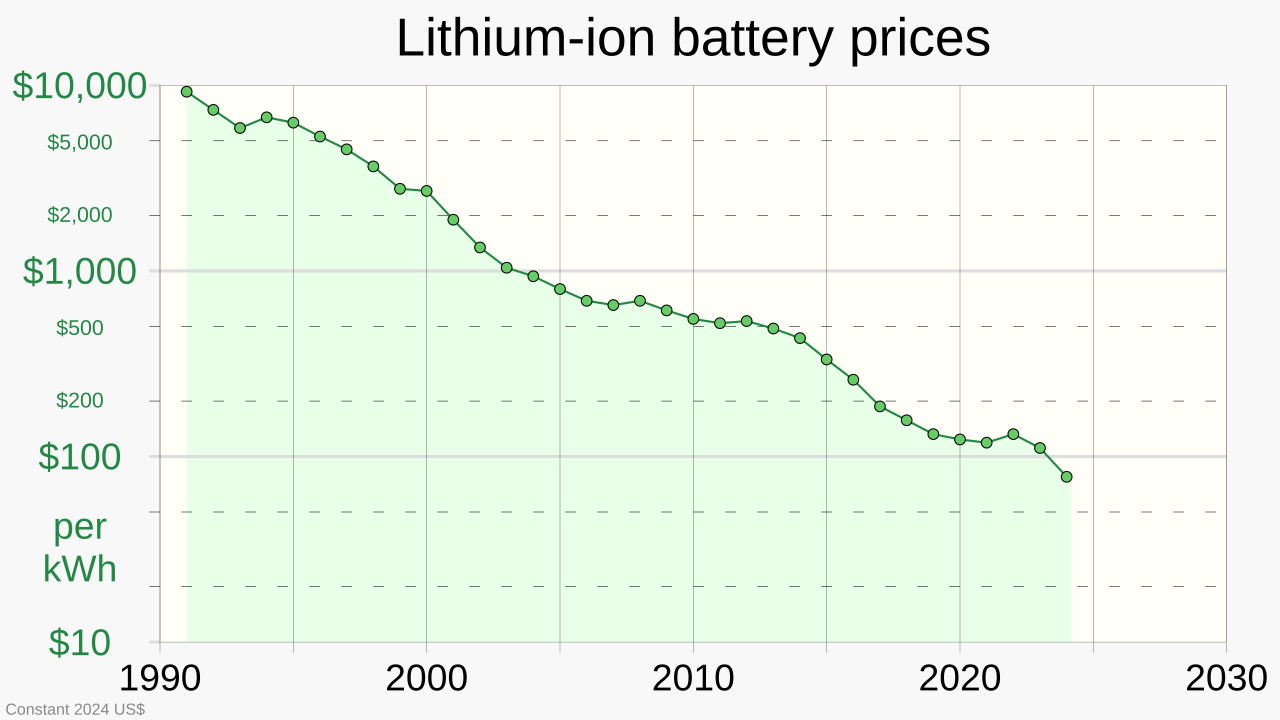
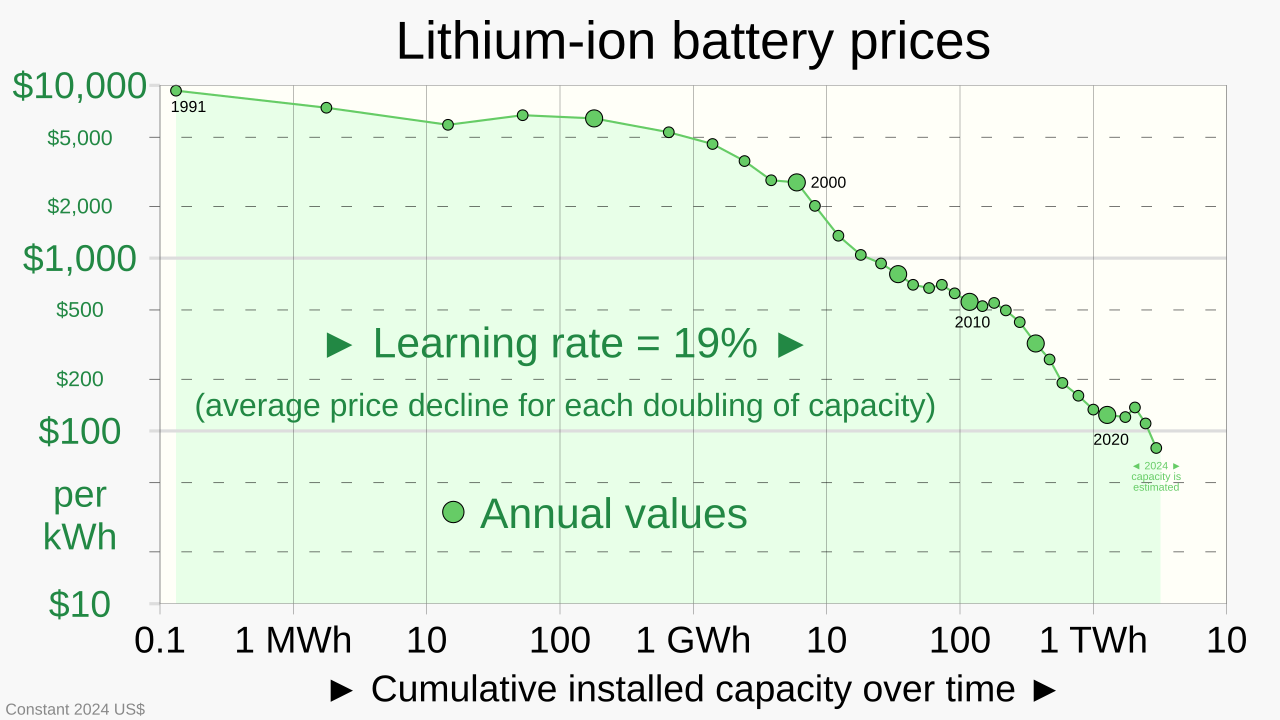
Since the first commercial sale in 1991, the amount of energy these batteries can pack into a given volume has tripled, while the cost has dropped to one-tenth of what it was. By late 2024, the world was demanding more than per year, yet factories could produce more than double that amount. The impact of these batteries on technology was recognized by the 2019 Nobel Prize in Chemistry, awarded to the key figures behind their development.
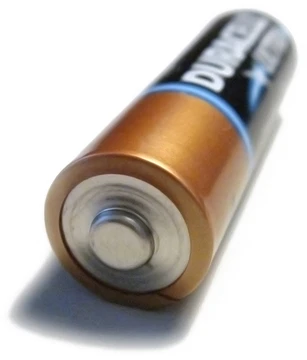
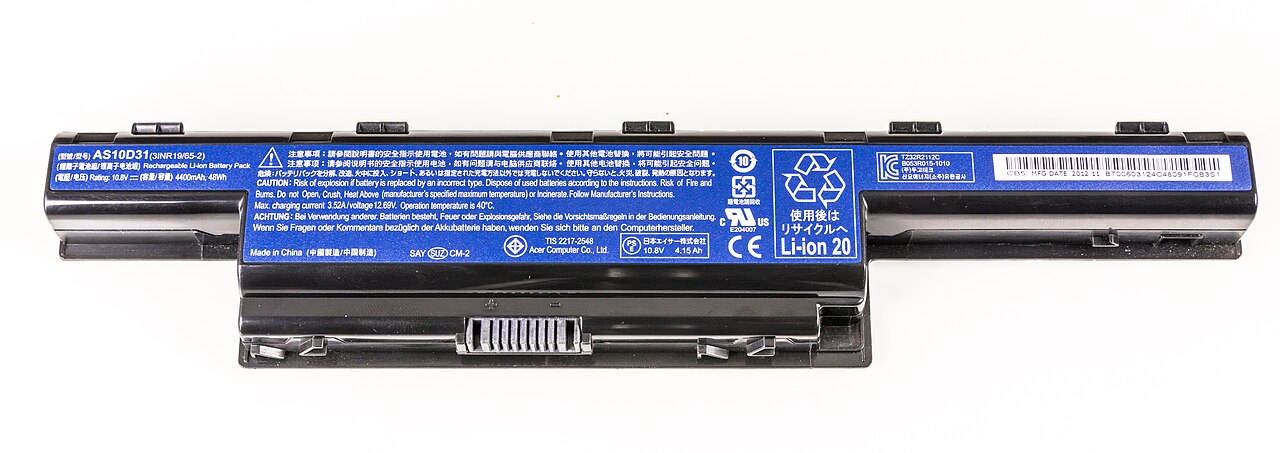
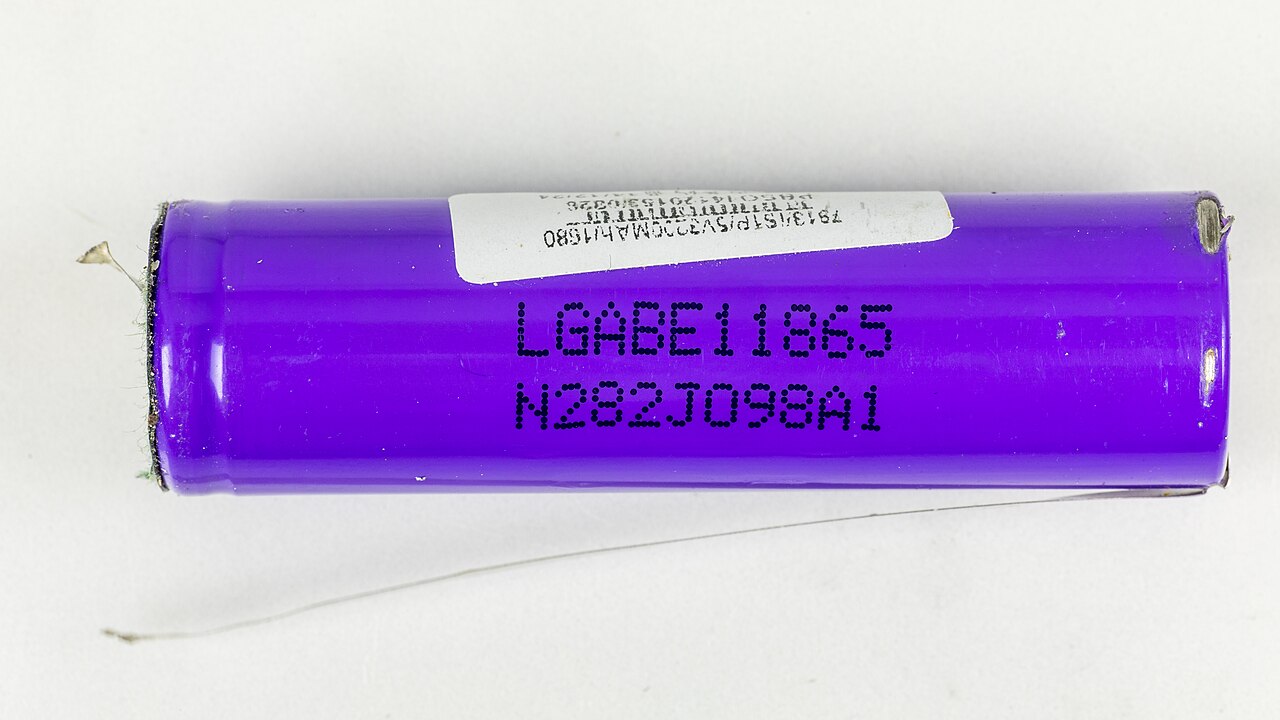
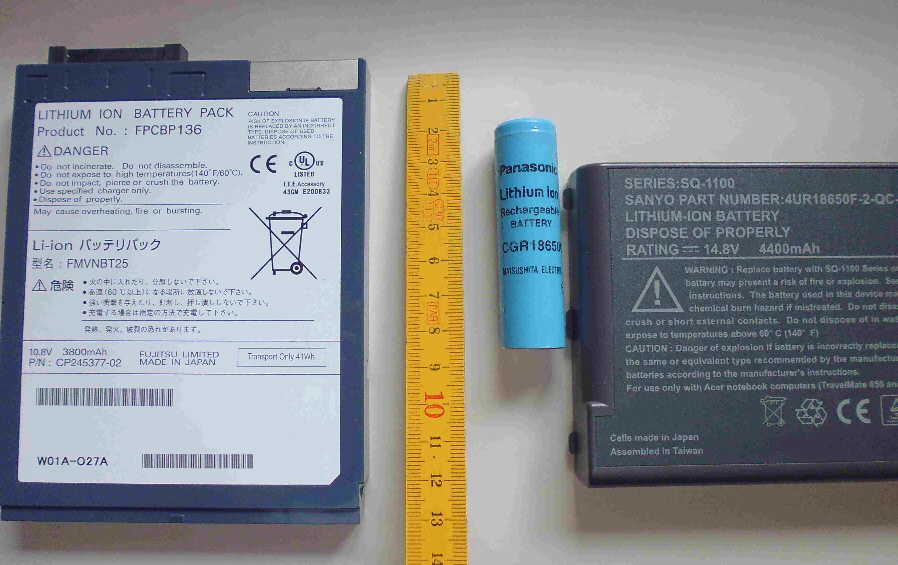
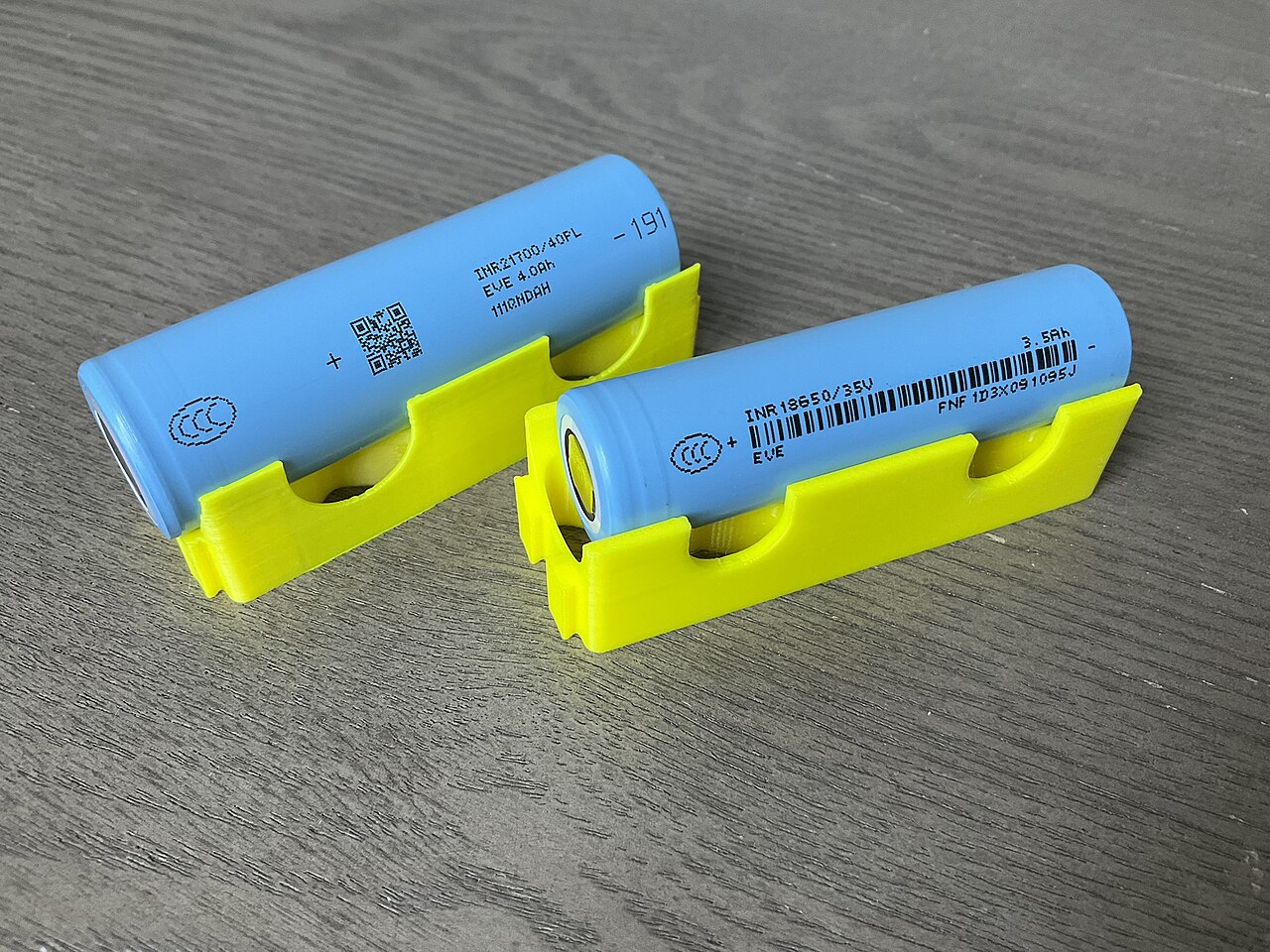
They made portable electronics, laptops, cell phones, and electric cars possible, and are also used for storing energy on the power grid, as well as in military and aerospace gear. Unlike standard disposable batteries (like AA cells), Li-ion batteries come in many different shapes and sizes, depending on the device and manufacturer. Their typical voltage is 3.6 or 3.7 volts.
Electrochemistry
The idea of intercalation electrodes was first explored by M. Stanley Whittingham in the 1970s. He built the first rechargeable lithium-ion battery using a titanium disulfide cathode and a lithium-aluminum anode, but it had safety issues and never reached the market. In 1980, John Goodenough improved the design by using lithium cobalt oxide for the cathode.
The first modern prototype, which swapped the lithium metal anode for a carbon-based one, was created by Akira Yoshino in 1985. It was then commercialized in 1991 by a team from Sony and Asahi Kasei led by Yoshio Nishi. Whittingham, Goodenough, and Yoshino shared the 2019 Nobel Prize in Chemistry for this work.
These batteries can be a fire or explosion risk because they contain flammable liquids (electrolytes). Safer versions are being developed, and solid-state lithium-ion batteries aim to remove the flammable electrolyte entirely.
Lore & Background
M. Stanley Whittingham conceived intercalation electrodes in the 1970s and created the first rechargeable lithium-ion battery using a titanium disulfide cathode and a lithium-aluminium anode, though it had safety problems and was never commercialized. John Goodenough expanded on this work in 1980 by using lithium cobalt oxide as a cathode. The first prototype of the modern Li-ion battery, which uses a carbonaceous anode rather than lithium metal, was developed by Akira Yoshino in 1985 and commercialized by a Sony and Asahi Kasei team led by Yoshio Nishi in 1991. Whittingham, Goodenough, and Yoshino were awarded the 2019 Nobel Prize in Chemistry for their contributions.
During discharge, lithium ions carry current within the battery from the negative to the positive electrode through a non-aqueous electrolyte and separator. During charging, an external power source applies an over-voltage, forcing electrons from the positive to the negative electrode, and lithium ions migrate through the electrolyte to become embedded in the porous electrode material via intercalation. The standard charging method is constant-current constant-voltage (CC/CV). Failure to follow current and voltage limitations can cause excessive heating and, in the case of overcharge, an explosion.
Lithium-ion batteries can be a fire or explosion hazard due to flammable electrolytes. Progress has been made in developing safer versions, and solid-state batteries are being developed to eliminate the flammable electrolyte. Mining of lithium and other minerals raises environmental and conflict concerns, encouraging research into alternatives such as lithium iron phosphate chemistries or non-lithium-based batteries like sodium-ion and iron-air.
Chemistry & Performance Tradeoffs
The lithium-titanate battery replaces the conventional graphite anode with lithium-titanate nanocrystals, a substitution that reshapes cell behavior in fundamental ways. While the theoretical specific capacity drops to 175 mAh/g compared with graphite's 372 mAh/g, the volume change during lithiation and delithiation shrinks dramatically from 10% to just 0.2%. This structural stability is what makes rapid charging at higher currents safer, since lithium dendrites are far less likely to form on the titanium-oxide surface.
The redox potential of Li+ intercalation into titanium oxides sits more positive than that of graphite, further reducing dendrite risk. Cycle life extends to 6,000–30,000 charge cycles under standard conditions, and even at an elevated 55 °C, roughly 1,000 cycles before capacity falls to 80% remains achievable. The tradeoff is voltage: LTO cells operate at an inherent 2.4 V versus the 3.7 V of standard lithium-ion, pushing specific energy down to roughly 30–110 Wh/kg, though some variants reach a volumetric density of 177 Wh/L.
Reader's Guide
The invention and commercialization of Li-ion batteries has had a large impact on technology, as recognized by the 2019 Nobel Prize in Chemistry. They have enabled portable consumer electronics, laptop computers, cellular phones, and electric cars, and are used for grid-scale energy storage as well as military and aerospace applications. In the three decades since their first sale in 1991, volumetric energy density increased threefold while cost dropped tenfold.
By late 2024, global demand had passed per year, with production capacity more than double that. Li-ion batteries are not standardized in size like AA batteries; they come in various form factors depending on device and vendor. Handheld electronics mostly use lithium polymer batteries with a lithium cobalt oxide cathode and graphite anode for high energy density.
Lithium iron phosphate, lithium manganese oxide, and lithium nickel manganese cobalt oxide (NMC) may offer longer life and higher discharge rate. NMC and its derivatives are widely used in transport electrification, a key technology for reducing greenhouse gas emissions from vehicles. Lithium nickel cobalt aluminum oxide (NCA) is another high-energy chemistry used in electric vehicle batteries.
Frequently Asked Questions
Who is Lithium-ion battery?
It is a rechargeable cell that stores and releases energy by shuttling lithium ions between two solid, conductive electrode materials in a reversible electrochemical reaction. Fans typically identify a specific Li-ion variant by the chemistry of its cathode material.
What is Lithium-ion battery's origin story?
It entered commercial sale in 1991 and has since roughly tripled how much energy fits into a given volume while dropping in cost by about a factor of ten through 2024. That steady improvement in density and affordability is what cemented its place as the go-to rechargeable format worldwide.
More in Battery Types
Sources
Compiled from Wikipedia and the sources listed below. Text from Wikipedia is available under CC BY-SA 4.0; this entry is adapted from it.
- Wikipedia: Lithium-ion battery (CC BY-SA 4.0).
Spotted an error? Know more?
Reader corrections go straight into our review queue. Suggest an edit · How this site is sourced