Nickel–metal hydride battery
Rechargeable battery with hydrogen-absorbing alloy negative electrode.
Last updated
A nickel–metal hydride battery (NiMH or Ni–MH) is a rechargeable battery. Its positive electrode works much like that of an older nickel–cadmium (NiCd) battery, both relying on nickel oxide hydroxide, NiO(OH).
The key difference is at the negative electrode, which uses a hydrogen-absorbing alloy instead of cadmium. For the same physical size, a NiMH battery holds two to three times more charge than a NiCd battery and has a much higher energy density, though this is still only about half that of a lithium-ion battery. NiMH batteries have largely replaced NiCd ones.
Consumer electronics
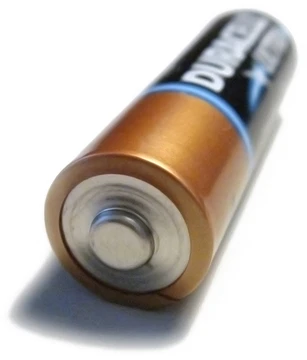
These batteries often serve as drop-in replacements for non-rechargeable alkaline and other primary batteries of the same shape. A NiMH cell delivers about 1.2 volts, while a fresh alkaline cell gives 1.5 volts, but most devices designed for alkalines can still function until the voltage drops to around 1.0 volt. Because a fully charged NiMH cell’s voltage declines more slowly than an alkaline’s, it offers similar runtime for devices that cut off at 1.0 volt. NiMH batteries also tend to leak corrosive electrolyte less often than primary batteries.
History
Work on NiMH technology began at the Battelle-Geneva Research Center after its invention in 1967, using sintered Ti₂Ni+TiNi+x alloys and NiOOH electrodes. Daimler-Benz and Volkswagen AG, through Deutsche Automobilgesellschaft, sponsored development for nearly two decades. These early batteries achieved a specific energy of 50 watt-hours per kilogram, a specific power up to 1000 watts per kilogram, and a life of 500 charge cycles at full depth of discharge. Patent applications were filed in European countries (with priority in Switzerland), the United States, and Japan, and the patents later transferred to Daimler-Benz.
Interest grew in the 1970s as the nickel–hydrogen battery was commercialized for satellites, and hydride technology offered a less bulky way to store hydrogen. Philips Laboratories and France’s CNRS developed new high-energy hybrid alloys containing rare-earth metals for the negative electrode, but these alloys proved unstable in alkaline electrolyte, leading to short cycle life. In 1987, Willems and Buschow demonstrated a successful battery using a mixture of La₀.₈Nd₀.₂Ni₂.₅Co₂.₄Si₀.₁, which retained 84% of its charge capacity after 4000 cycles.
Lore & Background
Work on NiMH batteries began at the Battelle-Geneva Research Center following the technology's invention in 1967. It was based on sintered Ti2Ni+TiNi+x alloys and NiOOH electrodes. Development was sponsored over nearly two decades by Daimler-Benz and by Volkswagen AG within Deutsche Automobilgesellschaft. The batteries' specific energy reached 50 W·h/kg, specific power up to 1000 W/kg and a life of 500 charge cycles.
Patent applications were filed in European countries, the United States, and Japan, and the patents transferred to Daimler-Benz. Interest grew in the 1970s with the commercialisation of the nickel–hydrogen battery for satellite applications. Research carried out by Philips Laboratories and France's CNRS developed new high-energy hybrid alloys incorporating rare-earth metals for the negative electrode, but these suffered from alloy instability in alkaline electrolyte. In 1987, Willems and Buschow demonstrated a successful battery using a mixture of La0.8Nd0.2Ni2.5Co2.4Si0.1, which kept 84% of its charge capacity after 4000 charge-discharge cycles.
More economically viable alloys using mischmetal instead of lanthanum were soon developed. The first consumer-grade NiMH cells became commercially available in 1989. In 1998, Stanford Ovshinsky at Ovonic Battery Co. improved the Ti–Ni alloy structure and composition and patented its innovations. In 2008, more than two million hybrid cars worldwide were manufactured with NiMH batteries.
In the European Union due to its Battery Directive, nickel–metal hydride batteries replaced Ni–Cd batteries for portable consumer use. In Switzerland in 2009, approximately 60% of portable rechargeable batteries were NiMH. In 2000, almost half of all portable rechargeable batteries sold in Japan were NiMH, compared to 22% in 2010. In 2015 BASF produced a modified microstructure that helped make NiMH batteries more durable, allowing changes to the cell design that saved considerable weight, allowing the specific energy to reach 140 watt-hours per kilogram.
Reader's Guide
NiMH batteries are typically used as a substitute for similarly shaped non-rechargeable alkaline and other primary batteries. While they provide a cell voltage of about 1.2 V and fresh alkaline cells provide 1.5 V, most devices designed for alkaline batteries can generally operate until cell voltage drops to around 1.0 V. Since the voltage of a fully-charged NiMH cell drops more slowly than an alkaline cell, it will provide similar endurance for a 1.0 V end point. NiMH batteries are less prone to leaking corrosive electrolyte than primary batteries. The negative electrode reaction is H2O + M + e− → OH− + MH, and on the positive electrode, NiO(OH) is formed.
The metal M is an intermetallic compound, with common classes being AB5 (rare-earth mixture with nickel, cobalt, manganese, or aluminium) and AB2 (titanium or vanadium with zirconium or nickel). NiMH cells have an alkaline electrolyte, usually potassium hydroxide. When fast-charging, a smart battery charger is advisable to avoid overcharging.
Trickle charging at low currents is considered safe, with manufacturers recommending limits such as C/10 or C/30. The ΔV charging method monitors voltage drop at full charge, though the drop is less pronounced for NiMH. The ΔT method monitors temperature increase, with a suggested maximal rate of 1 °C per minute. Modern NiMH cells contain catalysts to handle gases produced by over-charging, but this only works with overcharging currents up to 0.1 C.
More in Battery Types
Sources
Compiled from Wikipedia and the sources listed below. Text from Wikipedia is available under CC BY-SA 4.0; this entry is adapted from it.
- Wikipedia: Nickel–metal hydride battery (CC BY-SA 4.0).
Spotted an error? Know more?
Reader corrections go straight into our review queue. Suggest an edit · How this site is sourced