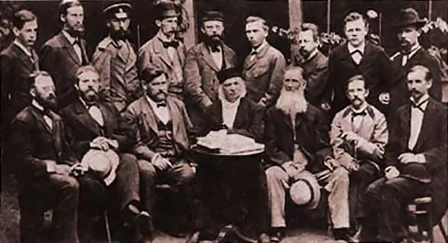
Arthur Eddington
English astrophysicist who confirmed general relativity and studied stellar interiors.

via Wikipedia: Arthur Eddington · see source
Arthur Stanley Eddington (28 December 1882 – 22 November 1944) was an English mathematician and astrophysicist. The Eddington limit—the maximum brightness a star can have, or the radiation produced when matter falls onto a dense object—bears his name. In a 1920 paper titled "The Internal Constitution of the Stars," he correctly guessed that stars are powered by the fusion of hydrogen into helium, a process that was still completely unknown at the time. He also led an expedition to the island of Príncipe to observe the solar eclipse on 29 May 1919, which gave one of the first experimental proofs of Einstein's general relativity.
Eddington was born on 28 December 1882 in Kendal, Westmorland (now Cumbria), to Quaker parents. His father, Arthur Henry Eddington, was headmaster of a Quaker school; his mother was Sarah Ann Shout. After his father died in the 1884 typhoid epidemic, his mother raised him and his sister on a small income. The family moved to Weston-super-Mare, where Eddington was first taught at home, then attended a preparatory school. They lived at 42 Walliscote Road in a house called Varzin, which now bears a plaque noting his scientific work.
In 1893 he entered Brynmelyn School, excelling in mathematics and English literature. His performance won him a scholarship to Owens College, Manchester (now the University of Manchester) in 1898. After a general first year, he focused on physics for three years, influenced by teachers Arthur Schuster and Horace Lamb. He lived at Dalton Hall, where the Quaker mathematician J. W. Graham left a lasting impression. He graduated with first-class honours in physics in 1902. That same year, his record earned him a scholarship to Trinity College, Cambridge. There, his tutor was Robert Alfred Herman, and in 1904 he became the first second-year student ever ranked Senior Wrangler. After earning his M.A. in 1905, he briefly researched thermionic emission at the Cavendish Laboratory and taught mathematics to engineering students. On the recommendation of E. T. Whittaker, he then took a post at the Royal Observatory, Greenwich, beginning his career in astronomy—a field he had been drawn to since childhood, when he would often "try to count the stars."
In January 1906, Eddington became chief assistant to the Astronomer Royal at the Royal Observatory, moving from Cambridge to Greenwich the following month. He analysed photographic plates of the asteroid 433 Eros to measure its parallax, a project started in 1900. He devised a statistical method using the apparent drift of two background stars, winning the Smith's Prize in 1907. This prize brought him a fellowship at Trinity College, Cambridge. After George Darwin died suddenly in December 1912, Eddington was appointed Plumian Professor of Astronomy and Experimental Philosophy in early 1913. Later that year, Robert Ball, holder of the theoretical Lowndean chair, also died, and Eddington became director of the Cambridge Observatory in 1914. He was elected a fellow of the Royal Society in May 1914, received the Royal Medal in 1928, and gave the Bakerian Lecture in 1926.
Eddington also studied the interiors of stars theoretically, developing the first real understanding of stellar processes. He began in 1916 by investigating possible physical explanations for Cepheid variable stars, extending Karl Schwarzschild's earlier work on radiation pressure in Emden polytropic models. These models treated a star as a gas sphere held up by internal thermal pressure against gravity. Eddington's key addition was showing that radiation pressure was necessary to keep the sphere from collapsing. He built his model even though he lacked firm knowledge of opacity and energy generation inside stars. His results allowed calculation of temperature, density, and pressure at every point inside a star, and he argued that the theory was so useful for further astrophysical research that it should be kept despite not resting on fully accepted physics. James Jeans contributed the important idea that stellar matter would be ionized, but that ended their collaboration; the two became known for their lively debates. Eddington defended his approach by pointing to the utility of his results, especially his mass–luminosity relation, which unexpectedly showed that nearly all stars—both giants and dwarfs—follow the same pattern.
- born
- 28 December 1882
- died
- 22 November 1944
- field
- Astrophysics, Mathematics
- nationality
- English
- known_for
- Eddington limit, mass–luminosity relation, confirmation of general relativity, f
Verified Timeline
Lore & Background
Eddington was born 28 December 1882 in Kendal, Westmorland (now Cumbria), England, the son of Quaker parents. His father died in the typhoid epidemic which swept England in 1884. His mother was left to bring up her two children with relatively little income. The family moved to Weston-super-Mare. In 1893 Eddington entered Brynmelyn School. His performance earned him a scholarship to Owens College, Manchester (now University of Manchester) in 1898. He graduated with a BSc in physics with First Class Honours in 1902. Based on his performance at Owens College, he was awarded a scholarship to Trinity College, Cambridge, in 1902. In 1904 Eddington became the first ever second-year student to be placed as Senior Wrangler. After receiving his M.A. in 1905, he began research on thermionic emission in the Cavendish Laboratory. Through a recommendation by E. T. Whittaker, he secured a position at the Royal Observatory, Greenwich, where he was to embark on his career in astronomy. In January 1906, Eddington was nominated to the post of chief assistant to the Astronomer Royal at the Royal Observatory. He developed a statistical method based on the apparent drift of two background stars, winning him the Smith's Prize in 1907. The prize won him a fellowship of Trinity College, Cambridge. In December 1912, George Darwin died suddenly, and Eddington was promoted to his chair as the Plumian Professor of Astronomy and Experimental Philosophy in early 1913. Later that year, Robert Ball also died, and Eddington was named the director of the Cambridge Observatory the next year. In May 1914, he was elected a fellow of the Royal Society. Around 1920, he anticipated the discovery and mechanism of nuclear fusion processes in stars, in his paper "The Internal Constitution of the Stars". He also led an expedition to observe the solar eclipse of 29 May 1919 on the Island of Príncipe that provided one of the earliest confirmations of general relativity.
Reader's Guide
Eddington's significance lies in his foundational contributions to astrophysics and the popularization of Einstein's theory of general relativity. His work on stellar interiors, including the mass–luminosity relation and the Eddington limit, shaped modern understanding of how stars generate energy and maintain stability. He was the first to correctly propose that nuclear fusion of hydrogen into helium powers stars, a remarkable insight given that fusion and the hydrogen composition of stars were not yet known. His 1919 eclipse expedition provided crucial early evidence for general relativity, helping to establish Einstein's theory in the English-speaking world after World War I. Eddington also wrote a number of articles that announced and explained Einstein's theory of general relativity to the English-speaking world. As a populariser of science, he became known for his popular expositions and interpretations of Einstein's theory. As a philosopher of science, Eddington speculated on the implications of quantum mechanics on mind and matter. His book 'The Internal Constitution of the Stars' (1926) became an important text for training a generation of astrophysicists. Despite some disagreement, Eddington's models were eventually accepted as a powerful tool for further investigation, particularly in issues of stellar evolution.
Did You Know?
- Eddington was the first ever second-year student to be placed as Senior Wrangler at Cambridge in 1904.
- He led an expedition to the Island of Príncipe to observe the solar eclipse of 29 May 1919, providing one of the earliest confirmations of general relativity.
- Around 1920, Eddington correctly speculated that stellar energy came from the fusion of hydrogen into helium, liberating energy according to Einstein's equation E = mc².
- His father died in the typhoid epidemic which swept England in 1884.
- Eddington was elected a fellow of the Royal Society in May 1914.
Frequently Asked Questions
Who is Arthur Eddington?
Arthur Stanley Eddington was a British astrophysicist and mathematician whose research reshaped our understanding of stellar interiors and who played a pivotal role in validating Einstein's general theory of relativity.
What is the Eddington limit?
The Eddington limit is the theoretical ceiling on a star's luminosity, beyond which outward radiation pressure would overpower gravity and blow the star apart. It emerged from Eddington's analysis of the balance between gravitational and radiative forces in stellar equilibrium.
How did Eddington help confirm general relativity?
In 1919 Eddington organized and led an eclipse expedition to photograph stars near the Sun's limb, measuring the slight deflection of their light predicted by Einstein's curved-spacetime model. The results matched general relativity and made both Eddington and Einstein internationally famous almost overnight.
What is the mass–luminosity relation and why does it matter?
Eddington showed that a star's total brightness scales in a predictable way with its mass, a relationship now called the mass–luminosity relation. It became a foundational tool for estimating stellar masses from observed luminosities and for building modern models of stellar structure.
When and where was Arthur Eddington born and when did he die?
Eddington was born on 28 December 1882 in England and passed away on 22 November 1944. His career spanned the early twentieth century and touched on nuclear stellar physics, cosmology, and the philosophy of measurement.
More in Astronomers And Cosmologists 1-24
Spotted an error? Know more?
This is a living reference — every entry is fact-audited, and reader corrections feed straight into our audit queue. Suggest an edit · See this site's audit record