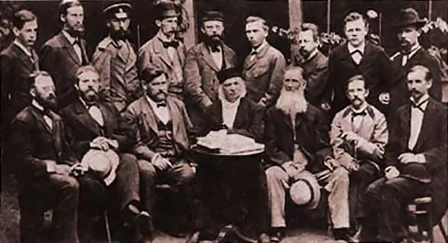
Anton Pannekoek
Dutch astronomer and council communist theorist.

via Wikipedia: Anton Pannekoek · see source
Anton Pannekoek was a Dutch astronomer, historian, philosopher, Marxist theorist, and socialist revolutionary, best known as a principal theorist of council communism and for his astrophysical research on stellar atmospheres and the Milky Way. Born in Vaassen, Gelderland, in 1873, his early interest in astronomy was sparked at age twelve when he identified the planet Saturn while studying the constellation Gemini using a borrowed textbook. He studied mathematics and physics at Leiden from 1891, publishing his first article on the Milky Way as a student. After briefly working as a geodesist, he returned to the Leiden Observatory to write his thesis on the variability of the star Algol. Politically, he became a convinced socialist after reading Edward Bellamy’s *Equality* and immersed himself in the works of Karl Marx and Joseph Dietzgen, soon becoming a prominent Marxist writer for Dutch and German socialist periodicals. His activism led to a clash with authorities: he was dismissed from the Leiden Observatory for leading a strike support committee. He later taught historical materialism for the Social Democratic Party of Germany but faced expulsion threats from German authorities. During World War I, stranded in the Netherlands, he worked as a science teacher and private lecturer in astronomy history at Leiden University. The Dutch government blocked his appointment as assistant director at the Leiden Observatory due to his Marxist views, but he became a lecturer at the University of Amsterdam in 1918, founded its astronomical institute in 1921, and rose to full professor by 1932. His astronomical work included systematic observations of variable stars and the Milky Way, for which he developed a photographic method using out-of-focus plates to measure surface brightness. He also provided early evidence for an expanded galaxy by measuring distant star clusters in Cygnus and Aquila. Later, he advanced the study of stellar atmospheres by expanding upon Meghnad Saha’s ionization formula, concluding that narrow spectral lines in certain stars indicated lower atmospheric pressure.
- field
- Astronomy, Marxist theory
- nationality
- Dutch
- known_for
- Council communism, Milky Way studies, stellar atmospheres
Verified Timeline
Lore & Background
His father managed a small metal foundry and his mother was a midwife. At age 12, he borrowed a textbook from his elder brother Adolf and studied the constellation Gemini, noticing an extra point of light that he realized was Saturn. He later attended the Hogere Burgerschool in Apeldoorn, showing strong aptitude in biology and astronomy. After reading Edward Bellamy's Equality, Pannekoek became a convinced socialist and studied Marx and Joseph Dietzgen. He became a well-known Marxist writer for Dutch and German socialist magazines. During World War I, he was stranded in the Netherlands and worked as a cosmographer and teacher.
Reader's Guide
Pannekoek's significance lies in his dual legacy as a pioneering astronomer and a radical Marxist theorist. In astronomy, he systematically observed the Milky Way, developing methods using isophotic lines and out-of-focus photography to map its light distribution. His measurement of distant star clusters in Cygnus and Aquila provided early evidence for Harlow Shapley's expanded galaxy. He also advanced the study of stellar atmospheres, producing the first curve of growth for a star other than the sun (Deneb) and founding astrophysics as a separate discipline in the Netherlands. As a Marxist theorist, Pannekoek was a founder of council communism, arguing that workers' revolution must be achieved through democratically organized workers' councils. He was a sharp critic of anarchism, social democracy, and Leninism, giving critical but conditional support to the Bolsheviks. His writings on workers' councils influenced radical left movements in the Netherlands and Germany.
Did You Know?
- At age 12, Pannekoek noticed an extra point of light in Gemini and realized it was the planet Saturn.
Frequently Asked Questions
Who is Anton Pannekoek?
Anton Pannekoek was a Dutch polymath who worked as an astronomer, philosopher, and political theorist. He is most widely recognized for developing the intellectual framework of council communism and for pioneering research into stellar atmospheres and the structure of the Milky Way.
What did Anton Pannekoek contribute to astronomy?
Pannekoek made key advances in understanding how stars form and evolve, particularly through his work on the physics of stellar atmospheres. He also helped map and explain the large-scale structure of the Milky Way galaxy, laying groundwork that later astrophysicists built upon.
What is Anton Pannekoek's connection to Marxism and council communism?
Beyond his scientific career, Pannekoek became a leading Marxist theorist and argued that workers should govern themselves through councils rather than through traditional party structures. His writings on council communism influenced socialist movements across Europe in the early twentieth century.
Why is Anton Pannekoek considered important in both science and politics?
Pannekoek is rare in that he left lasting marks on two very different fields: astrophysics and political theory. His dual legacy means he is studied both in the history of astronomy and in the history of socialist thought, making him a uniquely interdisciplinary figure.
More in Astronomers And Cosmologists 1-24
Spotted an error? Know more?
This is a living reference — every entry is fact-audited, and reader corrections feed straight into our audit queue. Suggest an edit · See this site's audit record