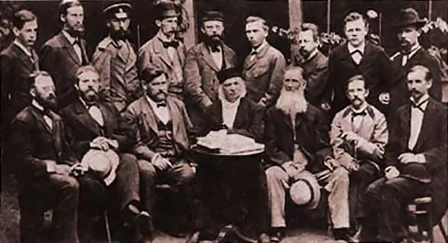
Jan Oort
Dutch astronomer who provided early evidence for dark matter.

via Wikipedia: Galaxy rotation curve · see source
Jan Hendrik Oort (28 April 1900 – 5 November 1992) was a Dutch astronomer who fundamentally advanced the understanding of the Milky Way galaxy and pioneered radio astronomy. He is recognized by the European Space Agency as one of the greatest astronomers of the 20th century, credited with revolutionizing astronomy through his discoveries. In 1955, *Life* magazine listed him among the 100 most famous living people, and he is noted for elevating the Netherlands to a leading position in postwar astronomy. Oort demonstrated that the Milky Way rotates and disproved the long-held idea that the Sun sits at its center. By analyzing the vertical motions of nearby stars, he estimated the local gravitational field and calculated the mass required to account for those motions perpendicular to the galactic plane. In 1932, comparing this mass to visible stars and gas, he concluded that considerable amounts of invisible matter must exist. This concept was termed “dark matter” the following year by Fritz Zwicky. Although Oort’s specific measurements were later challenged and may have been spurious, his work anticipated the discovery that dark matter constitutes about 84.5% of the universe’s mass and governs the clustering of galaxies. He also identified the galactic halo—stars orbiting outside the Milky Way’s main disk—and made crucial insights about comets, realizing their orbits indicated a solar system far larger than the planetary region. His legacy includes the Oort cloud, Oort constants, Oort Limit, a crater on Pluto, and an asteroid.
- field
- Astronomy
- nationality
- Dutch
- known_for
- Galactic rotation, Oort constants, Oort limit, discovery of galactic halo, early
Lore & Background
Oort's work on motion inside the Milky Way included trying to determine what are known as the Oort constants, though he did not find very accurate values. In 1932, he became the first to report that measurements of the stars in the solar neighborhood indicated that they moved faster than expected when a mass distribution based upon visible matter was assumed, but these measurements were later determined to be essentially erroneous. In 1939, Horace Babcock reported measurements of the rotation curve for Andromeda which suggested that the mass-to-luminosity ratio increases radially, attributing it to either absorption of light or modified dynamics, not missing matter. Reporting on NGC 3115, Oort wrote that "the distribution of mass in the system appears to bear almost no relation to that of light... one finds the ratio of mass to light in the outer parts of NGC 3115 to be about 250." On page 302–303 of his journal article, he wrote that "The strongly condensed luminous system appears imbedded in a large and more or less homogeneous mass of great density" and speculated this mass may be either extremely faint dwarf stars or interstellar gas and dust, but had clearly detected the dark matter halo of this galaxy.
Reader's Guide
Jan Oort's significance lies in his foundational contributions to the study of dark matter. In 1932, he became the first to report that measurements of the stars in the solar neighborhood indicated they moved faster than expected when a mass distribution based upon visible matter was assumed, though these measurements were later determined to be essentially erroneous. Reporting on NGC 3115, Oort wrote that "the distribution of mass in the system appears to bear almost no relation to that of light" and that "the ratio of mass to light in the outer parts of NGC 3115 to be about 250." He speculated this mass may be either extremely faint dwarf stars or interstellar gas and dust, but had clearly detected the dark matter halo of that galaxy. The existence of dark matter was first posited in the 1930s by Jan Oort in his measurements of the Oort constants and Fritz Zwicky in his studies of the masses of galaxy clusters. Oort also did work on motion inside the Milky Way, and tried to determine what are known as the Oort constants, but did not find very accurate values.
Did You Know?
- In 1932, Jan Oort became the first to report that stars in the solar neighborhood moved faster than expected based on visible matter, though these measurements were later determined to be essentially erroneous.
- Reporting on NGC 3115, Oort wrote that 'the distribution of mass in the system appears to bear almost no relation to that of light' and found a mass-to-light ratio of about 250 in the outer parts.
- Oort speculated that the mass he detected in NGC 3115 could be either extremely faint dwarf stars or interstellar gas and dust, but he had clearly detected the dark matter halo of that galaxy.
- The existence of dark matter was first posited in the 1930s by Jan Oort in his measurements of the Oort constants and Fritz Zwicky in his studies of galaxy clusters.
- Oort tried to determine the Oort constants from motion inside the Milky Way but did not find very accurate values.
Frequently Asked Questions
Who is Jan Oort?
Jan Hendrik Oort was a Dutch astronomer born in 1900 in Franeker who spent his career reshaping how we understand the structure and motion of the Milky Way. He is remembered as one of the foundational figures in both galactic astronomy and early radio astronomy.
What is the Oort cloud?
The Oort cloud is a vast, spherical shell of icy bodies that Oort theorized surrounds the outermost reaches of our solar system. He proposed it in 1950 to explain where long-period comets originate before being nudged inward by passing stars.
How did Jan Oort prove the Milky Way rotates?
By analyzing the motions of stars across different regions of the galaxy, Oort demonstrated that the Milky Way spins as a whole rather than being a static collection with the Sun at its center. His calculations, later formalized as the Oort constants, became the standard tool for measuring galactic rotation.
What is Jan Oort's connection to dark matter?
While studying stellar velocities in the outer parts of the galaxy, Oort noticed the stars moved faster than the visible mass could account for. He suggested in 1932 that unseen matter must be present, making him one of the earliest scientists to point toward what we now call dark matter.
Why is Jan Oort important in astronomy?
Oort fundamentally changed galactic astronomy by showing the Milky Way is a rotating disk, identifying the galactic halo, and providing the first quantitative hint of dark matter. His work also helped launch radio astronomy as a serious observational discipline.
More in Astronomers And Cosmologists 1-24
Spotted an error? Know more?
This is a living reference — every entry is fact-audited, and reader corrections feed straight into our audit queue. Suggest an edit · See this site's audit record