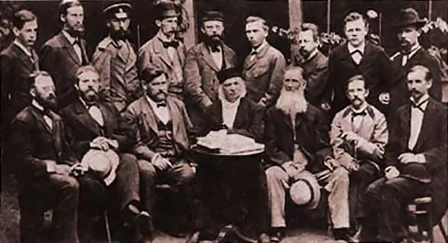
John Flamsteed

via Wikipedia: Star · see source
John Flamsteed, born in 1646 in Denby, Derbyshire, was the only son of a maltster. Educated at Derby School, he gained a strong command of Latin and a love of history before leaving in 1662. Chronic ill health delayed his entry to Jesus College, Cambridge, but during this period he assisted his father, learning arithmetic and fractions, and developed a deep interest in mathematics and astronomy. His fascination began in July 1662 with a thirteenth-century work on the sphere, and he observed his first partial solar eclipse that September. In 1663, reading about dialling sparked an interest in sundials, and he studied several mathematical works, including Thomas Street’s astronomical tables. He befriended local astronomy enthusiasts, notably William Litchford, whose library contained the work of Jeremiah Horrocks, which greatly impressed Flamsteed. At nineteen, in 1665, he wrote his first paper on the design and use of an astronomer’s quadrant. He entered his name at Cambridge in 1670 and later heard Isaac Newton’s lectures. Ordained a deacon, he was preparing for a Derbyshire living when his patron, Jonas Moore, brought him to London. In early 1675, Flamsteed assisted a Royal Commission examining a longitude proposal. The commission dismissed the proposal but recommended establishing an observatory. On 4 March 1675, Flamsteed was appointed the first Astronomer Royal, tasked with correcting celestial tables to aid navigation. He laid the foundation stone of the Royal Greenwich Observatory that August, became a Fellow of the Royal Society in 1676, and moved into the observatory that July. In 1684, he was ordained a priest and became rector of Burstow, Surrey, holding both posts until his death in 1719. He is buried at Burstow, where a plaque marks his grave. His posthumous star catalogue and atlas catalogued about 3,000 stars, and he made the first recorded observations of Uranus, though he mistakenly listed it as a star.
- field
- Astronomy
- nationality
- English
- known_for
- First Astronomer Royal; Catalogus Britannicus; Atlas Coelestis; first recorded o
Lore & Background
John Flamsteed was an English astronomer who served as the first Astronomer Royal. He is best known for producing a catalogue of three thousand stars, titled *Catalogus Britannicus*, and a star atlas called *Atlas Coelestis*, both published after his death. He also made the earliest recorded observations of the planet Uranus, though he mistakenly classified it as a star. Flamsteed laid the foundation stone for the Royal Greenwich Observatory. He was born in Denby, Derbyshire, the only son of Stephen Flamsteed and Mary Spadman. He attended the free school of Derby and Derby School, where most masters were Puritans, and gained a solid command of Latin. Chronic ill health delayed his entry to Jesus College, Cambridge. During this time, he learned arithmetic and fractions from his father and developed a strong interest in mathematics and astronomy. In July 1662, he was captivated by a thirteenth-century work on the sphere, and in September of that year observed his first partial solar eclipse. By early 1663, he was studying sundials and later acquired astronomical tables by Jeremiah Horrocks, whose work greatly impressed him. At nineteen, he wrote his first paper on astronomy, concerning the design and use of an astronomer’s quadrant. He was ordained a deacon and later a priest, serving as rector of Burstow in Surrey while continuing as Astronomer Royal until his death. He is buried at Burstow.
Reader's Guide
Over some forty years, he observed and meticulously recorded data for his star catalogue, which eventually tripled the number of entries in Tycho Brahe's sky atlas. The pirated publication of his data by Isaac Newton and Edmond Halley in 1712 led Flamsteed to burn three hundred of the four hundred printings, reflecting his insistence on releasing only verified observations. His work underpinned later advances in navigation and astronomy.
Did You Know?
- After Isaac Newton and Edmond Halley pirated his data in 1712, Flamsteed burned three hundred of the four hundred printings.
More in Astronomers And Cosmologists 1-24
Spotted an error? Know more?
This is a living reference — every entry is fact-audited, and reader corrections feed straight into our audit queue. Suggest an edit · See this site's audit record