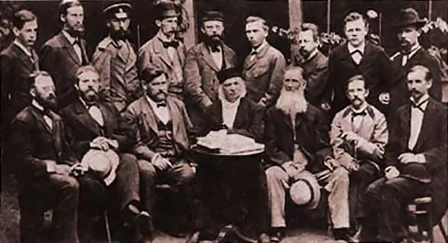
Johann Gottfried Galle
First to view Neptune, validating celestial mechanics.

Johann Gottfried Galle (9 June 1812 – 10 July 1910) was a German astronomer born in the Papsthaus, a house in the Pabst wood two kilometers west of Radis, near Gräfenhainichen. He was the first son of Marie Henriette née Pannier and Johann Gottfried Galle, who operated a tar oven. After attending the Gymnasium in Wittenberg, he studied at Friedrich-Wilhelms-Universität Berlin from 1830 to 1833, later teaching mathematics and physics at the Gymnasium in Guben before transferring to a Berlin Gymnasium. In 1835, he became an assistant to Johann Franz Encke at the new Berlin Observatory, where he worked for sixteen years using a Fraunhofer refractor with a 22.5-centimeter aperture. In 1838, he discovered an inner, dark ring of Saturn, and from December 1839 to March 1840 he found three new comets. He earned his doctorate in 1845 with a thesis critically reducing Ole Rømer’s observations of meridian transits from October 1706. That same year, he sent a copy of his thesis to Urbain Le Verrier, who replied a year later. On 23 September 1846, Le Verrier’s letter arrived, containing coordinates for a predicted planet based on perturbations of Uranus. That night, with Encke’s reluctant permission and the assistance of student Heinrich Louis d’Arrest, Galle observed an 8th-magnitude star one degree from the predicted position, not recorded on the Berliner Akademischen Sternkarte. Over two subsequent nights, a proper motion of four arcseconds confirmed it as a planet, later named Neptune. Galle always credited Le Verrier as the discoverer. In 1847, he was designated to succeed Friedrich Wilhelm Bessel as director of Königsberg Observatory, but withdrew in early 1848 following an intrigue led by Carl Gustav Jacob Jacobi. He moved to Breslau in 1851 to direct the local observatory, becoming professor of astronomy at the university there in 1856, and served as rector for the 1875/76 academic year. Over 45 years in Breslau, he published over 200 works on planetary orbits, methods for calculating aurora heights and meteor paths, and a compilation of all 414 comets known by 1894, also studying Earth’s magnetic field and climatology. He returned to Potsdam in 1897 and died there at age 98, survived by his wife and two sons. A memorial was erected in Gräfenhainichen in 1977. Craters on the Moon and Mars, the asteroid 2097 Galle, and a ring of Neptune bear his name. A street in
- field
- Astronomy
- nationality
- German
- known_for
- First to view and identify Neptune
Verified Timeline
Lore & Background
Johann Gottfried Galle was a German astronomer, born in a house known as the Papsthaus, located west of Radis near Gräfenhainichen. He was the first son of a tar oven operator and his wife. Galle attended the Gymnasium in Wittenberg and later studied at Friedrich-Wilhelms-Universität Berlin. He began his career teaching mathematics and physics at a Gymnasium in Guben before transferring to a school in Berlin. In 1835, he became an assistant to Johann Franz Encke at the new Berlin Observatory, where he worked for sixteen years, primarily using a Fraunhofer refractor telescope. During his time there, he discovered an inner dark ring of Saturn and three new comets. He earned his doctorate with a thesis that reduced and critically discussed Ole Rømer's meridian transit observations. Galle is most famous for being the first person to view and identify the planet Neptune on 23 September 1846, following a prediction by Urbain Le Verrier. After receiving Le Verrier’s letter containing the predicted coordinates, Galle, with student Heinrich Louis d'Arrest, found an eighth-magnitude star within one degree of the calculated position that was absent from existing star charts. Subsequent observations of its proper motion confirmed it as a planet. Galle always credited Le Verrier as the discoverer. He later became director of the observatory in Breslau and a professor of astronomy there, working for over forty-five years. His research included determining planetary orbits, calculating aurora heights and meteor paths, and compiling data on comets. He also studied Earth's magnetic field and climatology, publishing over two hundred works. Galle died in Potsdam at age ninety-eight.
Reader's Guide
Johann Gottfried Galle’s career was defined by his work at the Berlin Observatory, where he served as an assistant to Johann Franz Encke for sixteen years, using a Fraunhofer refractor with an aperture of about 22.5 centimeters. In 1838, he identified an inner dark ring around Saturn, and between December 1839 and March 1840 he discovered three comets. His doctoral thesis, completed in 1845, involved a reduction and critical discussion of Ole Rømer’s observations of meridian transits of stars and planets from October 1706. Galle’s most famous achievement came on 23 September 1846, when he received a letter from Urbain Le Verrier containing coordinates for an undiscovered planet derived from perturbations in Uranus’s orbit. That same night, with student Heinrich Louis d’Arrest, Galle found an eighth-magnitude star not recorded on the Berliner Akademischen Sternkarte, just one degree from the predicted position. Over the next two nights, a proper motion of four arcseconds confirmed it as a planet, later named Neptune. Galle consistently refused credit for the discovery, insisting it belonged to Le Verrier. After leaving Berlin, he directed the observatory in Breslau for over forty-five years and became a professor of astronomy there, serving as rector for the 1875–76 academic year. He published more than two hundred works, focusing on precise planetary orbit calculations, methods for determining aurora heights and meteor paths, and a comprehensive catalog of all 414 comets known by 1894, compiled with his son. He also studied Earth’s magnetic field and climatology.
Did You Know?
- Galle always refused to be acknowledged as the discoverer of Neptune, attributing the discovery to Urbain Le Verrier.
More in Astronomers And Cosmologists 1-24
Spotted an error? Know more?
This is a living reference — every entry is fact-audited, and reader corrections feed straight into our audit queue. Suggest an edit · See this site's audit record