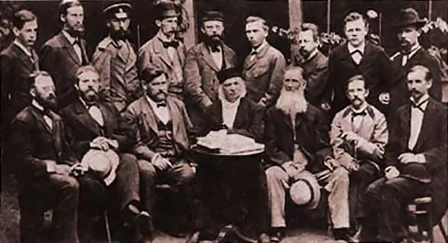
Friedrich Wilhelm Bessel
German astronomer who first measured the distance to a star.
Friedrich Wilhelm Bessel (22 July 1784 – 17 March 1846) was a German astronomer, mathematician, physicist, and geodesist. He was the first astronomer to determine a reliable distance from the Sun to another star using the method of parallax, a breakthrough that expanded the known scale of the universe. Bessel also systematically studied a class of mathematical functions that later became known as Bessel functions. Born in Minden, Westphalia, as the second son of a civil servant in a large family, he left school at age fourteen due to a dislike of Latin education and apprenticed with a trading firm in Bremen. His work with cargo ships led him to apply mathematics to navigation problems, which sparked an interest in astronomy for determining longitude. In 1804, he refined orbital calculations for Halley’s Comet using old observations, catching the attention of astronomer Heinrich Wilhelm Olbers. After completing his commercial training, Bessel became an assistant at Johann Hieronymus Schröter’s private observatory in Lilienthal, where he processed James Bradley’s stellar data to produce precise positions for over three thousand stars. Despite lacking a university education, he was appointed director of the newly founded Königsberg Observatory in 1810 by King Frederick William III. To secure the right to teach mathematics, he obtained an honorary doctorate from the University of Göttingen through Carl Friedrich Gauss, with whom he corresponded for decades. Bessel married Johanna Hagen, whose sister married physicist Franz Ernst Neumann, a close colleague who adopted Bessel’s rigorous measurement methods. Bessel had two sons and three daughters; his elder son died young, and his younger son died shortly after birth. He died in 1846 after several months of illness from retroperitoneal fibrosis.
- known_for
- First reliable stellar parallax (61 Cygni); Bessel functions; Besselian elements
Lore & Background
Friedrich Wilhelm Bessel was a German astronomer, mathematician, physicist, and geodesist. He was the first astronomer to determine a reliable value for the distance from the Sun to another star using the method of parallax. In 1838, he published a parallax of 0.314 arcseconds for the star 61 Cygni, indicating it was 10.3 light-years away, a figure with an error of 9.6% compared to the modern measurement of 11.4 light-years. This work provided the second empirical evidence of Earth's relative movement, after James Bradley's discovery of the aberration of light in 1728. Bessel also systematically studied certain important mathematical functions, which were later named Bessel functions in his honor. He was born in Minden, Westphalia, the second son of a civil servant. After leaving school at age 14 due to a dislike of Latin instruction, he apprenticed in a Bremen import-export firm, where his work on navigation led him to astronomy. He refined orbital calculations for Halley's Comet in 1804 using old observation data, catching the attention of astronomer Heinrich Wilhelm Olbers. In 1806, Bessel became an assistant at Johann Hieronymus Schröter's private observatory in Lilienthal, where he worked on James Bradley's stellar observations to produce precise positions for about 3,222 stars. Despite lacking a university education, he was appointed director of the new Königsberg Observatory in 1810 at age 25. He received an honorary doctorate from the University of Göttingen in 1811, arranged by Carl Friedrich Gauss. Bessel married Johanna Hagen; the physicist Franz Ernst Neumann married her sister. Bessel died in March 1846 at his observatory from retroperitoneal fibrosis.
Reader's Guide
Bessel's significance lies in his pioneering measurement of stellar distance, which expanded the known scale of the universe. This provided the second empirical evidence of Earth's motion after the aberration of light. He also noticed deviations in the motions of Sirius and Procyon, correctly predicting unseen companions—leading to the discovery of Sirius B, the first white dwarf. Bessel systematically studied cylinder functions (now Bessel functions), critical in solving differential equations across classical and quantum physics. He developed Besselian elements for calculating eclipses, a method still in use. His work on the personal equation—that different observers record slightly different transit times—influenced precision measurement.
Did You Know?
- The first direct measurement of the distance to a star (61 Cygni at 11.4 light-years) was made in 1838 by Friedrich Bessel using the parallax technique.
- In 1834, Friedrich Bessel observed changes in the proper motion of the star Sirius and inferred a hidden companion.
- Parallax measurements demonstrated the vast separation of the stars in the heavens.
- The first solution to the problem of deriving an orbit of binary stars from telescope observations was made by Felix Savary in 1827.
Frequently Asked Questions
Who is Friedrich Wilhelm Bessel?
Friedrich Wilhelm Bessel was a German scientist active in the early nineteenth century who worked across astronomy, mathematics, physics, and geodesy. He is best remembered as the first person to successfully measure the distance to a star using the parallax method.
What is Bessel's most famous astronomical achievement?
In 1838 he calculated the first reliable stellar parallax for 61 Cygni, giving humanity its first accurate distance to a star beyond the Sun. That single measurement proved stars sit at vastly different distances and opened the door to modern celestial distance measurement.
What are Bessel functions and why do they matter?
Bessel functions are a family of mathematical solutions to a particular differential equation that Bessel was the first to study systematically. They now appear throughout physics and engineering, from acoustics to electromagnetism, and carry his name as a permanent tribute.
When was Friedrich Wilhelm Bessel born and when did he die?
He was born on 22 July 1784 in Germany and died on 17 March 1846. His life spanned just over sixty-one years, during which he reshaped several fields of science.
Why is Bessel considered important in the history of science?
He bridged pure mathematics and practical measurement, producing tools like the Bessel ellipsoid for geodesy and the concept of the personal equation to correct for individual observer bias. His work set standards of precision that still influence how astronomy and geodesy are practiced today.
More in Astronomers And Cosmologists 1-24
Spotted an error? Know more?
This is a living reference — every entry is fact-audited, and reader corrections feed straight into our audit queue. Suggest an edit · See this site's audit record