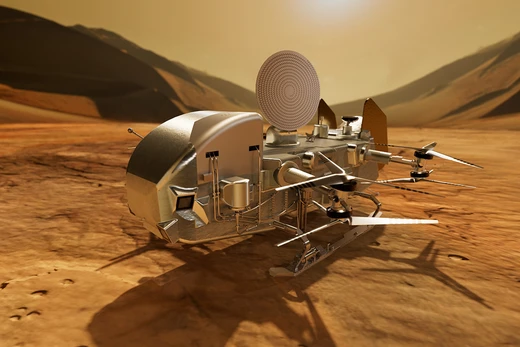
Fobos-Grunt
Failed Russian sample return mission to Phobos, Mars's moon.

Fobos-Grunt (Фобос-Грунт, meaning “Phobos-soil”) was a Russian mission designed to collect a sample from Phobos, one of Mars’s moons, and return it to Earth. It was the first Russian-led interplanetary mission since the failed Mars 96, and the last successful Soviet interplanetary missions had been Vega 2 in 1985–1986 and the partially successful Phobos 2 in 1988–1989. The spacecraft also carried China’s first Mars orbiter, Yinghuo-1, and the Living Interplanetary Flight Experiment, a Planetary Society project testing whether organisms could survive deep space. Launched on 8 November 2011 at 20:16 UTC from Baikonur Cosmodrome, the rocket burns meant to send it toward Mars failed, stranding it in low Earth orbit. Attempts to reactivate it were unsuccessful, and it re-entered Earth’s atmosphere uncontrollably on 15 January 2012 over the Pacific Ocean west of Chile. The return vehicle was intended to bring back up to 200 grams of Phobos soil in August 2014, which would have made it the first spacecraft to return a macroscopic sample from an extraterrestrial body since Luna 24 in 1976.
The project was funded by the Russian Federal Space Agency and developed by Lavochkin and the Russian Space Research Institute. The chief designer was Maksim Martynov, and lead scientist Alexander Zakharov described the mission as “possibly the most difficult interplanetary one to date.” The total cost was planned at 5 billion rubles (US$163 million), with 1.5 billion rubles for the project itself and about 2.4 billion rubles for 2009–2012 funding including post-launch operations. Most of the spacecraft and instruments were new, though designs drew on three successful Soviet Luna missions from the 1970s that retrieved Moon rocks.
Development began in 1999 with a 9 million rouble feasibility study by the Russian Space Research Institute and NPO Lavochkin, the main developer of Soviet and Russian interplanetary probes. The initial design resembled the probes from the Phobos program of the late 1980s. Work started in 2001, and a preliminary design was completed in 2004, but the project stalled due to low funding until a new government space plan for 2006–2015 made Fobos-Grunt a flagship mission. With improved funding, the launch was set for October 2009. The design was revised several times, and international partners were invited. In June 2006, NPO Lavochkin began manufacturing an
- Mission type
- Sample return (attempted)
- Target
- Phobos, moon of Mars
- Launch date
- 8 November 2011, 20:16 UTC
- Launch site
- Baikonur Cosmodrome
- End date
- 15 January 2012 (uncontrolled re-entry)
- Funding agency
- Russian Federal Space Agency
- Cost
- 1.5 billion rubles (US$64.4 million) initially; total planned 5 billion rubles (US$163 million)
Quick Facts
- Names List
- Phobos-Grunt / Фобос-Грунт
- Mission Type
- Phobos lander / Sample return
- Operator
- Roscosmos
- Satcat
- 37872
- Mission Duration
- 3 years (planned) / Failed in Earth orbit
- Manufacturer
- Lavochkin, Russian Space Research Institute
- Dry Mass
- 2300 kg
- Launch Mass
- 13505 kg
- Power
- 1 kW (main orbiter/lander) + 300 W (Earth return vehicle)
- Launch Date
- 8 November 2011, 20:16:02 UTC
- Launch Rocket
- Zenit-2SB41
- Launch Site
- Baikonur Cosmodrome, Site 45/1
Facts from the source article.
Lore & Background
The launch was originally set for October 2009 but was delayed to 2011 due to difficulties with onboard computer development and software integration. The spacecraft arrived at Baikonur on 17 October 2011 and launched successfully on 8 November 2011 atop a Zenit-2SB41 rocket. After reaching an initial parking orbit, two firings of the main propulsion unit were required to send it to Mars. The first burn did not occur, and the spacecraft remained in low Earth orbit. Contact was eventually lost, and it re-entered over the Pacific Ocean west of Chile on 15 January 2012.
Reader's Guide
Fobos-Grunt was the first Russian-led interplanetary mission since the failed Mars 96, and the last successful Soviet interplanetary missions had been Vega 2 in 1985–1986 and Phobos 2 in 1988–1989. It was designed to be the first spacecraft to return a macroscopic sample from an extraterrestrial body since Luna 24 in 1976. The mission's failure highlighted the challenges of developing complex interplanetary spacecraft after a long hiatus, and its loss was a setback for Russian planetary science. The project's lead scientist described the Phobos sample return as 'possibly the most difficult interplanetary one to date.' Despite the failure, the mission fostered international cooperation, including China's first interplanetary probe and experiments from multiple countries.
Did You Know?
- Fobos-Grunt carried a Polish-built drill as an additional scientific instrument for subsurface sampling, not as a back-up soil extraction device.
Frequently Asked Questions
What is Fobos-Grunt?
Fobos-Grunt, a name that translates to "Phobos-soil," was a Russian spacecraft built to fly to the Martian moon Phobos, scoop up surface material, and bring that sample back to Earth. It marked Russia's first independently led interplanetary mission since the Mars 96 failure in 1996.
What was Fobos-Grunt's primary mission objective?
The spacecraft was designed to perform a sample-return operation: descend near Phobos, collect soil, and deliver that material to Earth for laboratory study. It also carried China's Yinghuo-1 Mars orbiter as a secondary payload intended to separate once in Mars orbit.
How did the Fobos-Grunt mission end?
After lifting off from Baikonur on 8 November 2011, the spacecraft lost all telemetry and never achieved its planned trajectory toward Mars. It ultimately re-entered Earth's atmosphere uncontrolled on 15 January 2012, bringing the mission to a complete failure.
Why is Fobos-Grunt notable in astrobiology?
The mission carried the Living Interplanetary Flight Experiment (LIFE), a Planetary Society project that sealed a community of extremophile microorganisms in a small capsule to test whether biological life could endure the vacuum, radiation, and thermal extremes of interplanetary travel. Though the spacecraft never reached its target, the experiment was specifically designed to probe the survival limits relevant to panspermia hypotheses.
What was the Living Interplanetary Flight Experiment (LIFE)?
LIFE was a Planetary Society initiative that packed a diverse set of microorganisms into a sealed container aboard Fobos-Grunt to observe whether they could survive the rigors of a Mars-bound journey. The results were intended to inform debates about whether life could plausibly hitch a ride on interplanetary debris.
More in Astrobiology space missions 1-24
Spotted an error? Know more?
This is a living reference — every entry is fact-audited, and reader corrections feed straight into our audit queue. Suggest an edit · See this site's audit record