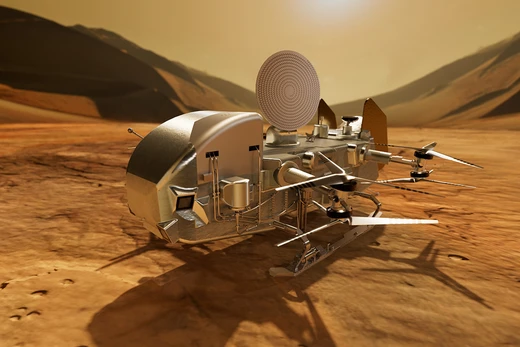
ExoMars
European astrobiology programme searching for past life on Mars.

ExoMars, short for Exobiology on Mars, is a European Space Agency (ESA) astrobiology program. It includes the Trace Gas Orbiter (TGO), the Schiaparelli entry, descent, and landing demonstrator, and a future rover named Rosalind Franklin. The program aims to find evidence of past life on Mars, study changes in Martian water and geochemistry, examine atmospheric trace gases and where they come from, and test technologies needed for a future mission to return samples from Mars.
The first part of the program launched in 2016. On March 14, 2016, the TGO and Schiaparelli—an entry, descent, and landing demonstrator built to test key technologies for safely delivering the later rover, though with limited battery life—lifted off. The TGO entered Mars orbit on October 19, 2016, and began mapping methane and other trace gases in the Martian atmosphere that could hint at biological or geological activity. It carries four instruments and also serves as a communications relay. Schiaparelli separated from the TGO on October 16 and followed a ballistic trajectory toward a landing in Meridiani Planum, but it crashed on the Martian surface due to premature parachute release and brief thruster firing.
The second part was originally set to launch in the early 2020s. A Russian descent module was to deliver ESA’s Rosalind Franklin rover to Mars, with the surface platform after landing named Kazachok, and some instruments built by Roscosmos. On March 17, 2022, ESA suspended the mission because of Russia’s invasion of Ukraine. In April 2024, new funding allowed the rover’s construction and delivery to restart, using a new European landing platform. NASA agreed to provide the launch, now scheduled for late 2028. Mission operations and communications for this second phase will be run from ALTEC’s Rover Control Centre in Italy.
The ExoMars concept has shifted many times since its start. It began in 2001 as part of ESA’s Aurora program for human Mars exploration, originally calling for a rover in 2009 and later a sample-return mission. Another Aurora project was a Phobos sample-return mission. In December 2005, ESA member nations approved the Aurora program and ExoMars. Aurora is optional, so each country chooses its level of involvement and funding. The program launched in 2002 with support from twelve nations: Austria, Belgium, France, Germany, Italy, the Netherlands, Portugal, Sp
- field
- Astrobiology / Mars exploration
- nationality
- European (ESA member states)
- known_for
- Searching for signs of past life on Mars; Trace Gas Orbiter mapping methane sources; Schiaparelli entry, descent, and landing demonstrator crash; Rosalind Franklin rover development
- launch_date_first_mission
- 14 March 2016
- key_partners
- ESA, Roscosmos (former), NASA (current)
Quick Facts
- Mission Type
- Mars reconnaissance
- Operator
- ESA, Roscosmos (until 2022)
- Mission Duration
- Trace Gas Orbiter: 14 March 2016 (in progress) / Schiaparelli: 14 March 2016 · October 2016
- Website
- http: · www.esa.int/exomars (ESA)
- Insignia
- File:ExoMars insignia.png
- Insignia Caption
- ESA insignia (2020s)
- Insignia Upright
- 0.6
Facts from the source article.
Lore & Background
ExoMars began in 2001 as part of the ESA Aurora program for the human exploration of Mars. That initial vision called for a rover in 2009 and later a Mars sample-return mission. In December 2005, the different nations composing the ESA gave approval to the Aurora program and to ExoMars. Originally conceived as a rover with a stationary ground station, ExoMars was planned to launch in 2011 aboard a Russian Soyuz Fregat rocket. In 2007, Canadian-based technology firm MacDonald Dettwiler and Associates Ltd. (MDA) was selected for a one-million-euro contract with EADS Astrium of Britain to design and build a prototype Mars rover chassis for the European Space Agency. Astrium was also contracted
Reader's Guide
ExoMars represents a major European effort in planetary science and astrobiology, aiming to answer fundamental questions about the possibility of past life on Mars. Its first mission, launched in 2016, successfully placed the Trace Gas Orbiter into Mars orbit to map methane and other trace gases, while the Schiaparelli lander crashed during its landing attempt. The programme's second part, originally planned with Russia, was suspended in March 2022 due to the ongoing invasion of Ukraine by Russia. In April 2024, the mission received new funding to restart construction and delivery of the Rosalind Franklin rover using a new European landing platform, with NASA providing the launch, currently scheduled for late 2028. The programme's significance lies in its technological demonstrations for future sample-return missions and its international collaboration, which has shifted from NASA to Russia and back to NASA and European partners over two decades.
Did You Know?
- The Schiaparelli lander crashed on the surface of Mars after separating from TGO on 16 October 2016.
- The Trace Gas Orbiter features four instruments and acts as a communications relay satellite.
- ESA suspended the mission on 17 March 2022 due to the ongoing invasion of Ukraine by Russia.
- In April 2024, the mission received new funding to restart construction using a new European landing platform, with NASA providing the launch.
Programme Architecture & Scientific Ambitions
ExoMars, formally known as Exobiology on Mars, is the European Space Agency's dedicated astrobiology programme designed to probe whether life ever existed beyond Earth. The architecture spans three major spacecraft: the Trace Gas Orbiter, the Schiaparelli experimental lander, and the yet-to-be-delivered Rosalind Franklin rover. Together they pursue a layered scientific agenda—hunting for biosignatures left by ancient Martian life, charting how water and geochemistry have shifted across the planet's history, and tracking atmospheric trace gases whose origins might point to biological or geological processes. Equally important is the programme's engineering mandate: proving out the technologies a future Mars sample-return mission will depend on. The Trace Gas Orbiter carries four scientific instruments and doubles as a communications relay, while the lander and rover components are built to validate entry, descent, and surface operations. This multi-spacecraft, multi-phase design reflects ESA's ambition to build a complete Mars exploration capability rather than a single one-off flyby.
The 2016 Mission & Schiaparelli's Tragic Descent
The first phase of ExoMars lifted off on 14 March 2016, carrying both the Trace Gas Orbiter and the Schiaparelli test lander. Six months later, on 19 October, TGO settled into its designated Mars orbit and began its primary task: mapping the sources of methane and other trace gases that might hint at biological or geological activity beneath the surface. Meanwhile, Schiaparelli—designed specifically to demonstrate new technologies for safely delivering the future rover—separated from the orbiter on 16 October and was guided toward a landing in Meridiani Planum. The experiment ended in disaster: the lander crashed upon reaching the Martian surface. Despite the loss, the mission validated critical orbital and atmospheric-mapping capabilities. TGO continues to operate as both a science platform and a communications relay satellite for subsequent surface operations. The Schiaparelli failure, while painful, provided invaluable data on entry and descent dynamics that informed the engineering of the next-generation landing system now being prepared for Rosalind Franklin.
A Decade of Shifting Alliances
ExoMars has never been a purely European endeavour; its history is threaded with international partnerships that have repeatedly reshaped the mission's scope. The programme traces its roots to 2001 within ESA's Aurora programme, approved by member states in December 2005, with twelve nations initially contributing. In 2009, NASA and ESA signed the Mars Exploration Joint Initiative, proposing an Atlas launch vehicle and a combined multi-spacecraft architecture that included a second rover called MAX-C. But in February 2012, President Obama's FY2013 budget terminated NASA's participation to cover James Webb Space Telescope overruns, forcing a complete restructuring. Russia then stepped in: a March 2013 agreement made Roscosmos a full partner, supplying Proton launch vehicles with Briz-M upper stages and an additional entry-descent-landing module. The 2016 mission was launched on a Proton. Then, on 17 March 2022, ESA suspended the second mission entirely in response to Russia's invasion of Ukraine, severing the partnership that had anchored the programme's launch and landing architecture for over a decade.
Rosalind Franklin — The Road Ahead
The second ExoMars mission, centred on the Rosalind Franklin rover, has endured the most turbulent timeline of any major space programme in recent memory. Originally slated for the early 2020s with a Russian-built Kazachok lander and Roscosmos-supplied instruments, it was frozen in March 2022 amid the Ukraine conflict. The revival came in April 2024, when ESA secured fresh funding to restart construction and delivery using an entirely new European landing platform, with NASA agreeing to provide the launch vehicle. The current target is late 2028. The rover will carry a mix of European and, per the original agreement, some Roscosmos-built instruments, though the political landscape has shifted dramatically since that deal was signed. Day-to-day operations and communications will be directed from ALTEC's Rover Control Centre in Italy. For ESA, Rosalind Franklin represents more than a science payload; it is the culmination of two decades of planning, a test of European autonomy in deep-space logistics, and the final proving ground before humanity attempts to bring Martian samples back to Earth.
Frequently Asked Questions
What is ExoMars?
ExoMars is a European Space Agency astrobiology program built to hunt for evidence that life once existed on Mars. It ties together an orbiter, a landing demonstrator, and a planned drilling rover into a single mission framework.
What spacecraft are part of the ExoMars program?
The program comprises the Trace Gas Orbiter, the Schiaparelli entry-descent-landing demonstrator, and the upcoming Rosalind Franklin rover. Each handles a different layer of investigation: atmospheric chemistry, surface landing technology, and deep subsurface sampling.
What happened to the Schiaparelli lander?
Schiaparelli was designed to prove that a probe could safely touch down on Mars, but it crashed during its 2016 descent. It transmitted a short burst of data before losing contact, and the mission was declared a failure.
What is the Rosalind Franklin rover and when will it launch?
Rosalind Franklin is the future ExoMars rover tasked with drilling up to two metres into Martian regolith to search for preserved biosignatures. With Roscosmos no longer a partner, ESA is now coordinating the mission alongside NASA, though a firm launch date remains in development.
Why is ExoMars important for the search for past life on Mars?
It directly targets the question of whether microbial communities ever thrived in Mars' wetter past by mapping methane sources, tracking water geochemistry, and drilling into ancient sediments. The data it gathers will also inform the technologies needed for a future Mars sample-return mission.
More in Astrobiology space missions 1-24
Spotted an error? Know more?
This is a living reference — every entry is fact-audited, and reader corrections feed straight into our audit queue. Suggest an edit · See this site's audit record