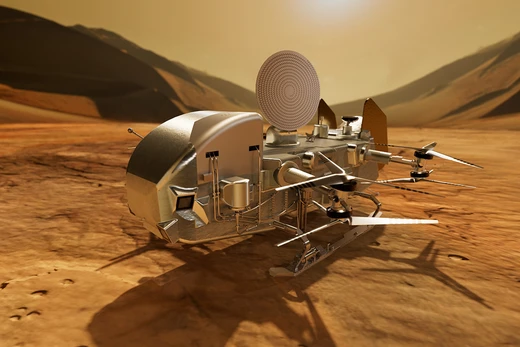
Biosatellite program
Three uncrewed satellites studying spaceflight effects on living organisms.

NASA flew three uncrewed satellites under its Biosatellite program, each built to return to Earth after studying how living things handle spaceflight, especially radiation and the lack of gravity. The central aim was to see how the space environment affects life at three scales: the basic chemistry inside cells; how cells and tissues grow and are structured; and the overall development of whole plants and animals.
The first mission, Biosatellite 1, launched on December 14, 1966, aboard a Delta G rocket from Cape Canaveral’s Launch Complex 17A. It went into an orbit with a low point of 296 kilometers, a high point of 309 kilometers, and a 33.5-degree tilt, circling Earth every 90.5 minutes. On board were various specimens meant to reveal how space affects biological processes. When it came time to come home, the entry capsule separated from the main satellite as planned, but the motor meant to push it out of orbit never fired. The capsule stayed in a slowly decaying orbit until it burned up on reentry on February 15, 1967.
Biosatellite 2 followed on September 7, 1967, also launched by a Delta G rocket, this time from Launch Complex 17B. It carried thirteen experiments featuring insects, frog eggs, plants, and microorganisms. The mission had to end about a day early because of an approaching tropical storm. Even so, the 45 hours of orbital flight gave enough data for valid conclusions in all thirteen experiments, which were checked against identical control samples kept on the ground.
The third and final mission, Biosatellite 3, failed to meet its scientific goals. But it left a lasting mark on how NASA ran later life-sciences flight experiments, highlighting the need for better central management, more realistic objectives, and thorough preflight testing of all experiments. Its specific aim was to study how spaceflight affects brain activity, behavior, heart and blood vessel function, fluid and salt balance, and metabolism.
- last_launch
- June 29, 1969
Quick Facts
- Manufacturer
- General Electric
- Country
- United States
- Operator
- NASA
- Applications
- Bioscience
- Design Life
- 8-30 days
- Orbits
- Low Earth orbit
- Launched
- 3
- First
- Biosatellite 1 · 14 December 1966
- Last
- Biosatellite 3 · 29 June 1969
Facts from the source article.
Lore & Background
Biosatellite 1, also known as Biosat 1 and Biosatellite A, was launched on December 14, 1966, by a Delta G rocket from Launch Complex 17A of the Cape Canaveral Air Force Station. It carried several specimens for studying the effects of the space environment on biological processes. Prior to reentry, the entry capsule separated from the satellite bus properly, but its deorbit motor failed to ignite, leaving it stranded in a slowly decaying orbit. It re-entered and disintegrated on February 15, 1967.
Biosatellite 2, also known as Biosat 2 and Biosatellite B, was launched on September 7, 1967, by a Delta G rocket from Launch Complex 17B. It carried thirteen biological experiments involving insects, frog eggs, plants, and microorganisms. The mission was ended early due to a tropical storm threat, but its 45 hours of earth-orbital flight enabled valid conclusions by comparing onboard samples to earthbound control organisms.
Biosatellite 3, also known as Biosat 3 and Biosat C, was the third mission. Though its scientific agenda was a failure, it was influential in shaping the life sciences flight experiment program, pointing to the need for centralized management, realistic goals, and substantial pre-flight experiment verification testing. Its objective was to investigate the effect of space flight on brain states, behavioral performance, cardiovascular status, fluid and electrolyte balance, and metabolic state.
Reader's Guide
The Biosatellite program represents an early NASA effort to systematically study biological responses to spaceflight using recoverable uncrewed satellites. Despite mixed technical success—Biosatellite 1 was lost due to a deorbit motor failure, and Biosatellite 3 failed to achieve its scientific agenda—the program provided foundational data on how weightlessness and radiation affect organisms at cellular, tissue, and whole-organism levels. Biosatellite 2, though cut short by a tropical storm, successfully returned 45 hours of flight data that allowed valid comparisons with ground controls. The program's legacy lies in its influence on later life sciences flight experiments, highlighting the need for centralized management, realistic goals, and rigorous pre-flight verification. It also set a precedent for using recoverable capsules to study biological specimens in space, a concept later expanded in programs like Bion and BIOPAN.
Did You Know?
- Biosatellite 1's deorbit motor failed to ignite, causing the capsule to remain in orbit until it re-entered and disintegrated on February 15, 1967.
- Biosatellite 2 carried thirteen biological experiments involving insects, frog eggs, plants, and microorganisms.
- Biosatellite 2's mission was ended early due to a tropical storm threat, but its 45 hours of flight still enabled valid conclusions.
- Biosatellite 3 was influential in shaping the life sciences flight experiment program despite its scientific failure.
Program Vision & Biological Scope
NASA conceived the Biosatellite program as a trio of uncrewed satellites, each built with a single overriding purpose: to carry living organisms into orbit and then bring them safely back to Earth for post-flight analysis. The central scientific question was how the space environment—specifically radiation exposure and the absence of gravity—disrupted biological function. Rather than treating life as a monolith, the program structured its investigations across three hierarchical levels of organization. At the most fundamental tier, researchers examined the basic biochemistry occurring within individual cells. A step up the ladder, they tracked how cells and tissues organized their growth and structural development. At the broadest scale, they observed the growth, form, and overall physiology of whole plants and animals. Every satellite in the series was engineered for atmospheric reentry and physical recovery, ensuring that the biological payloads could be examined in detail after their orbital sojourn.
Biosatellite 1: A Promising Start, a Frustrating End
The inaugural flight of the program lifted off on December 14, 1966, atop a Delta G rocket from Launch Complex 17A at Cape Canaveral Air Force Station. The satellite, variously called Biosat 1 or Biosatellite A, settled into an orbit with a perigee of 296 kilometers, an apogee of 309 kilometers, an inclination of 33.5 degrees, and a period of roughly 90.5 minutes. Aboard were multiple biological specimens intended to reveal how the space environment altered living processes. The mission's conclusion, however, was anything but smooth. When the time came to bring the payload home, the entry capsule did separate cleanly from the satellite bus as designed, but the deorbit motor never ignited. The capsule was left adrift in a gradually shrinking orbit, drifting for more than two months before it finally re-entered the atmosphere and disintegrated on February 15, 1967. The specimens were lost, but the experience underscored the engineering challenges of recovering biological payloads from orbit.
Biosatellite 2: Cut Short Yet Scientifically Sound
The second mission launched on September 7, 1967, from Launch Complex 17B at Cape Canaveral, again riding a Delta G rocket. Biosatellite 2, also referred to as Biosatellite B, carried thirteen distinct biological experiments covering a diverse range of organisms: insects, frog eggs, plants, and microorganisms. The mission was brought to an early close when a tropical storm threatened the recovery zone, forcing controllers to end the flight roughly a day ahead of schedule. Despite the abbreviated timeline, the satellite had already accumulated approximately 45 hours of orbital flight—enough time for the experiments to yield valid scientific conclusions. Researchers were able to draw meaningful comparisons between the space-exposed samples and their earthbound control organisms, confirming that even a shortened mission could produce reliable data on how weightlessness and the space environment affected biological systems at the cellular and organismal levels.
Biosatellite 3 & the Program's Lasting Influence
The final mission, designated Biosatellite 3 or Biosatellite D, set an ambitious scientific agenda: investigating how spaceflight impacted brain states, behavioral performance, cardiovascular status, fluid and electrolyte balance, and overall metabolic state. In the end, the mission's scientific objectives were not met, and the campaign is generally regarded as a failure in terms of data collection. Yet its influence extended far beyond its own results. The shortcomings of Biosatellite 3 became a critical lesson for the broader life sciences flight experiment community. The experience highlighted the urgent need for centralized management of biological spaceflight programs, the importance of setting realistic and achievable scientific goals, and the necessity of conducting substantial pre-flight verification testing before committing organisms to orbit. In this way, the program's most troubled chapter helped reshape how subsequent space biology missions were planned, managed, and executed.
Frequently Asked Questions
What was the Biosatellite program?
It was a NASA initiative that sent three uncrewed satellites into orbit to observe how the space environment impacts living organisms. Each satellite carried biological specimens and returned to Earth so scientists could analyze the results.
What was the main scientific goal of the Biosatellite program?
The program aimed to understand how radiation and microgravity affect life at three levels: molecular chemistry within cells, the growth and structure of tissues, and the development of entire plants and animals.
When did the Biosatellite missions fly?
The first satellite launched in December 1966 on a Delta G rocket from Cape Canaveral, and the final mission went up on June 29, 1969. All three flights took place within roughly a three-year window.
How many satellites did the Biosatellite program launch?
NASA flew exactly three uncrewed satellites under this program. Each one was designed to reenter the atmosphere and return its biological payloads to the ground for post-flight analysis.
Why is the Biosatellite program important to astrobiology?
It provided some of the earliest dedicated data on how space conditions—particularly ionizing radiation and weightlessness—alter biological processes. Those findings helped shape later thinking about whether life could survive or thrive beyond Earth.
More in Astrobiology space missions 1-24
Spotted an error? Know more?
This is a living reference — every entry is fact-audited, and reader corrections feed straight into our audit queue. Suggest an edit · See this site's audit record