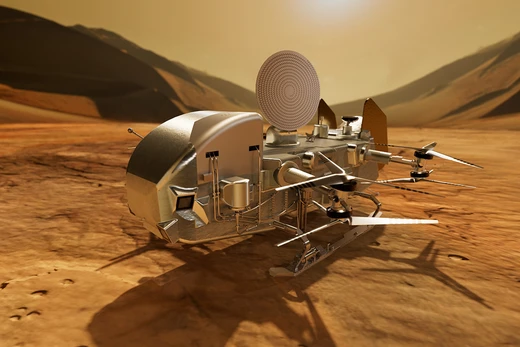
Dragonfly (Titan space probe)
NASA rotorcraft mission to study Titan's prebiotic chemistry.

Dragonfly is a NASA mission, still in development, that will send a robotic rotorcraft to Saturn's largest moon, Titan. Its goals are to investigate prebiotic chemistry and assess the potential for extraterrestrial life. The craft will be the first to achieve powered, fully controlled flight on a natural satellite, using vertical takeoffs and landings (VTOL) to hop between different sites on Titan's surface. The mission is slated for a July 2028 launch, with arrival at Titan expected in 2034.
Titan is a top priority for astrobiology and origin-of-life research because it is the only other body in the Solar System with a surface rich in complex carbon chemistry, covered in water ice, and likely harboring an internal liquid water ocean. The Dragonfly proposal was submitted to NASA's New Frontiers program in April 2017 by the Johns Hopkins Applied Physics Laboratory (APL). Out of twelve proposals, it was chosen as one of two finalists in December 2017 for further concept refinement. On 27 June 2019, NASA selected Dragonfly as the fourth New Frontiers mission. In April 2024, the mission received official confirmation and moved into its final development stages.
**Overview**
Dragonfly is an astrobiology mission designed to examine Titan's microbial habitability and prebiotic chemistry across multiple locations. It will use controlled flights and VTOL to travel between sites, sampling diverse geological settings. Titan is a compelling target because its surface holds abundant complex carbon-rich compounds, and both liquid water (temporarily) and liquid hydrocarbons can exist there, potentially creating a prebiotic primordial soup. If successful, Dragonfly will be the second rotorcraft to fly on a celestial body beyond Earth. The first was Ingenuity, an uncrewed helicopter that landed on Mars with the Perseverance rover on 18 February 2021 and achieved its first powered flight on 19 April 2021.
**History**
The initial idea for Dragonfly emerged from a dinner conversation between scientists Jason W. Barnes (University of Idaho, who previously proposed the AVIATR Titan aircraft) and Ralph Lorenz (Johns Hopkins APL). It took 15 months to develop into a detailed mission proposal. The principal investigator is planetary scientist Elizabeth Turtle, also at Johns Hopkins APL.
The mission builds on earlier studies of mobile aerial exploration on Titan, including the
- Mission type
- Astrobiology rotorcraft
- Target
- Titan (moon of Saturn)
- Launch date
- July 2028
- Arrival date
- 2034
- Operator
- NASA / Johns Hopkins Applied Physics Laboratory
- Cost
- Total lifecycle cost US$3.35 billion (as of April 2024)
- Known for
- First aircraft on Titan; first powered flight on a natural satellite
Quick Facts
- Names List
- New Frontiers 4
- Mission Type
- Titan rotorcraft
- Operator
- NASA / APL
- Website
- https: · dragonfly.jhuapl.edu
- Mission Duration
- 10 years (planned)nasa-20200925 / 3.3 years (Science phase)Turtle_2021
- Spacecraft Type
- Rotorcraft lander
- Manufacturer
- Applied Physics Laboratory
- Landing Mass
- ≈450 kgLorenz_2018a
- Power
- 70 watts (desired)Lorenz_2018a from an MMRTG
- Launch Date
- 5–25 July 2028 (planned)nasa-20241125
- Launch Rocket
- Falcon Heavynasa-20241125
- Launch Site
- Kennedy, LC-39A
Facts from the source article.
Lore & Background
Dragonfly was conceived during a dinner conversation between scientists Jason W. Barnes and Ralph Lorenz, and took 15 months to develop into a detailed mission proposal. The principal investigator is Elizabeth Turtle of the Johns Hopkins Applied Physics Laboratory. The mission builds on earlier studies of Titan aerial exploration, including the 2007 Titan Explorer Flagship study and the AVIATR airplane concept, as well as a 2000 rotorcraft proposal by Lorenz that used battery power recharged by a radioisotope source during the eight-Earth-day Titan night.
Dragonfly was proposed in April 2017 to NASA's New Frontiers program and was selected as one of two finalists in December 2017. On 27 June 2019, it was chosen as the fourth New Frontiers mission. After passing its preliminary design review in March 2023, the launch was delayed from June 2027 to July 2028 due to funding uncertainties. The mission was confirmed in April 2024 and moved to final development stages. Construction of the spacecraft began on 10 March 2026, and by June 2026 thermal-structural testing of the heat shield had been completed in New Mexico using Sandia's Solar Tower.
Dragonfly will use vertical takeoffs and landings (VTOL) to move between exploration sites, sampling diverse regions and geological contexts. It will carry an instrument suite to measure surface composition, atmospheric conditions, and geologic processes. If successful, it will be the second rotorcraft to fly on a celestial body other than Earth, after Ingenuity on Mars.
Reader's Guide
Dragonfly represents a significant step in planetary exploration, targeting Titan—the only extraterrestrial body in the Solar System with abundant, complex carbon-rich chemistry and a surface dominated by water ice, with an interior water ocean. This makes Titan a high-priority target for astrobiology and origin-of-life studies. The mission aims to assess microbial habitability and study prebiotic chemistry at various locations, potentially providing clues to how life may have arisen on early Earth.
The mission's use of a multi-rotor vehicle for controlled flights and VTOL operations is a novel approach to exploring a distant moon, allowing access to multiple sites that would be unreachable by a stationary lander or rover. Dragonfly builds on the legacy of the Huygens lander, which detected tholins—hydrocarbon compounds—on Titan in 2005. By measuring surface composition and atmospheric conditions, Dragonfly could reveal the specific compositions of solid hydrocarbon materials on Titan's surface, which remain essentially unknown.
Despite funding uncertainties and delays caused by the COVID-19 pandemic, which raised the total lifecycle cost to US$3.35 billion, Dragonfly has progressed through critical design review and begun full-scale construction. Its success would demonstrate the viability of rotorcraft for exploring other worlds with atmospheres, expanding the toolkit for future planetary missions.
Did You Know?
- Dragonfly was conceived during a dinner conversation between scientists Jason W. Barnes and Ralph Lorenz.
- The mission will make the first powered and fully controlled atmospheric flight on any natural satellite.
- Dragonfly's launch was delayed by one year in November 2023 due to funding uncertainties, with a new launch date set for July 2028.
- If successful, Dragonfly will be the second rotorcraft to fly on a celestial body other than Earth, after Ingenuity on Mars.
Why Titan, and Why Now?
Titan stands alone in our Solar System as the only world beyond Earth where carbon-rich chemistry is abundant, complex, and diverse, all set against a landscape dominated by water ice with a subsurface ocean of liquid water beneath. That combination means both transient liquid water and liquid hydrocarbons can coexist on the surface, creating conditions that scientists describe as a possible prebiotic primordial soup. Dragonfly was conceived precisely to exploit this unique setting. As an astrobiology mission, its core mandate is twofold: assess whether Titan's environment could support microbial life and document the prebiotic chemical reactions occurring across its surface. Rather than studying a single landing site, the probe is designed to fly between multiple locations, sampling diverse geological contexts and atmospheric conditions. Each powered flight opens a new window into how organic molecules interact in a world that may preserve chemical pathways relevant to the origin of life. In essence, Dragonfly turns Titan into a natural laboratory for asking one of science's deepest questions: how does chemistry cross the threshold into biology?
From a Dinner Table to a Flagship Mission
The story of Dragonfly began not in a conference room but over a dinner conversation between Jason W. Barnes, a physicist at the University of Idaho who had earlier championed the AVIATR airplane concept for Titan, and Ralph Lorenz of the Johns Hopkins Applied Physics Laboratory. What started as an informal exchange took roughly fifteen months to mature into a full mission proposal. Elizabeth Turtle, a planetary scientist at APL, would go on to serve as principal investigator. The concept did not emerge in a vacuum. It grew from a lineage of earlier Titan aerial studies, including a 2007 flagship study favoring a Montgolfier balloon, the AVIATR airplane idea considered for NASA's Discovery program, and a 2014 JPL rotorcraft study by Larry Matthies. Lorenz himself had sketched the battery-powered rotorcraft lander concept as early as 2000. The proposal entered NASA's New Frontiers competition in April 2017, survived a field of twelve to become one of two finalists in December of that year, and was formally selected as the program's fourth mission on June 27, 2019.
An Eight-Rotor Craft Built for a Thick Atmosphere
Dragonfly is, in the most literal sense, an aircraft: a multi-rotor vehicle equipped with eight rotor assemblies mounted on arms extending from a nearly four-meter fuselage. Its vertical takeoff and landing capability lets it hop from one exploration site to the next, carrying a full instrument suite that will measure surface composition, atmospheric state, and active geologic processes at each stop. Power comes from a radioisotope source that recharges onboard batteries during Titan's eight-Earth-day night, while the craft draws on stored energy for daytime flights. The vehicle also carries a high-gain antenna for communications back to Earth. Engineering validation has been rigorous: the entry probe's heat shield underwent thermal-structural testing at Sandia National Laboratories' Solar Tower in New Mexico, where hundreds of calibrated mirrors focused concentrated solar energy onto the unit. Notably, the test article had defects deliberately introduced, yet it still withstood the extreme thermal loads. The lander frame assembly, including its skids, power-system cover, and rotor arms, completed a month of structural testing before the fuselage was delivered for integration ahead of schedule.
The Long Road to a 2028 Launch
Dragonfly's path to the launch pad has been marked by both steady progress and external turbulence. The spacecraft passed its preliminary design review in March 2023, but the following November NASA postponed formal confirmation amid funding uncertainties, pushing the launch window a full year to July 2028. Confirmation finally came in April 2024, and by late November of that year the launch service award was announced: a SpaceX Falcon Heavy with a targeted window from July 5 to July 25, 2028. On April 25, 2025, the mission cleared its critical design review, officially opening the door to full-scale physical construction, which began on March 10, 2026. The 2025 federal government shutdown briefly raised concerns at Goddard Space Flight Center, where building closures and equipment consolidation were announced. NASA characterized the move as a pre-planned strategic consolidation and stated Dragonfly work would continue as excepted operations, though some staff worried about impacts on specialized testing labs. By June 2026, the team had completed heat-shield testing, measured the high-gain antenna's signal patterns in an APL space-simulation chamber, and delivered the fuselage for integration ahead of schedule.
Frequently Asked Questions
What is Dragonfly (Titan space probe)?
Dragonfly is a NASA-built autonomous rotorcraft designed to explore the surface of Saturn's moon Titan. It will hop between multiple landing sites using vertical takeoff and landing to study the moon's complex organic chemistry.
What is Dragonfly (Titan space probe)'s mission?
The probe's primary scientific goal is to investigate prebiotic chemical processes on Titan and evaluate whether conditions there could support or have supported extraterrestrial life. It will accomplish this by flying to dozens of distinct surface locations over its operational lifetime.
When does Dragonfly (Titan space probe) launch and arrive?
NASA has scheduled the launch for July 2028, with the craft expected to reach Titan roughly six years later in 2034. The total lifecycle budget stands at approximately 3.35 billion dollars as of 2024.
Why is Dragonfly (Titan space probe) a first?
It will be the first machine to achieve powered, fully controlled flight on a natural satellite anywhere in the solar system. No previous mission has attempted VTOL operations on a moon, and Titan's dense nitrogen atmosphere is what makes the feat possible.
Why does Dragonfly (Titan space probe) target Titan specifically?
Titan is the only known body besides Earth that has both a thick atmosphere and active surface liquid cycles, making it a prime analog for early-Earth conditions. Its rich inventory of organic molecules and liquid methane lakes give it top priority in origin-of-life research.
More in Astrobiology space missions 1-24
Spotted an error? Know more?
This is a living reference — every entry is fact-audited, and reader corrections feed straight into our audit queue. Suggest an edit · See this site's audit record