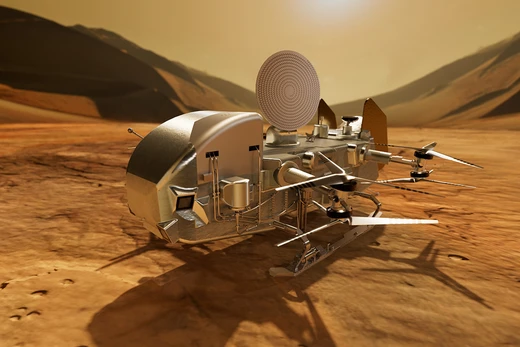
Breakthrough Enceladus mission
A privately funded concept to seek life on Enceladus.

Breakthrough Enceladus is a concept for a privately funded mission, led by Breakthrough Initiatives (founded by Yuri Milner), that would investigate whether life exists on Saturn’s moon Enceladus. If realized, it would be one of the first deep-space missions financed primarily by private sources.
The plan involves a flyby probe that would search for microbes in the water plumes shooting up from Enceladus’s warm subsurface ocean, which lies beneath an icy crust at the moon’s south pole. Research in *Geophysical Research Letters* suggests that crust is only two to five kilometers thick—much thinner than Europa’s, which is estimated at 19 to 25 kilometers—allowing the probe to use ice-penetrating radar to study the ocean below.
NASA has agreed to provide expert reviewers and feedback on the mission’s design. In 2018, Thomas Zurbuchen of NASA signed a Pre-Phase A partnership agreement with Pete Worden, executive director of the Breakthrough Initiatives, to jointly develop the mission concept. The probe's cost has not been publicly confirmed by the Breakthrough Initiatives; early speculation suggested around $60 million, but no official figure has been released. A comparable NASA-led effort would likely cost many times more and take over two decades.
Writing for NBC News, *Discover* magazine editor-in-chief Corey S. Powell noted the mission could “rewrite the rules of space exploration” by being the first to find evidence of complex non-Earth life in the Solar System, and that it is “riskier than anything NASA would attempt on its own.” Planetary scientist Christopher McKay of NASA Ames Research Center compared the project to Magellan’s circumnavigation and Richard Byrd’s polar expeditions, saying it “would create a new paradigm for exploration.” No updates have been published since 2018.
- Estimated cost
- Not publicly confirmed (early speculation ~$60 million)
- Partnership
- Pre-Phase A agreement signed with NASA on 13 September 2018, with Pete Worden (executive director of Breakthrough Initiatives)
Lore & Background
Breakthrough Enceladus was conceived as a privately funded astrobiology mission by Breakthrough Initiatives, founded by Yuri Milner. Its goal is to assess the possibility of life on Saturn's moon Enceladus. The mission proposes a flyby to search for microbes in the plumes of water ejected from Enceladus's warm ocean, which lies under an ice crust estimated to be two to five kilometers thick. This ice crust is thinner than Europa's, potentially allowing the use of ice-penetrating radar to investigate the ocean's contents.
Reader's Guide
The significance of Breakthrough Enceladus lies in its potential to rewrite the rules of space exploration, as noted by Corey S. Powell, editor-in-chief of Discover magazine. It could be the first mission to find proof of complex non-Earth life in the Solar System, taking risks that NASA would not attempt on its own. Christopher McKay, a planetary scientist at NASA Ames Research Center, compared it to Magellan's circumnavigation and Richard Byrd's pole expeditions, stating it would create a new paradigm for exploration. The privately funded probe is estimated to cost $60 million and take a decade to build, whereas a NASA government-funded approach could take over two decades and cost 15 times as much. On 13 September 2018, Thomas Zurbuchen of NASA signed a Pre-Phase A partnership agreement with Breakthrough Prize Foundation's chairman Pete Worden to jointly create the mission concept and plan. No updates have been published since 2018.
Did You Know?
- Breakthrough Enceladus is a concept for a privately funded deep space mission—no such mission has yet been completed.
- The mission proposes to search for microbes in the plumes of water ejected from Enceladus's warm ocean.
- Enceladus's ice crust is estimated to be two to five kilometers thick, thinner than Europa's ice layer.
- A NASA government-funded approach could take over two decades and cost many times more than the private concept's speculative budget.
The Ocean Beneath the Ice
Breakthrough Enceladus is designed as a flyby mission with a singular scientific ambition: to detect microbial life within the water plumes erupting from Saturn's moon Enceladus. Beneath a shell of ice on the moon's south pole lies a warm ocean, and the mission would sample the jets of water shooting upward through cracks in that shell. According to research published in Geophysical Research Letters, Enceladus's ice crust measures roughly two to five kilometers in thickness. That is dramatically thinner than the ice layer covering Europa, which is estimated at nineteen to twenty-five kilometers. This relative thinness opens a tantalizing possibility: a probe equipped with ice-penetrating radar might be able to probe the contents of the Enceladian ocean directly. The entire concept rests on the idea that if life exists in that hidden ocean, the plumes offer a natural sampling opportunity without the need for a full landing or drilling operation.
A New Model for Deep Space
Perhaps the most groundbreaking aspect of Breakthrough Enceladus is not where it goes, but who pays for it and how. Backed by Breakthrough Initiatives, the venture founded by investor Yuri Milner, the project would become the first privately funded deep space mission in history. The estimated price tag sits at sixty million dollars, with a construction timeline of roughly ten years. By contrast, a comparable government-funded effort through NASA would require more than two decades and cost fifteen times as much. This dramatic difference in both budget and schedule is what makes the model so striking. NASA's role in the partnership is advisory rather than financial: the agency commits to providing expert reviewers and design feedback. The formal framework was established on September 13, 2018, when NASA's Thomas Zurbuchen signed a Pre-Phase A partnership agreement alongside Pete Worden, chairman of the Breakthrough Prize Foundation, to jointly develop the mission concept and plan.
Echoes of Great Explorations
The comparisons drawn to Breakthrough Enceladus reveal how its proponents view the mission's place in the broader story of human exploration. Corey S. Powell, editor-in-chief of Discover magazine and writing for NBC News, called the project a rule-rewriter for space exploration, noting its potential to deliver the first evidence of complex non-Earth life anywhere in the Solar System. He also acknowledged that the endeavor is riskier than anything NASA would greenlight independently. Christopher McKay, a planetary scientist at NASA's Ames Research Center, reached further back in history, likening the mission to Magellan's circumnavigation of the globe and to Richard Byrd's polar expeditions. In his view, such a voyage would create an entirely new paradigm for exploration. These analogies frame the project not as a routine scientific survey but as a bold, almost reckless leap into the unknown, the kind of undertaking that redefines what is considered possible.
From Agreement to Silence
The documented history of Breakthrough Enceladus is, by any measure, brief. The project's most concrete milestone to date is the Pre-Phase A partnership agreement signed on September 13, 2018, between NASA's Thomas Zurbuchen and Pete Worden of the Breakthrough Prize Foundation. That document set the stage for the two parties to jointly shape the mission concept and plan, with NASA contributing expert review and design feedback while Breakthrough Initiatives provided the funding. The construction phase, if it proceeds, is estimated to take approximately a decade. Yet since that 2018 agreement, no further public updates have been published. The project exists in a state of quiet uncertainty, its future dependent on whether the private funding pipeline holds and whether the technical challenges of sampling Enceladus's plumes can be solved within the proposed budget and timeline. For now, the mission remains a promise rather than a reality.
Frequently Asked Questions
What is the Breakthrough Enceladus mission?
It is a privately financed spacecraft concept designed to investigate whether microbial life exists on Saturn's moon Enceladus. The project is spearheaded by Breakthrough Initiatives, the venture backed by investor Yuri Milner.
Who leads the Breakthrough Enceladus mission?
Breakthrough Initiatives, the organization founded by Yuri Milner, takes the lead on the project. Pete Worden, who serves as the group's executive director, is a key figure on the team.
How does the Breakthrough Enceladus probe search for life?
The concept calls for a flyby spacecraft that would sample the water geysers erupting from Enceladus's south-polar region. Those plumes rise from a liquid ocean trapped beneath an ice shell estimated at just two to five kilometers thick.
How much would the Breakthrough Enceladus mission cost?
No official budget has been published, but early estimates floated around the sixty-million-dollar mark. As a privately funded effort, it would stand apart from most government-led deep-space programs.
What is the Breakthrough Enceladus mission's status with NASA?
In September 2018, the team signed a Pre-Phase A agreement with NASA, formally kicking off the early engineering and design phase. The mission remains a concept rather than a fully approved flight.
More in Astrobiology space missions 1-24
Spotted an error? Know more?
This is a living reference — every entry is fact-audited, and reader corrections feed straight into our audit queue. Suggest an edit · See this site's audit record