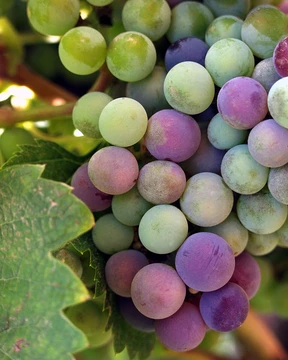
Wine production in Odesa Oblast
Ukraine's largest wine region, with ancient roots and modern protected designations.
Odesa Oblast is the largest wine-growing region in Ukraine, located on the northwestern Black Sea coast from the Danube River to the Tylihul Estuary. As of 2018, wine production in the region covered 26.29 thousand hectares, accounting for 60.44% of Ukraine's total vineyard area. The region includes the Black Sea and Bessarabian wine regions, and its winemaking history dates back to ancient times.
- Area of vineyards 2018
- 26.29 thousand hectares
- Share of ukraine vineyards 2018
- 60.44%
- Grape production 2018
- 2,966,984.57 quintals
- Largest wine product share 2018
- grape must (57.88%)
- Second largest wine product share 2018
- wine ≤15% alcohol (24.08%)
- Third largest wine product share 2018
- sparkling wine from fresh grapes (10.77%)
- Legal entities growing grapes 2016
- 528
- Private enterprises growing grapes 2016
- 55
- Legal entities producing grape wine 2016
- 152
- Entrepreneurs producing grape wine 2016
- 4
Lore & Background
Winemaking in Odesa Oblast predates Greek colonization, when local inhabitants already supported the craft. It became widespread during Greek colonization and continued under Roman influence after the conquest of Dacia in 105–106. Roman colonists who remained after 271 passed on grape breeding and winemaking methods to the native population. The first written mention from the late modern era is a 1600–1625 letter from Voivode Stefan Chmielecki presenting a vineyard. After the capture of Ochakov in 1788, Prince Potemkin provided vineyards to colonists and Ukrainians in several settlements. In the 19th century, Armenian, Bulgarian, German, Greek, Ukrainian, Moldovan, and Swiss settlers contributed to the region's winemaking, earning it the description 'America of the Old World.' The first vineyard in Odesa was founded in 1798 by a retired major of the Greek battalion, using seedlings from Ackerman, France, and Spain. By 1860, Odesa alone produced 32,000 barrels of wine. The years 1885–1910 were the most productive, with vineyard area reaching 7,000 hectares. After the Great War and Russian Revolution, plantations were massively destroyed, but winemaking was partially restored from the mid-1920s until 1936. The 1960s saw rapid development, with Odesa's vineyards nearly equaling those of Moldova. At the end of the 1980s, the region produced 3.2 million litres of wine and over 10 million bottles of champagne. Perestroika-era prohibition led to mass destruction, with losses estimated at almost 1 billion dollars from 1985–1990. Over the past thirty years, vineyard area decreased by more than 2.5 times, and over 50,000 hectares were uprooted. Since 2023, wines from Odesa Oblast have geographical indication protection in Ukraine, including Chabag, Acha-Abag, Prydunaiska Bessarabia, Yapluh, and Frumushika Valley.
Reader's Guide
Odesa Oblast's significance lies in its status as Ukraine's dominant wine region, producing over 60% of the nation's wine grapes. Its favorable climate—humid and temperate with maritime and continental features, mild winters, hot summers, and 340–470 mm of annual precipitation—supports viticulture across 13 districts. The region's history reflects a continuous thread of winemaking from ancient Greek and Roman times through waves of 19th-century immigration, which brought diverse techniques and varieties. The 1885–1910 period marked a golden age, with Odesa importing and exporting substantial quantities of wine. The 20th century saw dramatic swings: destruction during war and revolution, recovery under NEP, a post-WWII decline, then a 1960s boom that rivaled Moldova and Crimea. The 1985 perestroika prohibition caused catastrophic losses, and subsequent decades saw massive vineyard uprooting. Despite this, the region's legacy endures through modern geographical indications like Shabo's Chabag and Acha-Abag, and the Prydunaiska Bessarabia designation. The region's wine production today is dominated by grape must (57.88%), followed by wine under 15% alcohol (24.08%) and sparkling wine (10.77%). The area's natural conditions—latitude 45°11' to 48°12' north, 2200 sunlight hours annually, and a growing season of 168–210 days—remain favorable for continued wine production.
Did You Know?
- Over 50,000 hectares of vineyards in Odesa Oblast have been uprooted in the past thirty years.
- Since 2023, wines from Odesa Oblast have geographical indication protection, including Chabag, Acha-Abag, and Frumushika Valley.
More in Winemaking 1-24
Spotted an error? Know more?
Reader corrections go straight into our review queue. Suggest an edit · How this site is sourced