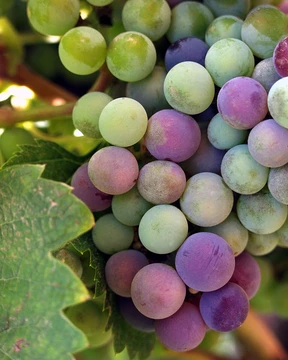
Co-fermentation
Co-fermentation locks in a blend before fermentation begins.
Co-fermentation is the practice in winemaking of fermenting two or more fruits simultaneously, as opposed to blending separate wine components after fermentation. While it could theoretically apply to any mixture of grape varieties or other fruits, it is today most common for red wines produced from a mix of red and a smaller proportion of white grape varieties.
- Common proportion in côte-rôtie
- 5–10% Viognier (up to 20% allowed)
- Allowed maximum viognier in côte-rôtie
- 20%
- Classical region still widely practicing
- Côte-Rôtie (northern Rhône)
Lore & Background
Co-fermentation is an old practice that traces back to the now uncommon field blends (mixed plantations of varieties) in vineyards. In regions such as Rioja and Tuscany, a small proportion of white grapes was historically used to soften red wines that tended to have harsh tannins under the winemaking methods of the time. It is believed the practice was also adopted because it was found empirically to give deeper and better colour to wines, due to improved co-pigmentation from components in white grapes.
Today, the only classical Old World wine region where co-fermentation is still widely practiced is the Côte-Rôtie appellation of northern Rhône. There, the red variety Syrah and the aromatic white variety Viognier must be co-fermented if Viognier is used. The reason Viognier has been retained in Côte-Rôtie—while white grapes like Marsanne and Roussanne have largely disappeared from red Hermitage and other red Rhône wines where they are allowed—is that it adds signature floral aromas to the wines.
The popularity of Côte-Rôtie has led to New World interpretations, most notably Australian Shiraz-Viognier blends, which are also produced by co-fermentation. Co-fermentation is also performed in situations where field blend varietals are indistinguishable from each other, necessitating the practice.
Reader's Guide
Co-fermentation is significant because it represents a traditional winemaking technique that has persisted in only one classical region—Côte-Rôtie—while largely disappearing from others like Rioja and Tuscany. Its legacy is tied to the empirical discovery that co-fermenting white grapes with red can improve colour through co-pigmentation and soften harsh tannins. In Côte-Rôtie, the practice is mandatory if Viognier is used, and it contributes distinctive floral aromas that have become a signature of the appellation. This success inspired New World winemakers, particularly in Australia, to adopt co-fermentation for Shiraz-Viognier blends. However, the technique is not widely practiced elsewhere because it locks in a specific blend at the start of fermentation, reducing the winemaker's ability to adjust the final cuvée. Co-fermentation also remains necessary in cases where field blend varietals cannot be separated. Its legacy is thus one of a historic method that survives in a niche but influential form, valued for the unique sensory qualities it imparts.
Did You Know?
- Co-fermentation differs from blending because it ferments two or more fruits together rather than combining separate wines after fermentation.
- In Côte-Rôtie, Syrah and Viognier must be co-fermented if Viognier is used, with 5–10% Viognier being common.
- The practice was historically used in Rioja and Tuscany to soften harsh tannins in red wines.
- Co-fermentation is believed to give deeper colour to wines due to improved co-pigmentation from white grape components.
The Biochemical Engine of Fermentation
The core transformation in winemaking is the conversion of grape juice sugars into ethanol, driven by yeast activity. When active yeasts encounter the must, phosphates bond to sugar molecules, and six-carbon sugars are cleaved into three-carbon fragments that undergo a cascade of rearrangement reactions. During this anaerobic sequence, a carboxylic carbon atom is expelled as carbon dioxide, while the remaining structure becomes acetaldehyde. In the absence of oxygen, that acetaldehyde is then reduced into ethanol. A small fraction, however, takes an oxidative path and becomes acetic acid — and when it accumulates beyond acceptable levels, it produces the wine fault known as volatile acidity, or vinegar taint. The entire primary fermentation typically spans five to fourteen days, with a possible secondary phase adding another five to ten days. Yeast activity ultimately ceases either when all available sugar has been metabolized or when alcohol concentration reaches roughly fifteen percent by volume, a threshold strong enough to arrest the enzymatic machinery of nearly every yeast strain. The spent cells settle as sediment called lees at the bottom of the vessel.
Yeast Selection and the Question of Control
Winemakers face a fundamental choice between ambient yeasts — the wild populations naturally residing on grape skins (the so-called bloom), in vineyards, and in cellar environments — and cultured yeasts that are isolated, dried, and deliberately inoculated. Wild genera encountered in winemaking include Candida, Klöckera/Hanseniaspora, Metschnikowiaceae, Pichia, and Zygosaccharomyces. These organisms can yield distinctive, high-quality wines, yet their behavior is unpredictable and they may introduce off-traits or even spoilage. Traditional European producers often champion ambient fermentation as an expression of regional terroir. In contrast, most modern winemakers favor the predictability of cultured strains, predominantly Saccharomyces cerevisiae, within which several hundred distinct strains allow precise modulation of fermentation vigor and flavor expression. The choice of strain is a major driver of wine diversity even within a single grape variety. Increasingly, alternative non-Saccharomyces yeasts are being employed to layer additional complexity. Once a winery has operated for years, active dry yeasts tend to outcompete the naturally occurring strains, narrowing the microbial diversity in spontaneous fermentations.
From Boiling Must to Mapped Pathways
The earliest human awareness of fermentation likely came from observing what appeared to be a vigorous boiling in the must — the visible release of carbon dioxide as yeast metabolized sugars under anaerobic conditions. The Latin root fervere, meaning to boil, gives the word fermentation its etymological foundation, and early references to the term in winemaking contexts described precisely this bubbling phenomenon. For centuries the underlying mechanism remained a mystery until the mid-nineteenth century, when Louis Pasteur established the critical link between living yeast cells and the chemical conversion of sugar into alcohol, identifying yeast as both catalyst and mediator in a series of reactions. A deeper molecular understanding arrived in the early twentieth century with the discovery of the Embden–Meyerhof–Parnas pathway by Gustav Embden, Otto Fritz Meyerhof, and Jakub Karol Parnas, which illuminated the complex sequence of biochemical steps by which sugar is ultimately converted to alcohol. Together, these milestones transformed fermentation from an observed kitchen phenomenon into a rigorously understood metabolic process.
Beyond Ethanol — Flavor, Aroma, and Faults
Fermentation produces far more than ethanol and carbon dioxide. The metabolic activity of yeasts on amino acids and sugar breakdown generates a wide array of volatile compounds — aldehydes, ethyl acetate, esters, fatty acids, fusel oils, hydrogen sulfide, ketones, and mercaptans — alongside non-volatile substances such as glycerol, acetic acid, and succinic acid. Yeast also releases glycoside hydrolase, an enzyme that breaks down flavor precursors: aliphatic compounds that interact with oak, benzene derivatives, monoterpenes responsible for the floral notes in Muscat and Traminer, norisoprenoids contributing spice character to Chardonnay, and various phenols. Certain strains further produce volatile thiols that deliver the gooseberry-like fruitiness associated with Sauvignon Blanc. On the negative side, the same chemistry can produce faults: excessive acetic acid creates vinegar taint, and the risk of a stuck fermentation — where yeast activity halts before sugar is fully consumed — remains a persistent concern. Managing temperature, oxygen exposure, and nutrient supply of carbon, nitrogen, sulfur, phosphorus, vitamins, and minerals is essential to steering the process toward desirable outcomes.
Frequently Asked Questions
Who is Co-fermentation?
Co-fermentation is the winemaking technique of throwing two or more grape varieties (or other fruits) into a single fermenting vessel at the same time, rather than making separate wines and marrying them later. In modern practice it most often shows up in red wines where a modest share of white grapes is added to the red crush.
What's Co-fermentation's main role in the winery?
Its job is to let the different varieties interact chemically and aromatically throughout the entire fermentation, so the finished wine reads as one unified expression instead of a post-fermentation marriage. In practical terms, the blend is locked in before the yeast even starts working.
Where does Co-fermentation shine most famously?
The Côte-Rôtie appellation in the northern Rhône is the classical region still widely practicing this method, pairing Syrah with a smaller share of Viognier. It remains the go-to example whenever the technique comes up in serious wine conversation.
What's the Viognier ratio rule in Côte-Rôtie?
Producers typically include 5–10% Viognier alongside the Syrah, and appellation regulations cap the white-grape portion at 20% maximum. That modest white component is what lends the red wine extra aromatic lift and texture.
How is Co-fermentation different from just blending two finished wines?
With co-fermentation the fruit varieties are locked together in the tank from the very start, so extraction, tannin development, and aroma formation all happen in concert. Blending, by contrast, is a post-fermentation decision where two already-complete wines are simply mixed together.
More in Winemaking 1-24
Spotted an error? Know more?
Reader corrections go straight into our review queue. Suggest an edit · How this site is sourced