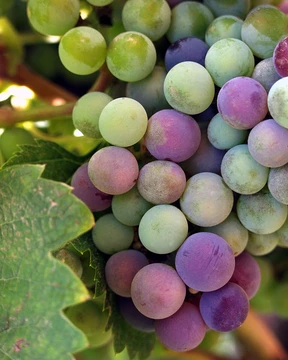
Carbonic maceration
Whole grapes fermented in carbon dioxide before crushing.
Carbonic maceration is a winemaking technique in which whole grapes are fermented in a carbon dioxide rich environment before crushing. It is often associated with the French wine region of Beaujolais. Unlike conventional alcoholic fermentation, which crushes grapes to free juice and pulp and uses yeast to convert sugar into ethanol, carbonic maceration ferments most of the juice while it is still inside the grape. Grapes at the bottom of the vessel are crushed by gravity and undergo conventional fermentation. The resulting wine is fruity with very low tannins, ready to drink quickly but lacking the structure for long-term aging.
- Associated region
- Beaujolais, France
- Grape variety
- Gamay
- Other regions
- Rioja Alavesa and Jumilla (Spain); Languedoc and Rhône (France); California (USA)
- Other grape varieties
- Carignan, Valdiguié
- Minimum aging period example
- Less than six weeks (Beaujolais nouveau)
- Early study by
- Louis Pasteur (1872)
Lore & Background
The process of carbonic maceration occurs naturally in a partial state without deliberate intervention and has occurred in some form throughout history. If grapes are stored in a closed container, gravity crushes those at the bottom, releasing juice. Ambient yeasts on the grape skins start conventional ethanol fermentation, and carbon dioxide released as a by‑product pushes out oxygen, creating an anaerobic environment for uncrushed clusters to undergo carbonic maceration. Early documented studies were conducted by French scientist Louis Pasteur, who noted in 1872 that grapes in an oxygen‑rich environment before crushing produced wines of different flavors than those in a carbon dioxide‑rich environment, because fermentation had already started inside the individual grape clusters before yeasts were introduced.
The use of carbonic maceration is closely associated with Beaujolais nouveau wine from the Gamay grape in Beaujolais and some wines in the Rioja Alavesa and Jumilla areas of Spain. The Gamay grape lends itself to simple, fruity wines, and Beaujolais winemakers have created a unique identity based on this style. Producers in other parts of France and in the New World have frequently utilized carbonic maceration for their own Gamay production or with other grape varieties. Winemakers in the Languedoc and Rhône regions sometimes employ the technique on coarse, tannic grapes like Carignan, especially if they are to be blended. In California, the process is used with Valdiguié grapes, producing what is labeled a 'Nouveau' wine. The process is almost always used with red wine production, as some flavor compounds from volatile phenols tend to form undesirable flavors with white wine grape varieties.
Reader's Guide
Carbonic maceration is notable for producing wines that are fruity, low in tannins, and ready to drink quickly, exemplified by Beaujolais nouveau, where the period between picking and bottling can be less than six weeks. The technique creates an anaerobic environment by pumping carbon dioxide into a sealed container filled with whole grape clusters. The carbon dioxide permeates the grape skins and stimulates fermentation at an intracellular level, with ethanol produced as a by‑product. Studies have shown that other unique chemical reactions take place that have a distinctive effect on the wine.
Semi‑carbonic maceration, where grapes undergo a short period of carbonic maceration followed by conventional yeast fermentation, is the process used in producing Beaujolais nouveau wines. Historically, most wines were treated to some form of semi‑ or partial carbonic fermentation, depending on the shape and size of the vessel; the deeper the vessel, the greater the proportion of grapes exposed to an anaerobic environment from carbon dioxide released by crushed grapes at the bottom. Carbonic maceration is distinct from 'whole bunch fermentation' common in Burgundy Pinot noir production, where whole clusters including stems are fermented before crushing, building a large cap of grape skins with pathways created by stems that allow juice to flow more evenly through caps, increasing skin contact or maceration.
Carbonic maceration techniques have recently been adapted to coffee processing. Ripe coffee cherries are placed in a hermetic stainless steel tank and left to undergo anaerobic fermentation, bringing out intense aromas with a taste profile akin to red wine and whisky, and usually producing a full‑body cup. Known varieties processed with semi‑carbonic maceration are Red and Yellow Catuai.
The Intracellular Fermentation Process
Carbonic maceration fundamentally reimagines where fermentation begins. Rather than crushing grapes to release juice and letting yeast convert sugars into ethanol externally, this technique keeps the berry intact and initiates the chemical transformation from within. A sealed vessel is filled with whole grape clusters, and carbon dioxide is pumped in to displace oxygen, establishing an anaerobic atmosphere. The CO2 gas seeps through the grape skins and triggers fermentation at the intracellular level, meaning the entire biochemical cascade unfolds inside each individual berry. Ethanol emerges as a by-product, but research indicates that additional unique chemical reactions occur during this sealed, gas-rich process, imparting distinctive characteristics to the finished wine. Grapes resting at the bottom of the vessel, however, are crushed by the weight of those above them and undergo more conventional fermentation. The resulting wine is notably fruity with very low tannin levels, ready to enjoy quickly but lacking the structural backbone needed for long-term aging. In extreme cases like Beaujolais nouveau, the window from harvest to bottle can shrink to under six weeks.
A Process Older Than Its Name
Long before winemakers deliberately engineered carbonic maceration, the process was happening naturally in wine cellars across centuries. When whole grape clusters were stored in closed wooden containers, gravity would crush the berries at the bottom, releasing juice. Ambient yeasts living on the grape skins would then interact with those sugars, kicking off conventional ethanol fermentation. The carbon dioxide released as a by-product, being denser than oxygen, would push the oxygen out through tiny gaps between wooden planks. This inadvertently created a mostly anaerobic pocket for the uncrushed clusters above, nudging them into a partial carbonic state. The depth and shape of the vessel determined how many grapes benefited from this accidental anaerobic exposure. The first documented scientific observations of the phenomenon came from Louis Pasteur in 1872. The French scientist noted that grapes kept in an oxygen-rich environment before crushing produced wines with markedly different flavors compared to those held in a carbon dioxide-rich setting. His key insight was that fermentation had already begun within the individual grape clusters before any external yeasts were introduced during the conventional process.
Regional Identity and Global Adaptation
No grape variety and wine region are more tightly linked to carbonic maceration than Gamay in Beaujolais. The grape's natural tendency toward simple, fruity profiles made it an ideal candidate, and Beaujolais winemakers built an entire regional identity around this distinctive style. The technique also found a home in Spain's Rioja Alavesa and Jumilla areas. Beyond these core regions, producers throughout France and the New World have adopted the method for their own Gamay lots or with other varieties. In the Languedoc and Rhône, winemakers sometimes apply carbonic maceration to coarse, tannic grapes such as Carignan, particularly when those grapes are destined for blending with other varieties to soften their edge. California has embraced the process with Valdiguié grapes, producing wines marketed under the Nouveau label. One important limitation exists: the technique is almost exclusively reserved for red wine production. This is because certain flavor compounds generated by volatile phenols during the process tend to create undesirable taste profiles when applied to white wine grape varieties, making the method a poor fit for lighter, aromatic whites.
Beyond the Grape: Coffee and Related Techniques
Carbonic maceration's influence has extended well beyond the wine cellar. In recent years, the technique, particularly semi-carbonic maceration, has been adapted to coffee processing. Ripe coffee cherries are placed in hermetic stainless steel tanks where they undergo anaerobic fermentation. The result is a cup with intense aromas and a taste profile that draws comparisons to red wine and whisky, typically delivering a full-bodied finish. Varieties such as Red and Yellow Catuai have been processed using this method, and details of the fermentation approach have begun appearing in specialty coffee publications. In the wine world itself, semi-carbonic maceration, where a short carbonic phase is followed by conventional yeast fermentation, is the standard approach for Beaujolais nouveau. It is also worth distinguishing carbonic maceration, sometimes called whole grape fermentation, from whole bunch fermentation used in Burgundy for Pinot noir. The latter involves fermenting entire clusters including stems before crushing, building a large cap of skins with stem-created pathways that allow juice to flow more evenly, increasing skin contact and maceration.
Frequently Asked Questions
What is Carbonic maceration and how does it differ from standard fermentation?
Carbonic maceration is a technique in which whole, uncrushed grapes are submerged in a CO₂-rich atmosphere and ferment their own juice internally before any crushing takes place. This stands in contrast to conventional winemaking, where grapes are crushed first to release juice that yeast then converts into alcohol.
Which grape and region is Carbonic maceration most famously linked to?
It is most strongly associated with the Gamay grape in France's Beaujolais region, where it is the signature method behind the light, fruity wines released as Beaujolais nouveau. The technique has also been adopted in parts of Spain (Rioja Alavesa, Jumilla), southern France (Languedoc, Rhône), and California, often with varieties such as Carignan or Valdiguié.
How does fermentation actually proceed inside the tank?
Grapes at the top of the vessel ferment whole within the CO₂ environment, while those at the bottom are crushed by their own weight and undergo conventional yeast-driven fermentation. The net effect is that most sugar-to-alcohol conversion happens inside the intact berry skin rather than in free juice.
What does a carbonic-macerated wine taste like, and how long can it be kept?
The resulting wine is characteristically fruity, with very low tannin levels and a light body that makes it pleasant to drink right away. Because of that low tannin structure it lacks real aging potential; Beaujolais nouveau, for example, is intended to be consumed within less than six weeks of release.
Who first studied this process, and why does it matter in winemaking history?
Louis Pasteur documented the phenomenon as early as 1872, long before it became a deliberate commercial technique. Its lasting importance is that it gives winemakers a reliable path to approachable, fruit-forward reds quickly—a profile that became central to Beaujolais's identity and later spread to other regions seeking similar styles.
More in Winemaking 1-24
Spotted an error? Know more?
Reader corrections go straight into our review queue. Suggest an edit · How this site is sourced