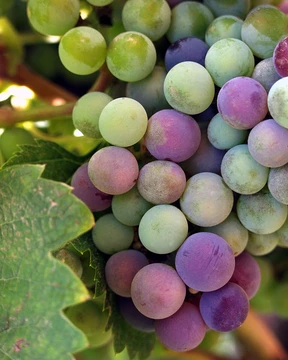
Sélection de Grains Nobles
French term for wines from noble-rot grapes, highest Alsace late-harvest category.
Sélection de Grains Nobles (SGN) translates from French as "selection of noble berries" and designates wines crafted from grapes that have been affected by noble rot. These are sweet dessert wines known for their rich, concentrated flavours. The term was first applied to wines from Alsace, where a legal definition was established in 1984, though it also appears in other French wine regions like the Loire.
In Alsace, SGN represents the highest official category for late harvest wines, with Vendange Tardive being the level below it. Only four "noble varieties" may carry the SGN or Vendange Tardive designation: Gewürztraminer, Pinot Gris, Riesling, and Muscat. In 2001, the minimum must weight requirements for SGN in Alsace were raised to 18.2% potential alcohol for Gewürztraminer and Pinot Gris, and 16.4% for Riesling and Muscat. These requirements make SGN roughly equivalent to a German Beerenauslese, but Alsace wines tend to have slightly higher alcohol levels, resulting in residual sugar that is often a little lower than in German wines, especially for Riesling and Muscat.
On rare occasions, the designation Quintessence de Grains Nobles (QGN) appears for wines that significantly exceed the minimum SGN requirements. Unlike the German Trockenbeerenauslese (TBA), QGN is not an official designation, but it can be thought of as the Alsatian equivalent of a high-grade TBA. The term was invented in 1983 by Domaine Weinbach for an exceptional cuvée from that vintage, and while still used primarily by Weinbach, it has been adopted by a few other producers, including Marcel Deiss.
In the Loire Valley, the SGN designation usually indicates extra-sweet wines produced by the region's so-called "sugar hunters." Often, the same producer will offer another wine from the same appellation with less residual sugar and no SGN label. The SGN designation can be used in the appellations Coteaux du Layon and Coteaux de l'Aubance, where it requires the grape must to have a minimum sugar content of 294 grams per liter, compared to the basic levels of 221 or 230 grams per liter, respectively.
- Alsace legal definition introduced
- 1984
- Minimum must weight for gewürztraminer a
- 18.2% potential alcohol
- Minimum must weight for riesling and mus
- 16.4% potential alcohol
- Noble varieties allowed in alsace
- Gewürztraminer, Pinot gris, Riesling, Muscat
- Loire minimum sugar content for sgn (cot
- 294 grams per liter
- Basic sugar level in those loire appella
- 221 or 230 grams per liter
Lore & Background
In Alsace, SGN is the highest official category for late harvest wines, with the step below called Vendange tardive. In 2001, the minimum must weight requirements for SGN in Alsace were increased to 18.2% for Gewürztraminer and Pinot gris, and 16.4% for Riesling and Muscat, expressed as potential alcohol. Only these four 'noble varieties' may carry the SGN or Vendange tardive designation. These requirements make SGN roughly equivalent to a German Beerenauslese, but the Alsace style tends to favour slightly higher alcohol levels, which means the residual sugar often is a little lower than in German wines, especially for Riesling and Muscat.
On rare occasions, the designation Quintessence de Grains Nobles (QGN) is seen for wines that significantly exceed the minimum requirements for SGN wines. Unlike the German designation Trockenbeerenauslese (TBA), QGN is no official designation, but it could be thought of as the Alsatian equivalent of a high-grade TBA. The term was invented in 1983 by Domaine Weinbach to describe an exceptional cuvee of that year's vintage, and while still used primarily by Weinbach, it has been adopted by a few other producers, including Marcel Deiss.
In the Loire valley, the designation SGN usually denotes wines that are extra sweet, produced by one of the region's so-called 'sugar hunters'. Often, the same producer will have another wine from the same appellation with less residual sugar without the SGN designation. The SGN designation can be used in the appellations Coteaux du Layon and Coteaux de l'Aubance, and in both cases this requires the grape must to have a minimum sugar content of 294 grams per liter rather than the basic level of 221 or 230 grams per liter respectively.
Reader's Guide
Sélection de Grains Nobles represents a pinnacle of sweet winemaking in France, particularly in Alsace where it was first legally defined in 1984. Its significance lies in its strict requirements: only four noble varieties—Gewürztraminer, Pinot gris, Riesling, and Muscat—may carry the designation, and the must weights are set high (18.2% potential alcohol for the first two, 16.4% for the latter two). This places SGN roughly on par with German Beerenauslese, though Alsace wines typically achieve slightly higher alcohol and thus lower residual sugar. The term's legacy extends to the Loire, where it is used by 'sugar hunters' in Coteaux du Layon and Coteaux de l'Aubance for wines with a minimum sugar content of 294 grams per liter, far above the appellation's basic levels. The rare, unofficial Quintessence de Grains Nobles, coined by Domaine Weinbach in 1983, further underscores the pursuit of extreme concentration, serving as an Alsatian counterpart to high-grade Trockenbeerenauslese. SGN thus endures as a marker of exceptional botrytized wines, balancing tradition with rigorous quality standards.
Did You Know?
- SGN stands for 'Sélection de Grains Nobles', French for 'selection of noble berries'.
- The legal definition for SGN in Alsace was introduced in 1984.
- Only four grape varieties may carry the SGN designation in Alsace: Gewürztraminer, Pinot gris, Riesling, and Muscat.
- The term Quintessence de Grains Nobles was invented in 1983 by Domaine Weinbach.
More in Winemaking 1-24
Spotted an error? Know more?
Reader corrections go straight into our review queue. Suggest an edit · How this site is sourced