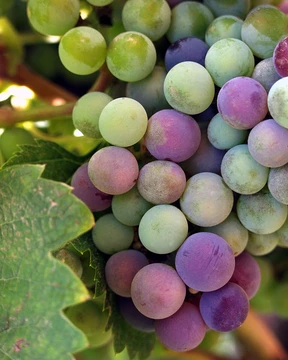
Must
Freshly crushed grape juice, first step in winemaking.
Must is the name for fruit juice—most often from grapes—that has been freshly crushed and still contains the skins, seeds, and stems. The solid part of this mixture is called pomace, and it usually accounts for between 7 and 23 percent of the must’s total weight. Producing must is how winemaking begins. Because it contains a high level of glucose, generally between 10 and 15 percent, must is also used as a sweetener in many different cooking traditions. The word comes from the Latin phrase *vinum mustum*.
- Pomace weight percentage
- 7–23%
- Glucose content
- 10–15%
- Minimum maturation for pdo balsamic vine
- 12 years
- Minimum maturation for pgi balsamic vine
- 60 days
- Andalusian mosto abv
- 9–12.5%
- Andalusian mosto fermentation duration
- approximately 40 days
Lore & Background
The length of time the pomace stays in the juice is critical for the final character of the wine. When the winemaker judges the time to be right, the juice is drained off the pomace, which is then pressed to extract the retained juice. Yeast is added to begin fermentation, while the pomace is often returned to the vineyard as fertilizer. A portion of unfermented must may be kept as Süssreserve to add sweetness before bottling. Some winemakers create a second batch of wine from used pomace by adding water, letting it sit for 24 hours, and draining the liquid; this wine may be used for employees or as a basis for pomace brandies. Grappa, however, must by law be produced only from pomace solids, with no water added.
Must is also essential for balsamic vinegar production. Two traditional varieties from Italy are protected under the European PDO system, while a mass-market variety (balsamic vinegar of Modena) is protected as a PGI. For the PGI variety, acetification uses selected bacterial colonies or the lenta in superficie or lenta a truciolo methods, followed by maturation in barrels of sessile oak, chestnut, oak, mulberry, or juniper. After a minimum of 60 days, expert technicians test the product analytically and organoleptically. The PDO traditional varieties require must to be concentrated only by heating, with a minimum maturation of 12 years.
In Spain, the word mosto has two distinct meanings. In northern Spain it refers to unfermented grape juice consumed as a non-alcoholic seasonal drink. In Andalusia, mosto denotes a young fermented wine of 9–12.5% ABV, produced from the autumn harvest and ready by late November after about 40 days of fermentation. In the Serranía de Ronda, the village of Atajate maintains a documented mosto tradition dating to the 17th century, with pre-phylloxera grape varieties such as Tempranillas, Perrunas, De Rey, and Uvas de Loja still cultivated.
Reader's Guide
Must holds significance across winemaking, vinegar production, cookery, and religious practice. In winemaking, the duration of pomace contact determines the wine's final character, and unfermented must can be reserved as Süssreserve for sweetening. The pomace itself finds use as fertilizer or for secondary wines and brandies, though grappa must be made solely from pomace solids.
In balsamic vinegar production, must is the essential starting ingredient, with strict European protections governing traditional varieties. The PDO varieties require concentration only by heating and a minimum 12-year maturation, while the PGI variety allows other acetification methods and a 60-day minimum.
Culinarily, reduced must has been used since ancient Greece and Rome as a sweetener and preservative. In modern times, it appears as petimezi, pekmez, or dibis in Greek, Balkan, French, and Middle Eastern cuisines, and is used in dishes such as moustalevria, soutzoukos, churchkhela, and must cookies. In South Africa, must is used to make mosbolletjies sweet buns.
In Catholic Eucharistic liturgy, must may be substituted for sacramental wine with the ordinary's permission for priests or laypersons who cannot ingest wine due to alcoholism. The term mustum is defined as grape juice fresh or preserved by methods that suspend fermentation without altering its nature (e.g., freezing), excluding pasteurized juice. This practice dates back at least to Pope Julius I (337–352), and Thomas Aquinas stated that must already has the species of wine, though offering fresh must in the chalice was forbidden except in necessity.
Did You Know?
- The name 'must' comes from the Latin vinum mustum.
- Must is used as a sweetener in cuisines due to its 10–15% glucose content.
- In Andalusia, mosto refers to a young fermented wine of 9–12.5% ABV, ready by late November.
- Must may be substituted for sacramental wine in Catholic liturgy for those unable to ingest alcohol.
More in Winemaking 1-24
Spotted an error? Know more?
Reader corrections go straight into our review queue. Suggest an edit · How this site is sourced