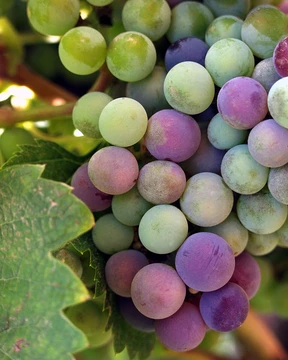
Mega Purple
A grape concentrate used to standardize color and flavor in wines.
Mega Purple is a grape juice concentrate made by the Vie-Del Company in Fresno, California, and is used as a food additive. The production method is proprietary, but based on winemakers' descriptions of its effects on wine, it likely involves vacuum distillation, fractional distillation, and solvent extraction. It belongs to a line of kosher concentrates marketed under names like Mega "Cherry Shade" Grape Juice Concentrate, Mega Purple Grape Juice Concentrate, and Mega Red Grape Juice Concentrate.
In winemaking, the additive has sparked debate over its use to boost color, taste, and mouthfeel. Reports indicate that up to 20% of all such additives are used in wine production, and nearly every producer of low- to moderate-value wines (those under $20 per 750 ml bottle) relies on Mega Purple to create a more consistent, standardized product. The concentrate is made from the teinturier grape Rubired, a cross of Alicante Ganzin and Tinta Cão, and contains 68% sugar, selling for roughly $135 per gallon.
The use of Mega Purple has stirred controversy among wine consumers, who view it as akin to adulteration. Some winemakers, like John Williams of Frog's Leap Winery, argue that its necessity points to poor viticulture or winemaking practices.
- Producer
- Vie-Del Company, Fresno, California
- Grape variety
- Rubired (a cross between Alicante Ganzin and Tinta Cão)
- Sugar content
- 68%
- Price
- approximately $135 per gallon
- Estimated wine industry usage
- as much as 20% of total production
- Typical wine price range
- below US$20 per 750 ml bottle
Lore & Background
Mega Purple is produced from the teinturier grape Rubired, a cross between Alicante Ganzin and Tinta Cão. The process used for producing the additive is proprietary, but based on descriptions of effects to wines by winemakers, it is likely produced by a series of processes such as vacuum distillation, fractional distillation, and solvent extraction. The product is one of a series of concentrates marketed as kosher additives for food, with names including Mega "Cherry Shade" Grape Juice Concentrate, Mega Purple Grape Juice Concentrate, and Mega Red Grape Juice Concentrate.
In winemaking, there has been discussion regarding the use of additives such as Mega Purple to bolster or enhance sensory attributes such as color, taste, and mouthfeel. It is reported that as much as 20% of the total production of such additives is related to wines. According to journal reports, Mega Purple is used by almost every low- to moderate-value wine producer (below US$20 per 750 ml bottle) to help standardize the bottled product, ensuring a more uniform product.
The use of Mega Purple has raised some controversy within the wine consuming community, as its use is considered to be akin to adulterating a wine. Others, such as John Williams, winemaker for Frog's Leap Winery, have stated that the need for its use is evidence of poor viticulture and/or winemaking.
Reader's Guide
Mega Purple occupies a significant yet contentious place in modern winemaking. Its primary significance lies in its role as a tool for standardization: winemakers use it to achieve consistent color, taste, and mouthfeel across vintages, particularly in wines priced below US$20 per 750 ml bottle. The fact that as much as 20% of the total production of such additives is related to wines underscores its commercial importance. However, its legacy is marked by controversy. Within the wine consuming community, its use is sometimes viewed as akin to adulterating a wine, raising questions about authenticity and craftsmanship. John Williams, winemaker for Frog's Leap Winery, has stated that the need for its use is evidence of poor viticulture and/or winemaking, suggesting that reliance on such additives may mask underlying deficiencies in grape growing or production. The proprietary nature of its production process, combined with the lack of public disclosure about its exact composition, adds to the debate. Despite the controversy, its widespread adoption indicates that it has become a standard tool for many producers seeking to deliver a uniform product to the market.
More in Winemaking 1-24
Spotted an error? Know more?
Reader corrections go straight into our review queue. Suggest an edit · How this site is sourced