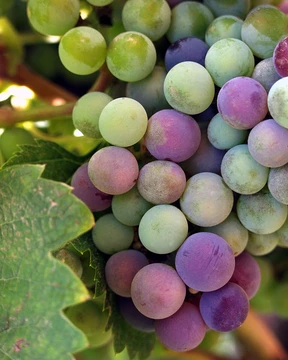
Fermentation in winemaking
Yeast converts grape sugars into ethanol and carbon dioxide.
Fermentation in winemaking is the process that converts grape juice into an alcoholic beverage. During fermentation, yeasts transform sugars present in the juice into ethanol and carbon dioxide as a by-product. The temperature, speed of fermentation, and oxygen levels in the must are important considerations, and the stage can last from 5 to 14 days for primary fermentation, with an additional 5 to 10 days for secondary fermentation. Fermentation may be carried out in stainless steel tanks, open wooden vats, wine barrels, or inside the wine bottle itself, as in the production of many sparkling wines.
- Primary fermentation duration
- 5 to 14 days
- Secondary fermentation duration
- 5 to 10 days
- Typical white wine fermentation temperat
- 18–20 °C
- Typical red wine fermentation temperatur
- 20–30 °C
- Alcohol concentration that halts yeast a
- 15% alcohol per unit volume
- Methanol concentration range in wine
- 0.1–0.2 g/liter
Lore & Background
The natural occurrence of fermentation means it was probably first observed long ago by humans. The earliest uses of the word 'fermentation' in relation to winemaking referred to the apparent 'boiling' within the must from the anaerobic reaction of yeast to sugars and the release of carbon dioxide; the Latin 'fervere' means, literally, to boil. In the mid-19th century, Louis Pasteur noted the connection between yeast and fermentation, in which yeast act as catalyst and mediator through a series of reactions converting sugar into alcohol. The discovery of the Embden–Meyerhof–Parnas pathway in the early 20th century contributed further to understanding the complex chemical processes involved.
In winemaking, distinctions are made between ambient yeasts naturally present in wine cellars, vineyards, and on grapes (sometimes called a grape's 'bloom' or 'blush') and cultured yeasts isolated and inoculated for use. Common genera of wild yeasts include Candida, Klöckera/Hanseniaspora, Metschnikowiaceae, Pichia, and Zygosaccharomyces. Wild yeasts can produce high-quality, unique-flavored wines but are often unpredictable and may introduce less desirable traits or spoilage. Traditional winemakers, particularly in Europe, advocate ambient yeast as a characteristic of terroir, while many winemakers prefer controlled fermentation with cultured yeast, most commonly Saccharomyces cerevisiae ('sugar yeast'), which includes several hundred strains that affect heat, vigor, and flavor. Alternative non-Saccharomyces cerevisiae yeasts are increasingly used for greater complexity.
Upon introduction of active yeasts to grape must, phosphates attach to sugar, and six-carbon sugar molecules split into three-carbon pieces, undergoing rearrangement reactions. Carboxylic carbon is released as carbon dioxide, and the remaining components become acetaldehyde. In the absence of oxygen, acetaldehyde is converted by reduction to ethanol. A small amount of acetaldehyde is converted by oxidation to acetic acid, which in excess can contribute to the wine fault known as volatile acidity. After yeast exhausts its life cycle, it falls to the bottom as sediment called lees. Yeast ceases activity when all sugar is converted or when alcohol content reaches 15% per unit volume.
Reader's Guide
Fermentation is central to winemaking, determining alcohol content, flavor, and aroma. The process involves careful management of sugar content, yeast strain, and temperature. White wines are typically fermented at 18–20 °C, though higher temperatures may be used for complexity; red wines are fermented at 20–30 °C, though cooler temperatures can bring out fruit flavors. Fermentation generates residual heat, which winemakers control through vessel size or cooling devices, ranging from placing vats on ice to tanks with built-in cooling rings. Risks include stuck fermentation and wine faults such as volatile acidity, which can be addressed with sulfur dioxide, though excess SO₂ can itself cause faults. Winemakers may stop fermentation early to retain residual sugar for dessert wines by cooling the must or adding alcohol to create fortified wines. The ethanol produced acts as an important co-solvent for non-polar compounds. The use of different yeast strains is a major contributor to wine diversity, even among the same grape variety. After a winery has operated for years, few yeast strains remain active; active dry yeasts reduce strain variety by outcompeting naturally present strains. The metabolism of amino acids and sugars creates volatile compounds (aldehydes, esters, fatty acids, fusel oils, hydrogen sulfide, ketones, mercaptans) and non-volatile compounds (glycerol, acetic acid, succinic acid) that contribute to wine's sensory profile. Some yeasts generate volatile thiols for fruity aromas, while Brettanomyces yeasts produce the 'barnyard aroma' characteristic in some red wines.
Did You Know?
- The Latin word 'fervere' means 'to boil', referring to the apparent boiling of must during fermentation.
- The most common cultured yeast used in winemaking is Saccharomyces cerevisiae, also known as 'sugar yeast'.
- Methanol in wine typically ranges from 0.1 to 0.2 g/liter and has no adverse effect on people.
Frequently Asked Questions
What is Fermentation in winemaking?
Fermentation in winemaking is the biological stage where naturally occurring or added yeasts break down the sugars in crushed grape juice, producing ethanol and releasing carbon dioxide as a waste product. It is the single step that turns a sweet, non-alcoholic must into wine.
How long does Fermentation in winemaking take?
The primary phase typically runs anywhere from five to fourteen days, after which a secondary phase follows for roughly five to ten more days. The exact timeline shifts depending on yeast strain, sugar content, and how the winemaker manages temperature and oxygen exposure.
At what temperature does Fermentation in winemaking run?
White-wine fermentations are generally kept cooler, around 18–20 °C, to preserve delicate aromatics, while red-wine fermentations are pushed warmer, between 20 and 30 °C, to help extract color and tannins from the skins. Staying within the correct band is critical because temperatures outside the range can stall the yeast or create off-flavors.
What vessels are used for Fermentation in winemaking?
Winemakers may carry out the process in stainless-steel tanks, open wooden vats, or traditional wine barrels, each imparting slightly different micro-oxygenation and flavor profiles. For many sparkling wines, the fermentation is deliberately sealed inside the bottle so the carbon dioxide stays trapped and creates the effervescence.
What stops Fermentation in winemaking?
The process naturally halts once the ethanol concentration reaches roughly 15% by volume, a level at which the yeast can no longer survive and the sugars are exhausted. Winemakers can also intervene by cooling the must, filtering out the yeast, or adding sulfur dioxide to arrest any remaining activity.
More in Winemaking 1-24
Spotted an error? Know more?
Reader corrections go straight into our review queue. Suggest an edit · How this site is sourced