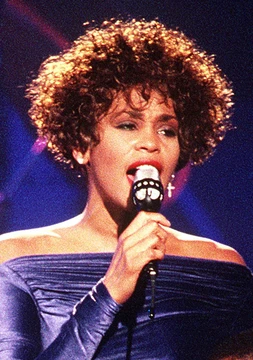
The Bodyguard (1992)
One voice that can't be muted, one badge that can't be faked, and a feeling neither of them can lock away.

The Bodyguard (1992) drops Whitney Houston's Rachel Marron—a glamorous but vulnerable pop singer—into the crosshairs of Kevin Costner's Frank Farmer, a stoic Secret Service–style bodyguard whose only job is to keep her breathing. Tony Scott directed the feature film, and it shoved Houston into the leading-cineematic-star lane and the global pop icon conversation in one stroke. The plot braids a slow-burn romance through stalking, threats, and escalating danger, with every score line sung live by Houston herself. For fans charting her career, this was the pivot: it proved she could carry a dramatic role on camera, it produced one of the best-selling soundtracks in history, and it handed us that aching, soaring ballad that became inseparable from her name. It's still the first title people pull up when they want to see how her charisma and emotional range walked right out of the concert arena and straight into mainstream cinema.
Quick Facts
- Director
- Mick Jackson
- Writer
- Lawrence Kasdan
- Producer
- Kevin Costner / Lawrence Kasdan / Jim Wilson
- Starring
- Kevin Costner / Whitney Houston / Gary Kemp / Bill Cobbs / Ralph Waite
- Cinematography
- Andrew Dunn
- Editing
- Donn Cambern / Richard A. Harris
- Music
- Alan Silvestri
- Studio
- Tig Productions / Kasdan Pictures
- Distributor
- Warner Bros.
- Released
- 23 November 1992 · Mann's Chinese Theater · 1992 · 11 · 25 · United States
- Runtime
- 129 minutes
- Country
- United States
Facts from the source article.
Lore & Background
In the world of The Bodyguard, Rachel Marron is the brightest star in pop music, adored by millions yet trapped in a gilded cage of her own making. Her manager, a controlling figure who blurs the line between mentor and predator, has made her a commercial machine but left her emotionally fragile. When a stalker begins sending threatening letters and the threat turns lethal, the industry's security apparatus steps in, and Frank Farmer is the man they hand the keys to her life. Frank is the antithesis of Rachel's glittering world: disciplined, silent, and bound by protocol. Their dynamic is built on mutual irritation—she resents the invisible wall he builds around her, he resents her recklessness. But as the threats intensify and Rachel is forced to confront the man who has been shaping her career, the professional distance between them cracks. What grows is not a fairy-tale romance but something messier: two people who see the other's loneliness and choose, against every instinct, to stay. The film's emotional architecture is driven by Whitney Houston's vocal performances, which function as both diegetic songs and raw, unfiltered expression of Rachel's inner life. The soundtrack—anchored by the devastating ballad she performs to a Dolly Parton composition—became a cultural artifact in its own right, selling in staggering numbers and earning Houston an Academy Award nomination for Best Original Song. For fans, the soundtrack is inseparable from the film; the music IS the character's confession.
Reader's Guide
The story opens with Rachel Marron at the height of her fame, performing to a roaring arena. Behind the spectacle, her manager exerts a suffocating control, and a stalker's letters signal that the danger is no longer theoretical. Frank Farmer is assigned to her protection, and their first encounters are defined by friction—she chafes at his rules, he chafes at her unpredictability. As the plot escalates, Rachel is forced to confront the truth about her manager's role in her life, a revelation that shatters her sense of safety. Frank becomes the one constant in a world that keeps shifting beneath her. Their relationship deepens through small, private moments: a walk in the park, a shared meal, a late-night conversation where Rachel finally lets someone see the fear behind the smile. The climax brings the threat to a head in a tense, action-driven sequence that tests both characters. Rachel must choose between the life she was built for and the life she actually wants. Frank must decide whether his duty is to protect her body or to protect her freedom. The resolution is bittersweet—survival, but at a cost that lingers. The final image is of Rachel, no longer performing for an audience, simply existing, and for the first time, choosing her own terms. The film's impact on Houston's career was enormous: it proved she could carry a dramatic role, introduced her voice to a cinema-going audience, and the soundtrack became a defining artifact of 1990s pop culture.
Did You Know?
- The film is adapted from a 1987 novel of the same name by author Rebecca Wells, which itself went on to become a bestseller after the movie's success.
- Whitney Houston's Academy Award nomination for Best Original Song was for her performance of a song originally written by country legend Dolly Parton decades earlier.
- The film's soundtrack became one of the best-selling in history, with multiple tracks reaching the top of the Billboard charts and remaining staples of 1990s pop radio for years.
- Kevin Costner and Whitney Houston's on-screen chemistry was a major draw for audiences, and their pairing became one of the defining romantic leads of early-'90s Hollywood.
More in Films, TV & Media
Elsewhere in Whitney Houston
Spotted an error? Know more?
Reader corrections go straight into our review queue. Suggest an edit · How this site is sourced