Nakatsu Castle
One of Japan's three mizujiro, or 'castles on the sea'.
Last updated
Nakatsu Castle sits in the city of Nakatsu, Ōita Prefecture, and is counted among Japan’s three mizujiro, or “castles on the sea,” alongside Takamatsu Castle in Kagawa Prefecture and Imabari Castle in Ehime Prefecture. Its construction was started in 1587 by daimyō Kuroda Yoshitaka after Toyotomi Hideyoshi appointed him governor of the region for his role in the Kyūshū Campaign. Yoshitaka received larger lands in Fukuoka following the Battle of Sekigahara, and daimyō Hosokawa Tadaoki took over and finished the castle. Tadaoki later moved to Kokura Castle once it was built, passing Nakatsu Castle to his son Hosokawa Tadatoshi.
The Ogasawara clan then controlled it, followed by the Okudaira clan in 1717. After the Meiji Restoration, the castle was abandoned in 1871, and a fire during the Satsuma Rebellion in 1877 destroyed the structure. The present castle, built in 1964 by descendants of the Okudaira samurai clan, was modeled on Hagi Castle.
Architecture
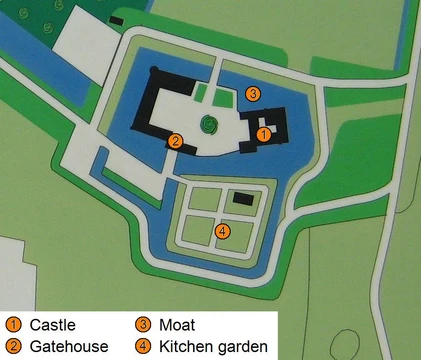
The castle grounds cover about 78,000 square meters, and the layout resembles an open fan. A traditional stone wall and a moat border the site. The main building is a five-story steel-frame structure with an observation deck on the top floor. Salt water from the nearby Seto Inland Sea is drawn into the moat.
Legacy
Local folklore says that after Yoshitaka faced rebellions from local people who attacked the castle, the rebels were killed, but their bloodstains kept showing through the walls even after repainting, so the governor had the walls painted red. The original castle once held a small shrine for the rebel leader Utsonomiya Shigefusa. Today, the castle serves as a museum displaying heirlooms of the families that ruled the region, with many materials on rangaku, since Nakatsu was a center for that learning.
Today
The castle also houses the Okudaira shrine, important to the city’s residents. In 2007, the owners put the castle up for sale. After talks with the Nakatsu City Council fell through, it was sold in 2010 to a Saitama-based company called Chiga. In 2017, the castle was listed as one of the Continued Top 100 Japanese Castles.
Lore & Background
According to local folklore, Yoshitaka faced rebellions from the people of his region, who attacked his castle. The rebels were slain, but their bloodstains showed through the walls even after painting them over, prompting the governor to have the walls painted red. The original castle housed a small shrine for the rebel leader Utsonomiya Shigefusa.
Reader's Guide
The total area of the castle grounds is about 78,000 sq. m and the structure was built in the shape of an open fan. The castle is bordered by a traditional stone wall and a moat. The building is a steel-frame five-storied structure, and the top floor is an observation deck. The castle draws salt water from the nearby Seto Inland Sea to fill the moat.
The present castle was built in 1964 by the descendants of the Okudaira samurai clan and was modeled on Hagi Castle. The castle is presently used as a museum displaying heirlooms of families that governed the region. The museum has many materials on rangaku, as the city of Nakatsu was a center of rangaku learning. Furthermore, the castle houses the Okudaira shrine, which is an important shrine for the people of the city.
More in Water castles
Sources
Compiled from Wikipedia and the sources listed below. Text from Wikipedia is available under CC BY-SA 4.0; this entry is adapted from it.
- Wikipedia: Nakatsu Castle (CC BY-SA 4.0).
Spotted an error? Know more?
Reader corrections go straight into our review queue. Suggest an edit · How this site is sourced