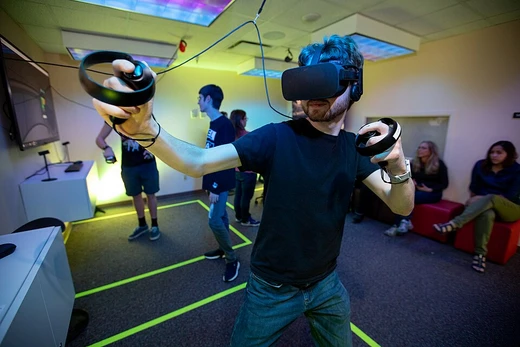
Aperture Hand Lab
A Portal-universe VR game demonstrating Valve Index finger tracking.

RCraig09 · CC BY-SA 4.0
Aperture Hand Lab is a virtual reality game from 2019, built by Cloudhead Games and released by Valve. It takes place within the Portal universe and was designed to demonstrate what the Valve Index headset can do, especially its finger tracking. The game was made available at no cost on Steam on June 25, 2019.
In this single-player simulation, the player takes on tests that require hand and finger movements, guided by artificial intelligence characters called personality cores. The player’s gestures—like devil horns or a middle finger—trigger different reactions and outcomes. The whole experience lasts about 15 minutes.
The story, written by Erik Wolpaw and Jay Pinkerton, follows a worker at Aperture Science testing robotic arms. Personality cores, including one named Friendly Frank, give instructions. After each set of tests, the cores are dropped into a pit. When the player shakes a core’s hand, they accidentally tear off its arm, causing a malfunction that sends both of them to the facility’s bottom. There, Frank, angry about being abandoned, threatens the player verbally but does not point a gun. He then changes his mind and calms down. The ending is fixed: Frank remains active, and the player sits in the pit with him, regardless of any player action. An announcer explains the experiment was about testing the limits of friendship and declares it a success or failure based on the player’s choice, but no actual choice is given. The cores are put into sleep mode, but Frank stays awake, and the game ends with him and the player sitting together in the pit.
Development began after Valve invited Cloudhead Games to a SteamVR summit in late 2014, where the studio decided roomscale was key to VR’s future. Since then, Cloudhead has made tech demos for each major SteamVR update. For this game, Valve gave them Portal assets to use as inspiration for the atmosphere. After seeing the original plot and cores, Valve brought in Wolpaw and Pinkerton to rewrite the story. Valve also provided audio and voice work. When the Valve Index was announced in April 2019, snippets of the game were shared. Besides the Index, the game works with HTC Vive and other SteamVR-compatible headsets, but it requires Valve Index controllers. It launched for free on Windows via Steam. A day later, an update added support for Oculus Touch.
Reviewers generally liked the game.
Quick Facts
- Title
- Aperture Hand Lab
- Developer
- Cloudhead Games
- Publisher
- Valve
- Series
- Portal
- Platforms
- Windows
- Released
- June 25, 2019
- Genre
- Virtual reality
- Modes
- Single-player
- Writer
- Erik Wolpaw · Jay Pinkerton
Facts from the source article.
Lore & Background
Aperture Hand Lab is a virtual reality game set in the Portal universe. The player controls a character working for Aperture Science, testing robotic arms under the guidance of personality cores such as Friendly Frank. The player must complete tests involving hand and finger gestures, with different reactions based on gestures like devil horns or the middle finger. The game can be completed in approximately 15 minutes.
The plot, written by Erik Wolpaw and Jay Pinkerton, involves the player accidentally ripping off a core's arm, causing a malfunction that drops both to the bottom of the facility. There, Frank threatens the player verbally but does not point a gun. The ending is fixed: Frank remains active, and the player sits in the pit with him, with no choice to help him escape or destroy him.
Reader's Guide
Aperture Hand Lab is significant as a demonstration title for the Valve Index VR headset, specifically its finger tracking capabilities. Reviewers commended the game's story and its demonstration of the headset's controls. Critics noted the game's appeal and humor, with praise for its writing and the analog grip of the controllers. However, some reviewers felt the finger tracking was more a proof of concept than a transformative gameplay innovation. The game's compatibility with HTC Vive was noted as potentially futile due to the lack of Valve Index controller support on that headset. As a free, short experience, it served as a tech demo and a narrative piece within the Portal universe, highlighting the collaboration between Cloudhead Games and Valve.
Did You Know?
- The game was developed to showcase the features of the Valve Index VR headset, particularly finger tracking.
- The plot was written by Erik Wolpaw and Jay Pinkerton, who were hired by Valve to rewrite the original story.
- An update released one day after launch introduced support for Oculus Touch controllers.
Gameplay & Design
Aperture Hand Lab is a single-player virtual reality simulation set within the Portal universe. The core loop revolves around completing a series of tests that require the player to perform specific hand and finger gestures, all while receiving instructions from artificial intelligence entities known as personality cores. What makes the experience distinctive is the responsiveness of the system—different gestures produce different reactions and outcomes, with the game acknowledging even playful or rude hand signals like devil horns or the middle finger. The entire experience is designed to be completed in roughly fifteen minutes, making it a compact but focused demonstration. The game functions as a simulation, emphasizing the physicality of interaction over traditional button-mashing. Players work with robotic arms for purposes that remain deliberately vague, and the personality cores guide them through each sequence of gestures. The design philosophy clearly prioritizes showcasing the physical capabilities of VR controllers, particularly the granular finger tracking that Valve Index hardware enables.
Plot & Narrative
The narrative follows a player character employed at Aperture Science, tasked with testing robotic arms for unspecified purposes. Throughout the sessions, various personality cores—each with distinct personalities—direct the player through gesture sequences. After each set is finished, the cores are simply dropped into the abyss. The story takes a sharp turn when the player, mid-handshake with one core, accidentally tears its arm off, triggering a catastrophic malfunction that sends both the player and the core tumbling to the bottom of the facility. There, Friendly Frank reappears, bitter about his abandonment. He holds the player at gunpoint, demanding freedom, but then has a change of heart and puts the weapon away. The player is then given a moral choice: help Frank escape or destroy him. Whichever path is chosen, the announcer reveals the entire experiment was designed to test the limits of friendship, declaring it either a success or failure accordingly. The cores are placed in sleep mode, yet Frank remains active, and the game closes with him and the player sitting together at the bottom of the pit, indefinitely.
Development & Valve Partnership
The game was developed by Cloudhead Games and published by Valve, with roots tracing back to late 2014 when Valve invited the studio to their SteamVR reveal summit. That experience cemented the team's belief that roomscale interaction represented VR's future, and since then the studio has contributed tech demos for every major SteamVR innovation. Aperture Hand Lab was specifically built to showcase the Valve Index headset, with particular emphasis on its finger tracking technology. Valve supplied the development team with Portal materials and assets to serve as inspiration and reference points for maintaining the franchise's world-building atmosphere. After reviewing the original plot and personality core designs, Valve brought in Erik Wolpaw and Jay Pinkerton to rewrite the story, and the company also contributed audio sounds and voice acting. When Valve announced the Index in April 2019, they shared public snippets of the game. The title launched free on Steam for Windows on June 25, 2019, with an Oculus Touch compatibility update following the very next day.
Reception & Critical Response
Critics responded warmly to Aperture Hand Lab, with praise centered on its narrative charm and its effectiveness as a hardware demonstration. Bo Moore of PC Gamer noted the game carried the appeal of earlier Portal titles, while Dan Stapleton at IGN highlighted the humor of the story. Jacob Ridley of PCGamesN complimented the writing and called the experience pleasant. The Valve Index features drew particular attention: Ridley and Hayden Dingman of PC World saw the game as an excellent showcase for the headset's capabilities, and Kris Graft of Gamasutra specifically praised the analog grip feel of the controllers. However, not all feedback was uniformly positive. Moore observed that the finger tracking, while impressive, felt more like a proof of concept than a genuine gameplay revolution. Andy Chalk of PC Gamer raised a practical concern, noting that the HTC Vive compatibility seemed somewhat pointless given that the headset does not support the required Valve Index controllers. Overall, reviewers found the game pleasing and well-crafted within its brief scope.
Gallery
More in Virtual reality games 1-24
Spotted an error? Know more?
Reader corrections go straight into our review queue. Suggest an edit · How this site is sourced