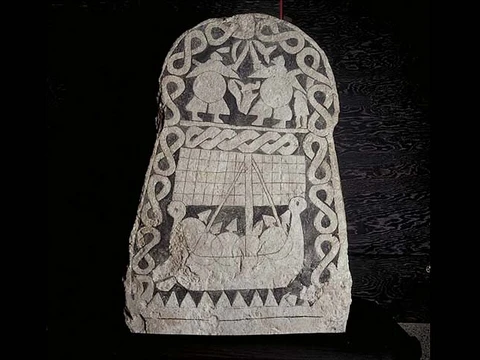
Vinland
Area of coastal North America explored by Vikings around AD 1000.

Vinland, also spelled Winland, was an area of coastal North America explored by Vikings around AD 1000, nearly five centuries before the voyages of Christopher Columbus and John Cabot. The name appears in the Vinland sagas and describes a land beyond Greenland, Helluland, and Markland, with much of the geographical content corresponding to present-day knowledge of transatlantic travel and North America. The etymology of the Old Norse root *vin-* is disputed; while often interpreted as "wine," some scholars argue for the homophone *vin*, meaning "pasture" or "meadow." Adam of Bremen, writing around 1075, recorded the name Winland, attributing it to wild grapevines producing the best wine. The 13th-century *Grœnlendinga saga* similarly derives the name from *vínber* (wineberry), a term for grapes. However, a competing etymology proposed in 1898 suggests a short vowel *vin* meaning "meadow," though this interpretation has been rejected by several linguists. Archaeological evidence from L'Anse aux Meadows, discovered in 1960 by Helge Ingstad and Anne Stine Ingstad, confirmed Norse presence in North America. The site, a UNESCO World Heritage Site since 1978, features a recreated Norse long house. Butternuts found there indicate Norse voyages into the Gulf of Saint Lawrence as far as northeastern New Brunswick, the northern limit for both butternut and wild grapes. L'Anse aux Meadows has been hypothesized to be the camp Straumfjörð mentioned in the *Saga of Erik the Red*. The Vinland sagas, preserved orally before being written down some 250 years later, report that parties of Vikings, including Leif Erikson, Thorvald Eiriksson, and Thorfinn Karlsefni, explored the region with crews ranging from 30 to 160 people.
- name
- Vinland
- also_known_as
- Vineland, Winland
- explored_by
- Leif Erikson (c. AD 1000)
- field
- Historical region
- known_for
- Pre-Columbian Norse exploration of North America
Lore & Background
Vinland was the name given to part of coastal North America explored by Vikings around AD 1000, nearly five centuries before later European voyages. The area was reached by Leif Erikson, and its name appears in the Vinland sagas, describing a land beyond Greenland, Helluland, and Markland. The geographical content of these sagas largely corresponds to modern knowledge of transatlantic travel and North America. In 1960, Helge Ingstad and Anne Stine Ingstad discovered the remains of Norse buildings at L’Anse aux Meadows on the northern tip of Newfoundland, Canada. This site, listed as a UNESCO World Heritage Site in 1978, provided the first archaeological proof of pre-Columbian Norse exploration of mainland North America. Among the finds were butternuts, indicating voyages into the Gulf of Saint Lawrence as far as northeastern New Brunswick. L’Anse aux Meadows has been hypothesized to be the camp Straumfjörð mentioned in the Saga of Erik the Red. The etymology of the Old Norse root vin- is disputed. It has usually been assumed to mean “wine,” as recorded by Adam of Bremen around 1075, who wrote that grapevines grew there producing the best wine. This is supported by the 13th-century Grœnlendinga saga, which describes naming from vínber, meaning “wineberry” or grapes. However, some scholars argue for the homophone vin, meaning “pasture” or “meadow.” The discovery of butternuts at L’Anse aux Meadows implies the Norse explored southward at least to the St. Lawrence River and parts of New Brunswick, the northern limit for both butternut and wild grapes.
Reader's Guide
Vinland holds significance as the first known European attempt to settle in the Americas, predating Columbus by nearly five centuries. The site's butternuts indicate voyages into the Gulf of Saint Lawrence as far as northeastern New Brunswick, showing the Norse explored further south. The ongoing debate over the name's etymology—whether it means 'wine-land' or 'pasture-land'—reflects broader questions about how the Norse perceived and named the new environment. Vinland's legacy endures as a symbol of pre-Columbian contact between Europe and North America, challenging traditional narratives of discovery and highlighting the role of oral tradition and archaeology in reconstructing history.
Did You Know?
- Leif Erikson landed in Vinland around AD 1000, nearly five centuries before Christopher Columbus and John Cabot.
- The name Vinland may derive from Old Norse vín ('wine') or vin ('pasture' or 'meadow'), a dispute unresolved by scholars.
- Archaeologists found butternuts at L'Anse aux Meadows, indicating Norse voyages as far as northeastern New Brunswick.
Common Misconceptions (Editorial)
1. Some assume Vinland was named exclusively for grapes or wine, but the Old Norse root *vin* is disputed and may instead mean “pasture” or “meadow,” as noted by scholars.
2. People often think Vinland was the first Norse settlement in North America, but the sagas describe it as one of several lands beyond Greenland, following Helluland and Markland, with geographical context matching known transatlantic routes.
3. A common belief is that Vinland’s existence relies solely on saga accounts, but archaeological finds like butternuts at L’Anse aux Meadows support Norse voyages as far as northeastern New Brunswick.
Why It Matters (Editorial)
Vinland endures as a landmark of pre-Columbian exploration, demonstrating that Norse mariners reached North America nearly five centuries before Columbus. Its contested etymology and archaeological evidence remind us that history often holds more complexity than popular narratives suggest, inviting ongoing curiosity about how early cultures connected across the Atlantic.
Frequently Asked Questions
What is Vinland?
Vinland (also called Vineland or Winland) is the name Norse sagas give to a stretch of North American coastline that Viking explorers reached around the year 1000. In the Vinland sagas it sits beyond Greenland, Helluland, and Markland in the order of travel.
Who first reached Vinland?
Leif Erikson is credited in the sagas with arriving in Vinland around AD 1000, making it one of the earliest recorded European contacts with the North American continent.
Where exactly is Vinland located?
The sagas place Vinland along the coast of what is now eastern North America, and the most widely accepted archaeological identification is the Norse settlement at L'Anse aux Meadows in Newfoundland, Canada.
Why does Vinland matter in Viking Age history?
Vinland demonstrates that Norse seafarers crossed the Atlantic nearly five hundred years before Columbus or Cabot, reshaping the timeline of European contact with the New World. It also shows that the Viking Age extended far beyond Scandinavia into transatlantic exploration.
More in The Viking Age 1-21
Spotted an error? Know more?
This is a living reference — every entry is fact-audited, and reader corrections feed straight into our audit queue. Suggest an edit · See this site's audit record