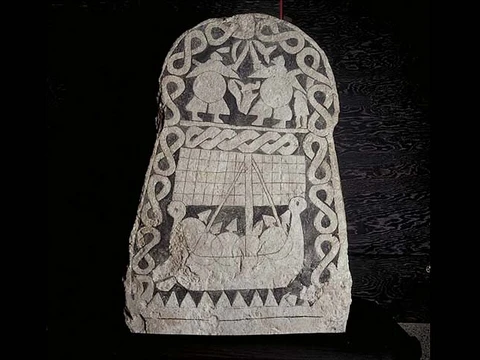
Rollo
Viking leader who founded Normandy and fathered the Normans.

Calreyn88 · CC BY-SA 4.0
Rollo (c. 835/870–933), also known as Rollo "the Walker", was a Viking leader who became the first ruler of Normandy, in what is now northern France, as Count of Rouen. He rose to prominence as a war chief among the Norsemen who had established a lasting presence in the lower Seine valley. Rollo was a key figure in the Viking siege of Paris in 885 and led the unsuccessful Siege of Chartres in 911. That defeat, however, led directly to the Treaty of Saint-Clair-sur-Epte, in which Charles the Simple, king of West Francia, granted Rollo territory between the river Epte and the sea. In return, Rollo agreed to stop his raiding, swear loyalty to Charles, convert to Christianity, and protect the Seine estuary from other Viking attacks.
Most of what is known about Rollo comes from the writings of Dudo of Saint-Quentin, though historians like W. Vogel, Alexander Bugge, and Henri Prentout have questioned the accuracy of Dudo's account. Rollo's origins and life remain heavily debated. He first appears in a charter from 918 as the leader of a group of Viking settlers, and he ruled Normandy until at least 928. His son, William Longsword, succeeded him as duke. Rollo and his followers, through intermarriage with local Franks and Gallo-Romans, became known as the Normans. Over the next two centuries, after the Norman conquest of England, southern Italy, and Sicily, their descendants ruled England, much of Ireland, Sicily, and Antioch, leaving a lasting mark on European and Near Eastern history.
The 13th-century *Heimskringla* identifies Rollo with Rolf the Ganger, who went to Normandy and ruled it, so Rollo is generally seen as a Latin form of the Old Norse name Hrólfr—supported by Saxo Grammaticus's use of *Roluo* in the *Gesta Danorum*. Some suggest it may come from another Norse name, Hrollaugr. Dudo records that Rollo took the baptismal name Robert. The 12th-century Norman French verse chronicle *Roman de Rou*, by Wace, uses the spelling Rou.
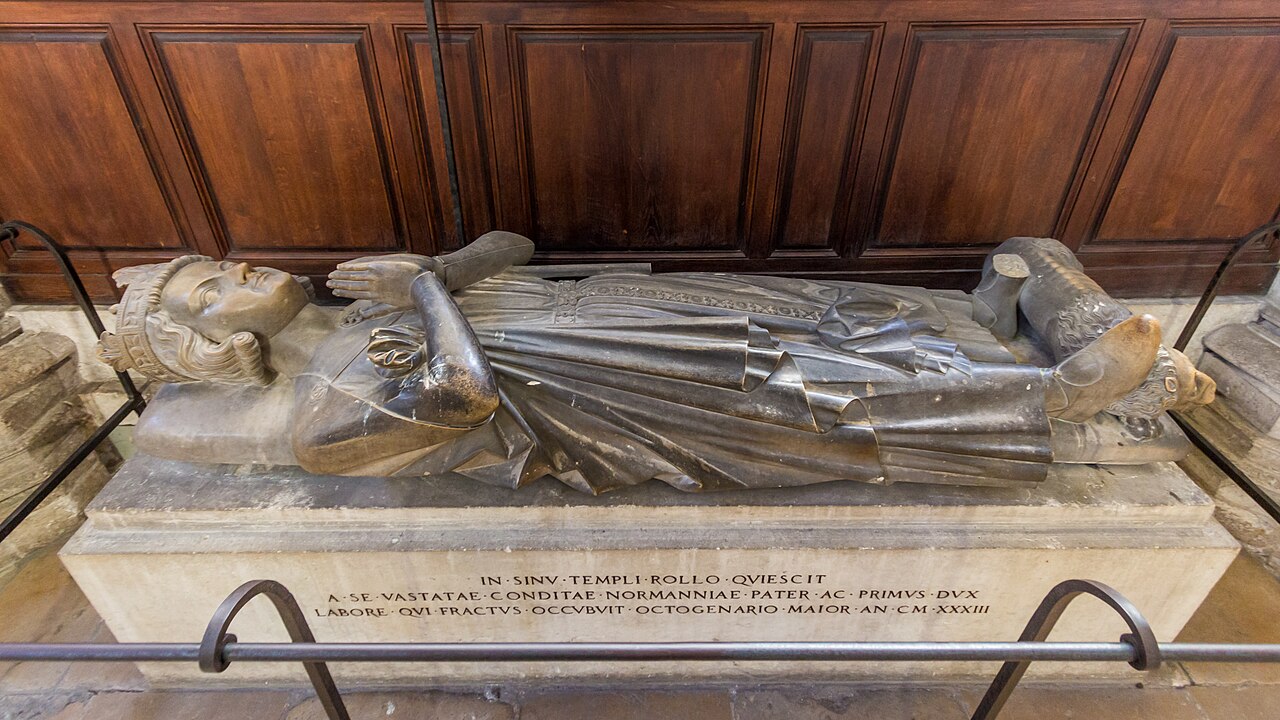
In medieval Norwegian and Icelandic sources, Rollo is identified with Hrólfr "the Walker" Rǫgnvaldsson, son of the jarl of Møre in western Norway. The earliest written mention appears in the Latin *Historia Norvegiæ* from Norway. Snorri Sturluson's sagas say Hrólfr conquered Normandy after raiding the Hebrides, the Irish Sea, and Francia, and that many Norwegians settled with him. In the late 19th century, a sharp debate emerged over Rollo's identity, often along national lines. Danish historian Johannes Steenstrup argued that Dudo explicitly called Rollo Danish. British, French, and Norwegian scholars have generally favored the Norwegian-Icelandic tradition, while Danish, Swedish, and German historians tend to follow Dudo. The question cannot be settled conclusively, but many Norwegian, French, and British historians now consider the case for a Norwegian origin stronger. What is clear is that Rollo was almost certainly born in Scandinavia—either Norway or Denmark—in the mid-9th century, as his tomb states he was in his eighties when he died in 933.
Dudo claimed Rollo "the Dane" was from Dacia and moved to Scandza, but Dudo's identification of Dacia with Denmark was based on a false etymology between *Daci* and *Dani*. One of Rollo's great-grandsons, a contemporary of Dudo, was known as Robert the Dane. Dudo's *Historia Normannorum* was commissioned by Rollo's grandson, Richard I of Normandy, and while Dudo likely had access to people with living memory of Rollo, the text's potential biases must be considered. According to Dudo, an unnamed Danish king was hostile to Rollo's family, including his father and brother Gurim; after their father died, Gurim was killed and Rollo fled Denmark. Dudo was the main source for later chroniclers William of Jumièges and Orderic Vitalis, who added their own details. A Norwegian origin was first explicitly claimed by the 11th-century monk Geoffrey Malaterra, who wrote that Rollo sailed from Norway. The 12th-century English historian William of Malmesbury also said Rollo was "born of noble lineage among the Norwegians." The mid-12th-century *Chronique des ducs de Normandie* by Benoît (likely Benoît de Sainte-More) stated Rollo was born in a town called "Fasge."
- field
- Viking leader, Count of Rouen, first ruler of Normandy
- nationality
- Scandinavian (disputed: Norwegian or Danish)
- known_for
- Founding the Duchy of Normandy; Treaty of Saint-Clair-sur-Epte; ancestor of the Normans who conquered England, Sicily, and Antioch
Quick Facts
- Succession
- Count of Rouen
- Reign
- 911–928
- Successor
- William Longsword
- Spouses
- Poppa of Bayeux / Gisela of France (possibly)
- Issue
- William Longsword / Gerloc
- Issue Link
- #Descendants
- Issue Pipe
- more
- House
- Normandy (founder)
- Birth Date
- c. 835/870
- Birth Place
- Scandinavia
- Death Date
- 933
- Death Place
- Duchy of Normandy
Facts from the source article.
Lore & Background
Rollo, also known as Rollo "the Walker," was a Viking war leader who became the first ruler of Normandy, a region in what is now northern France. He emerged as a prominent figure among the Norsemen who had established a permanent foothold in the valley of the lower Seine. He participated in the Viking siege of Paris in 885 and later led the unsuccessful Siege of Chartres in 911. This event, however, led directly to the Treaty of Saint-Clair-sur-Epte, in which King Charles the Simple of West Francia granted Rollo lands between the river Epte and the sea. In exchange, Rollo agreed to cease his raiding, swear allegiance to Charles, convert to Christianity, and protect the Seine estuary from other Viking attackers. Rollo is first recorded in a charter from 918 as the leader of a group of Viking settlers, and he ruled over the region until at least 928. He was succeeded by his son, William Longsword. The intermingling of Rollo and his followers with the local Frankish and Gallo-Roman population produced the people known as the Normans. Rollo’s life was recorded by the cleric Dudo of Saint-Quentin, whose account is heavily debated by historians. His origin is disputed, with some sources claiming a Danish background and others a Norwegian one; the evidence is unambiguous only that he was born in Scandinavia in the mid-9th century, as his tomb states he was in his eighties when he died in 933.
Reader's Guide
Rollo's significance lies in his establishment of Normandy, which became a powerful duchy and the homeland of the Normans. Through intermingling with local Franks and Gallo-Romans, Rollo's followers became known as Normans. Their descendants, after the Norman conquest of England and of southern Italy and Sicily over the following two centuries, came to rule England, much of Ireland, Sicily, and Antioch from the 11th to 13th centuries, leaving an enduring legacy in European and Near Eastern history. The debate over Rollo's origins—whether Norwegian or Danish—remains unresolved, but his role as the founder of a dynasty that shaped medieval Europe is undisputed.
Did You Know?
- Rollo is also known as Rollo 'the Walker', possibly because he was so large that no horse could carry him.
- The Treaty of Saint-Clair-sur-Epte (911) granted Rollo lands in exchange for his conversion to Christianity and pledge to defend the Seine estuary.
- Rollo's son William Longsword succeeded him as ruler of the new Duchy of Normandy.
- The 12th-century Norman French verse chronicle Roman de Rou, commissioned by King Henry II of England, uses the variant spelling Rou for Rollo.
The Treaty That Forged a Nation
Rollo rose to prominence as a war leader among the Norsemen who had carved out a permanent settlement in the lower Seine valley of Frankish territory. Two decades later, his forces attempted the Siege of Chartres in 911—an expedition that ultimately failed. Yet this very failure proved transformative. The pressure of Rollo's campaign compelled King Charles the Simple to negotiate the Treaty of Saint-Clair-sur-Epte, a landmark accord that reshaped western Europe. Under its terms, Charles ceded territory from the river Epte to the sea, while Rollo pledged to cease his raids, swear fealty, embrace Christianity, and commit his warriors to guarding the Seine estuary against rival Viking bands. In return, Rollo assumed the title of Count of Rouen and became the founding ruler of Normandy.
The Question of Origins
The question of where Rollo was born has generated one of the most persistent debates in medieval historiography. The Norwegian-Icelandic tradition, preserved in sources like the Heimskringla and the Historia Norvegiæ, identifies him with Hrólfr "the Walker" Rǫgnvaldsson, son of the jarl of Møre in western Norway. Snorri Sturluson's sagas describe a warrior who raided through the Hebrides and the Irish Sea before conquering Normandy. In the late nineteenth century, Danish historian Johannes Steenstrup challenged this reading, anchoring his argument in the claims of Dudo of Saint-Quentin, who described Rollo as Danish and even traced his origins to a place called Dacia. Dudo's account, however, was commissioned by Rollo's grandson Richard I, introducing the bias of an official family biography. The dispute split scholars along national lines: British, French, and Norwegian historians generally favor the Norwegian identification, while Danish, Swedish, and German scholars tend to side with Dudo.
A Dynasty That Remade Europe
The political entity Rollo established in the lower Seine valley became the seed from which one of history's most consequential dynasties grew. His son William Longsword inherited the duchy, and over the following generations the offspring of Rollo and his Norse followers intermingled with the local Frankish and Gallo-Roman population, giving rise to a new people known as the Normans. The impact of this synthesis radiated far beyond northern France. Over the two centuries following Rollo's death, his descendants mounted the Norman conquest of England and established dominion over southern Italy and Sicily. From the eleventh through the thirteenth centuries, rulers tracing their lineage back to Rollo held the English throne, governed much of Ireland, controlled Sicily, and even held the principality of Antioch in the Near East. The reach of his legacy is visible even in the literary record: the twelfth-century Roman de Rou, composed by Wace and commissioned by King Henry II of England—a direct descendant of Rollo—preserved the Norman ducal narrative in verse. A single Viking settlement in a French river valley thus became the root of a political and cultural transformation spanning from the British Isles to the Levant.
Name, Sources, and the Elusive Man
The very identity of Rollo is layered in linguistic and textual ambiguity. His name appears across sources as Rou, Rolloun, Hrólfr, and Rollon, with the epithet "the Walker" attached in several traditions. Scholars generally presume the Latinized form Rollo derives from the Old Norse Hrólfr, a theory reinforced by the Gesta Danorum's rendering of the name as Roluo. A minority view suggests it may instead be a Latinization of Hrollaugr. Dudo of Saint-Quentin records that Rollo received the baptismal name Robert upon his conversion to Christianity. The principal biographical source, Dudo's Historia Normannorum, was composed in the late tenth century at the behest of Rollo's grandson, and it served as the foundation for later writers including William of Jumièges and Orderic Vitalis. Yet historians such as W. Vogel, Alexander Bugge, and Henri Prentout have questioned the reliability of Dudo's narrative, noting that the text blends genuine memory with the embellishments of a commissioned family history.
Common Misconceptions (Editorial)
Some believe Rollo was a king or duke immediately upon receiving his land grant, but the facts show he was granted the title Count of Rouen and only later became the first ruler of what became the Duchy of Normandy. Another misconception is that his origins are firmly known; the facts explicitly state his nationality is disputed between Norwegian and Danish, and historian accounts of his life—especially those by Dudo of St. Quentin—are heavily disputed.
Why It Matters (Editorial)
Rollo matters because his treaty with King Charles the Simple in 911 did not just end Viking raids along the Seine—it laid the political and cultural foundation for Normandy, a duchy that would reshape European history. As the direct ancestor of the Normans who conquered England, Sicily, and Antioch, his legacy endures in the dynasties and nations that followed, making him a pivotal figure in the transition from Viking raiding to medieval state-building.
Gallery
Frequently Asked Questions
Who is Rollo?
Rollo was a Scandinavian Viking warrior, most likely from Norway or Denmark, who lived roughly between the late ninth and early tenth centuries. He earned the nickname 'the Walker' and ultimately became the first count of Rouen and the founding ruler of what would be called Normandy in northern France.
What is Rollo's role in The Viking Age?
He acts as a war leader among Norse settlers who had carved out a permanent base along the lower Seine River in Frankish territory. His central arc revolves around shifting his people from seasonal raiders into settled lords by negotiating directly with the Frankish crown.
Why is Rollo important to Viking history?
He is the founding ancestor of the Normans, the very people who would later take England in 1066, conquer Sicily, and reach as far as Antioch. His 911 agreement with King Charles the Simple marked the moment Viking raiders formally became feudal lords on Frankish soil.
What happened at the Treaty of Saint-Clair-sur-Epte?
In 911, after leading his forces during the Siege of Chartres, Rollo struck a deal with the Frankish king that handed him territory stretching from the Epte River to the coast. In exchange, Rollo swore loyalty, accepted Christian baptism, and pledged to guard the Seine estuary against other Viking incursions.
More in The Viking Age 1-21
Spotted an error? Know more?
This is a living reference — every entry is fact-audited, and reader corrections feed straight into our audit queue. Suggest an edit · See this site's audit record