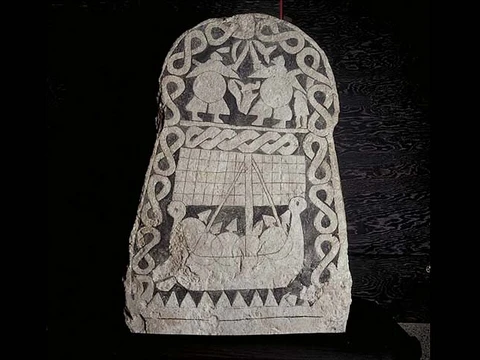
The Viking Age
Norsemen expanded across Europe and reached North America during the Viking Age.

Between roughly 800 and 1050 CE, the Middle Ages saw the rise of the Viking Age, a period when Norse people—often called Vikings—conducted widespread raiding, colonization, conquest, and trade across Europe and even reached North America. This era covers not just Scandinavia itself but any region where Scandinavians established significant settlements. While only a minority of these Scandinavians were actually pirates in the strict sense, the term "Vikings" is commonly used for all of them.
Setting out by sea from what are now Denmark, Norway, and Sweden, the Norse settled in the British Isles, Ireland, the Faroe Islands, Iceland, Greenland, Normandy, the Baltic coast, and along the Dnieper and Volga trade routes in Eastern Europe, where they were also called Varangians. They briefly established a settlement in Newfoundland, making them the first Europeans to reach North America. From these colonies emerged groups such as the Norse-Gaels, Normans, Rus' people, Faroese, and Icelanders. The Vikings founded several kingdoms and earldoms, including the Kingdom of the Isles, Orkney, York and the Danelaw, Dublin, Normandy, and Kievan Rus'. During this period, the Norse homelands themselves consolidated into larger kingdoms, and the short-lived North Sea Empire encompassed much of Scandinavia and Britain. In 1021, Vikings reached North America—a feat whose exact date was only confirmed a millennium later.
Several factors fueled this expansion. The Vikings were attracted by the growth of wealthy towns, monasteries, and weak kingdoms abroad. They may also have been pushed from home by overpopulation, scarce good farmland, and political turmoil from Norway’s unification. The aggressive expansion of the Carolingian Empire and the forced conversion of neighboring Saxons to Christianity might have played a role as well. Innovations in sailing allowed them to travel farther and longer than before.
Our knowledge of the Viking Age comes largely from primary sources written by those they encountered, along with archaeology, supplemented by secondary sources like the Icelandic Sagas.
In England, the Viking attack on June 8, 793, which destroyed the abbey on Lindisfarne—a learning center off Northumberland’s northeast coast—is traditionally seen as the start of the Viking Age. Judith Jesch has argued that the beginning might be pushed back to 700–750, since the Lindisfarne raid was unlikely the first, and archaeological evidence suggests earlier contacts between Scandinavia and the British Isles. Early raids were probably small-scale but grew during the 9th century. During the Lindisfarne attack, monks were killed, drowned, or taken as slaves along with church treasures, inspiring the unverified prayer: “Free us from the fury of the Northmen, Lord.” Three Viking ships had landed in Weymouth Bay four years earlier (though a scribal error in the Anglo-Saxon Chronicle dates this to 787 instead of 789), but that incident may have been a failed trading expedition rather than a raid. Lindisfarne was different. The devastation was reported by the Northumbrian scholar Alcuin of York, who wrote that such terror had never been seen in Britain before. Vikings were depicted as purely violent and bloodthirsty by their enemies; Robert of Gloucester’s Chronicle around 1300 describes them as “wolves among sheep” in East Anglia.
The first challenges to these negative portrayals in Britain emerged in the 17th century. Pioneering scholarly works on the Viking Age reached only a small audience there, while linguists traced Viking origins in rural idioms and proverbs. New dictionaries and grammars of Old Icelandic allowed Victorian scholars to read the Icelandic Sagas directly. In Scandinavia, 17th-century scholars like Thomas Bartholin, Ole Worm, and Olaus Rudbeck were the first to use runic inscriptions and sagas as primary historical sources. During the Enlightenment and Nordic Renaissance, historians such as Thormodus Torfæus, Ludvig Holberg, and Olof von Dalin adopted a more rational and pragmatic approach. By the late 18th century, although the sagas remained important sources, the Viking Age was again seen as a barbaric and uncivilized period in Nordic history. Scholars outside Scandinavia did not begin to reassess Viking achievements—recognizing their artistry, technology, and seamanship—until the 1890s.
The Vikings who invaded western and eastern Europe were mainly pagans from what is now Denmark, Norway, and Sweden. They also settled in the Faroe Islands, Ireland, Iceland, parts of Scotland (Caithness, the Hebrides, and the Northern Isles), Greenland, and Canada. Their North Germanic language, Old Norse, became the basis for modern Scandinavian languages. By 801, a strong central authority seems to have formed in Jutland, and the Danes began looking beyond their borders for land, trade, and plunder. In Norway, mountainous terrain and fjords created strong natural boundaries, keeping communities independent. By 800, about 30 small kingdoms existed there. The sea was the easiest way to communicate between Norwegian settlements.
- Period
- about 800–1050 CE
- Region
- Scandinavia and areas settled by Scandinavians
- Known for
- Raiding, colonising, conquest, trading, reaching North America
- Languages
- Old Norse (precursor to present-day Scandinavian languages)
- Notable colonies
- British Isles, Ireland, Faroe Islands, Iceland, Greenland, Normandy, Baltic coast, Dnieper and Volga trade routes, Newfoundland
Lore & Background
The Viking Age is defined by the seaborne expansion of Norse people from their homelands in Denmark, Norway, and Sweden. These Norsemen, though often collectively called Vikings, were not all raiders; many were traders, settlers, and colonists. Their voyages took them across the North Atlantic to the British Isles, Ireland, the Faroe Islands, Iceland, and Greenland, and they briefly established a settlement in Newfoundland, making them the first Europeans in North America. In the east, they traveled the Dnieper and Volga rivers, where they were known as Varangians, and founded the Kievan Rus'. The Norse established several political entities, including the Kingdom of the Isles, Orkney, the Danelaw, Dublin, Normandy, and the short-lived North Sea Empire. Their expansion was driven by factors such as the growth of wealthy monasteries and towns abroad, overpopulation, land scarcity, and political strife from the unification of Norway, as well as pressure from the Carolingian Empire. Sailing innovations enabled longer voyages. The period is known from primary sources written by those they encountered, archaeological finds, and later Icelandic Sagas. The attack on Lindisfarne in 793 is traditionally seen as the start, though earlier raids likely occurred. The Norse were pagans, and their language, Old Norse, evolved into modern Scandinavian languages.
Reader's Guide
The Viking Age represents a significant period of expansion and cultural exchange, driven by factors such as the growth of wealthy towns and monasteries overseas, weak kingdoms, overpopulation, lack of good farmland, political strife, and the aggressive expansion of the Carolingian Empire. Sailing innovations allowed the Vikings to travel farther and longer. Information about the Viking Age is drawn largely from primary sources written by those the Vikings encountered, as well as archaeology, supplemented with secondary sources such as the Icelandic Sagas. The Norse founded several kingdoms and earldoms, including the Kingdom of the Isles, Orkney, York, the Danelaw, Dublin, Normandy, and Kievan Rus'. The homelands were unified into larger kingdoms, and the short-lived North Sea Empire included large swathes of Scandinavia and Britain. Scholarly reassessment of Viking achievements, recognizing their artistry, technological skills, and seamanship, began outside Scandinavia in the 1890s.
Did You Know?
- The Viking attack on Lindisfarne in 793 is regarded as the beginning of the Viking Age, though some scholars push the start back to 700–750.
- In 1021, the Vikings reached North America, a date not determined until a millennium later.
- The Norse were also known as Varangians in eastern Europe along the Dnieper and Volga trade routes.
- The Vikings founded several kingdoms and earldoms, including the Danelaw, Dublin, Normandy, and Kievan Rus'.
Common Misconceptions (Editorial)
Some people think all Scandinavians during the Viking Age were Vikings, but the facts show that “few of the Scandinavians of the Viking Age were Vikings in the sense of being engaged in piracy.” Another common misconception is that the Viking Age began with a single, undisputed date; while the attack on Lindisfarne in 793 is regarded as the start, some scholars argue for an earlier beginning around 700–750.
Why It Matters (Editorial)
The Viking Age endures in historical imagination because it bridges the classical and medieval worlds while stretching across an extraordinary range of territories, from the Baltic to North America. It also highlights how a relatively small maritime culture could transform politics, trade, and settlement patterns across an entire continent, leaving lasting legacies in languages, place names, and legal systems.
Frequently Asked Questions
What was the Viking Age?
It was a roughly 250-year span (c. 800–1050 CE) during which Norse people from Scandinavia carried out widespread raiding, trading, and colonisation across Europe and as far as North America.
Were all Scandinavians actually Vikings?
No—only a small fraction of Norse people engaged in piracy or large-scale raiding. The broader population consisted of farmers, craftsmen, and traders, yet the entire Scandinavian society of that era is commonly labelled 'Vikings' or 'Norsemen' in historical writing.
Where did Norse settlers establish colonies?
Significant settlements sprang up in the British Isles, Ireland, Iceland, Greenland, the Faroe Islands, Normandy, and along the Baltic, Dnieper, and Volga trade routes, with the most distant confirmed outpost at Newfoundland.
What language did Vikings speak?
They spoke Old Norse, the direct ancestor of the modern Scandinavian languages such as Norwegian, Swedish, Danish, and Icelandic.
Why is the Viking Age considered significant?
It reshaped the political and cultural map of medieval Europe through conquest, long-distance trade networks, and settlement, and it produced one of the earliest known transatlantic contacts in recorded history.
More in The Viking Age 1-21
Spotted an error? Know more?
This is a living reference — every entry is fact-audited, and reader corrections feed straight into our audit queue. Suggest an edit · See this site's audit record