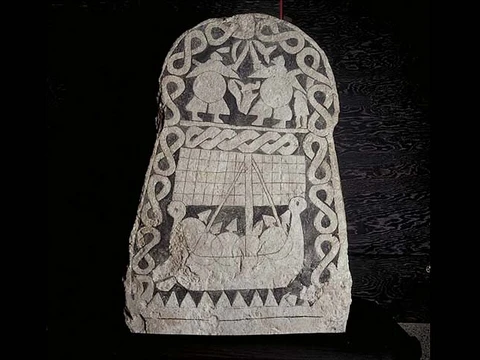
Berserkers
Scandinavian warriors who fought in a trance-like fury.

Berserkers (Old Norse: berserkir) were Scandinavian warriors attested to in numerous Old Norse sources, said to have fought in a trance-like fury. This characteristic later gave rise to the modern English adjective 'berserk,' meaning furiously violent or out of control. The Old Norse form of the word was berserkr, a compound of ber and serkr, with serkr meaning 'shirt' and ber most likely meaning 'bear,' thus 'bear-shirt'—someone who wears a coat made of a bear's skin. The thirteenth-century Icelandic historian Snorri Sturluson, writing about two centuries after berserkers were outlawed in Iceland in 1015, interpreted the word differently, suggesting it meant "bare-shirted," implying warriors fought without armor. This view has largely been abandoned due to contradicting and lacking evidence. Some authors propose that the northern warrior tradition originated from hunting magic, with three main animal cults developing around the bear, the wolf, and the wild boar. The earliest potential record of Germanic bear- and wolf-warriors fighting together appears on Trajan's Column in Rome, completed in 113 AD, which depicts barefoot, bare-chested warriors wearing bearhoods and wolfhoods. Later artifacts, such as the Golden Horns of Gallehus from the early 5th century and the Torslunda plates from the Vendel era, show animal-headed figures that may represent berserker rituals. A 7th-century Alemanni grave in Germany contained a silver sword scabbard featuring a warrior with a wolf’s head, thought to depict an ulfheðinn (wolf warrior). Berserkers were associated with the bear cult; they would howl like beasts, foam at the mouth, and gnaw their shield rims in battle, believed to be immune to steel and fire during their frenzies, but weak and tame afterward. The term "to go berserk" was linked to "hamask," meaning to change form, with some warriors described as "hamrammr" or "shapestrong," able to shapeshift into a bear. Wolf warriors, called ulfheðnar, are mentioned in several sagas as elite followers, often presented as a group of berserkers.
- field
- Warfare / Norse culture
- known_for
- Fighting in a trance-like fury; origin of the word 'berserk'
- nationality
- Scandinavian
- era
- Viking Age (attested in Old Norse sources)
Lore & Background
Berserkers were Scandinavian warriors described in numerous Old Norse sources as fighting in a trance-like fury, a state that gave rise to the modern English word "berserk." The term itself is a compound of *ber* and *serkr*, with *serkr* meaning "shirt" or "coat." While the first element *ber* has multiple possible meanings, it is most likely interpreted as "bear," making *berserkr* literally "bear-shirt." The thirteenth-century historian Snorri Sturluson, writing about two centuries after berserkers were outlawed in Iceland in 1015, instead interpreted the word as "bare-shirt," suggesting they fought without armor, but this view is now largely rejected due to lack of supporting evidence. In battle, berserkers were subject to fits of frenzy: they howled like wild beasts, foamed at the mouth, and gnawed the rims of their shields. During these fits, they were believed immune to steel and fire, causing great havoc among enemies, but afterward they became weak and tame. The act of going berserk was called *hamask*, meaning "to change form," and some warriors were considered *hamrammr* ("shapestrong"), able to shapeshift into a bear’s form. The tradition likely originated from hunting magic, with cults devoted to the bear, wolf, and wild boar. Bear warriors, or berserkers proper, were associated with the bear cult; their dead were laid out in bearskins before funeral rites. Wolf warriors, called *ulfheðnar* ("wolf-skin-ers"), are mentioned in sagas such as the *Vatnsdæla saga*, *Haraldskvæði*, and *Grettis saga*, consistently presented as elite followers of a king. Depictions of animal-headed warriors appear on artifacts like the Golden Horns of Gallehus (early 5th century), the Torslunda plates from Öland, and the Gutenstein scabbard showing a wolf-headed warrior. Germanic mercenaries wearing bear- and wolf-hoods are also depicted fighting together on Trajan’s Column in Rome, completed in 113 AD.
Reader's Guide
Berserkers appear prominently in a multitude of sagas and poems. Many earlier sagas portrayed berserkers as bodyguards, elite soldiers, and champions of kings. This image would change as time passed and sagas began to describe berserkers as boasters rather than heroes, and as ravenous men who loot, plunder, and kill indiscriminately. Within the sagas, berserkers can be narrowed down to four different types: the King's Berserkr, the Hall-Challenging Berserkr, the Hólmgangumaðr, and the Viking Berserkr. Later, by Christian interpreters, the berserker was viewed as a 'heathen devil.' The term 'to go berserk' was to 'hamask,' which translates as 'change form,' in this case with the sense 'enter a state of wild fury.' Some scholars have interpreted those who could transform as a berserker as 'hamrammr' or 'shapestrong'—literally able to shapeshift into a bear's form.
Did You Know?
- The earliest surviving reference to the term 'berserker' is in the Haraldskvæði, a skaldic poem from the late 9th century.
- The thirteenth-century historian Snorri Sturluson interpreted berserkr as 'bare-shirt,' meaning warriors went into battle without armour, but this view has largely been abandoned.
- The Torslunda plates, found in Öland, Sweden, show what appears to be a berserker ritual.
Common Misconceptions (Editorial)
- A common misconception is that berserkers were simply wild, uncontrollable fighters at all times. The facts indicate that their frenzied state was temporary: they would enter a trance-like fury during battle, after which they became "weak and tame." - Another misconception is that the name "berserker" means "bare-shirt" or armorless warrior. While Snorri Sturluson once promoted this interpretation, the facts note that the Old Norse compound ber and serkr most likely means "bear-shirt," referring to a coat made of a bear's skin, and the "bare-shirt" view has been largely abandoned.
Why It Matters (Editorial)
The berserker endures in popular imagination because it embodies a primal, almost supernatural intensity that modern life rarely permits—a state where fear and pain dissolve into pure action. This figure also serves as a lasting reminder of how ancient cultures mythologized the psychology of combat, transforming extreme human behavior into legend that still shapes our language and metaphors for rage and recklessness.
Frequently Asked Questions
What were berserkers in the Viking Age?
Berserkers were Scandinavian warriors recorded in Old Norse texts who entered a trance-like state of fury during combat. They are the historical origin of the modern English adjective 'berserk,' used to describe someone acting with uncontrolled violence.
What does the word 'berserk' literally mean?
The Old Norse term berserkr is a compound of ber (most likely meaning 'bear') and serkr (meaning 'shirt'), essentially describing a person who wears a coat made of bear skin.
How did berserkers behave in battle?
These warriors were described as fighting in a trance-like fury that set them apart from ordinary soldiers. Their distinctive intensity in combat is what eventually gave the English language the word 'berserk' for out-of-control aggression.
What sources document berserkers?
Berserkers appear across numerous Old Norse sources from the Viking Age, making them one of the better-attested warrior types in Scandinavian history.
Why are berserkers still culturally significant today?
They remain one of the most recognizable symbols of Viking-era warfare and Norse culture. Their legacy endures in everyday English through the word 'berserk,' which still carries the same connotation of furious, uncontrolled violence.
More in The Viking Age 1-21
Spotted an error? Know more?
This is a living reference — every entry is fact-audited, and reader corrections feed straight into our audit queue. Suggest an edit · See this site's audit record