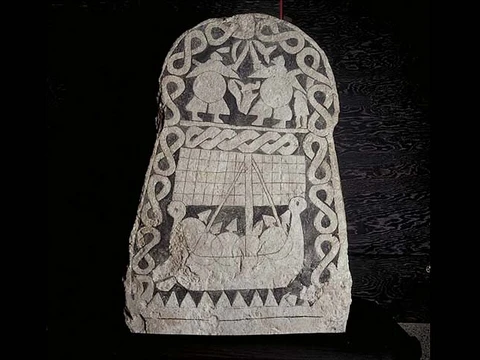
L'Anse aux Meadows
Only confirmed Norse site in North America outside Greenland.

L'Anse aux Meadows is an archaeological site on the northernmost tip of the island of Newfoundland, Canada, first excavated in the 1960s. It is the only undisputed pre-Columbian site of European contact with the Americas outside Greenland, dating to approximately 1000 CE. The site provides evidence of Norse presence in North America and is possibly linked to the accounts of Leif Erikson in the 13th-century Sagas.
The settlement, carbon-dated to a mean of 1014 and tree-ring dated to 1021, contains the remains of eight sod-and-wood buildings spanning a designated area of land and sea. Over 800 Norse artifacts have been unearthed, including bronze, bone, and stone items, as well as evidence of iron production. The largest building measured multiple rooms, while smaller structures served as workshops, including an iron smithy with a forge and slag, a carpentry workshop, and a boat repair area with worn rivets. Everyday finds include a stone oil lamp, a whetstone, a bronze pin, a bone needle, and a spindle fragment, indicating both men and women lived there. Food remains such as butternuts, which do not grow north of New Brunswick, suggest travel south. The Norse also hunted caribou, seal, whale, and other local game. The site likely served as a base camp for exploration, not a permanent settlement, with no burials, agriculture, or animal pens found. Indigenous groups, including the Dorset people, occupied the area centuries before the Norse, but none were contemporaneous. Designated a National Historic Site of Canada in 1968 and a UNESCO World Heritage Site in 1978, the site is managed by Parks Canada.
- location
- Near St. Anthony, Newfoundland and Labrador, Canada
- area
- 8,000 hectares (31 sq mi)
- buildings
- Eight sod-over-wood-frame structures
- artifacts
- Over 800 Norse objects, including bronze, bone, stone, and iron production evidence
- managed_by
- Parks Canada
Lore & Background
L'Anse aux Meadows is an archaeological site on the northernmost tip of Newfoundland, near St. Anthony, in the Canadian province of Newfoundland and Labrador. It contains the remains of eight buildings constructed of sod over a wooden frame, spanning an area of land and sea. The structures include dwellings and workshops, with the largest building consisting of several rooms; smaller buildings may have served as living quarters for lower-status individuals or as workshops. A specialized iron smithy with a forge and slag, a carpentry workshop with wood debris, and a boat repair area with worn rivets have been identified. Over 800 Norse artifacts have been unearthed, including bronze, bone, and stone items such as a stone oil lamp, a whetstone, a bronze fastening pin, a bone needle, and part of a spindle. Stone weights found in one building may have been part of a loom. The presence of the spindle and needle suggests women inhabited the settlement alongside men. Food remains include butternuts, which do not grow naturally north of New Brunswick, indicating travel to the south. Evidence shows the Norse hunted caribou, wolf, fox, bear, lynx, marten, birds, fish, seal, whale, and walrus. The site is the only undisputed pre-Columbian trans-oceanic European settlement in the Americas outside of Greenland, dating to approximately 1,000 years ago. It was first excavated in the 1960s and is managed by Parks Canada.
Reader's Guide
L'Anse aux Meadows, located on the northern tip of Newfoundland, is the only confirmed pre-Columbian European settlement in the Americas outside of Greenland. Excavated in the 1960s, the site contains the remains of eight sod-and-wood buildings, including dwellings, workshops, and an iron smithy with a forge and slag. Over 800 Norse artifacts have been recovered, such as a bronze pin, a stone oil lamp, a bone needle, spindle parts, and stone loom weights, indicating both men and women lived there. The settlement likely served as a base camp for exploring regions to the south, evidenced by butternuts found at the site, which do not grow naturally north of New Brunswick. No burials, agriculture, or animal pens were discovered, suggesting the occupation was temporary and orderly abandoned. The population at any time could have ranged from 30 to 160 people. Tree-ring analysis of wood from the site has dated Norse activity to the year 1021. The site is associated with the 13th-century sagas of Leif Erikson and Erik the Red. It was designated a National Historic Site of Canada in 1968 and a UNESCO World Heritage Site in 1978, managed by Parks Canada.
Did You Know?
- The name 'L'Anse aux Meadows' may be a corruption of the French 'L'Anse aux Méduses' (Jellyfish Cove) or 'L'Anse à la Médée' (Medea Cove).
- The site contains remains of eight buildings, including a forge, carpentry workshop, and boat repair area.
- Evidence of iron production was found at the site.
- The Norse settlement was not contemporaneous with earlier Indigenous occupations, the oldest dating to roughly 6,000 years ago.
Common Misconceptions (Editorial)
Some people mistakenly believe L'Anse aux Meadows was a large, long-term Viking colony, but the facts show it contained only eight sod-over-wood-frame structures and was not contemporaneous with earlier Indigenous occupations. Another common misconception is that the site proved Norse sagas like Leif Erikson’s were literally accurate, but the facts record only a "possible" link to the 13th-century Sagas, not a direct confirmation. A third error is assuming the name has a clear Norse origin, whereas it may be a corruption of French phrases meaning "Jellyfish Cove" or "Medea Cove."
Why It Matters (Editorial)
L'Anse aux Meadows endures because it provides the only undisputed physical proof that Europeans reached the Americas before Columbus, rewriting the narrative of transatlantic contact. Its modest scale—eight buildings and over 800 artifacts—makes the achievement of Norse exploration all the more remarkable, reminding us that history’s most significant discoveries sometimes come from the smallest, most fragile of footprints.
Frequently Asked Questions
What is L'Anse aux Meadows?
It is the sole confirmed Norse settlement in North America outside Greenland, uncovered through excavations that began in the 1960s on Newfoundland's northern coast. The site consists of eight sod-covered wooden buildings dating to roughly the early 11th century.
Where exactly is L'Anse aux Meadows located?
The settlement sits near the community of St. Anthony on the northernmost tip of Newfoundland and Labrador, Canada. The protected area covers approximately 8,000 hectares of coastal terrain.
What artifacts were uncovered at L'Anse aux Meadows?
More than 800 Norse objects have been recovered, spanning bronze, bone, stone, and iron pieces that indicate local metalworking and craft activity. These finds point to a sustained Scandinavian occupation rather than a one-time landing.
More in The Viking Age 1-21
Spotted an error? Know more?
This is a living reference — every entry is fact-audited, and reader corrections feed straight into our audit queue. Suggest an edit · See this site's audit record