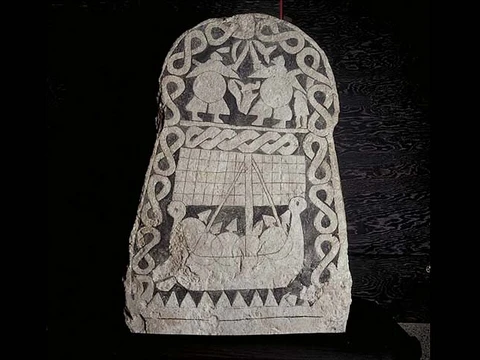
Harald Fairhair
First king of Norway according to medieval sagas.

via Wikipedia: Harald Fairhair · see source
Harald Fairhair (Old Norse: Haraldr Hárfagri; c. 850 – c. 932) is remembered as a Norwegian king. Stories from Norway and Iceland in the 11th and 12th centuries say he ruled from about 872 to 930 and was the first person to be king of all Norway. After his death, two of his sons—Eric Bloodaxe and Haakon the Good—are said to have taken the throne. But most of what we know about him is shaky. The main accounts of his life come from sagas written down roughly three hundred years after he lived. A few fragments of praise poems by his court poet, Þorbjörn Hornklofi, survive, but the sagas themselves disagree on many details.
The meaning of his nickname, *hárfagri*, is tricky to translate. The Old Norse *hár* simply means "hair," while *fagr* means "fair, fine, beautiful"—but without the moral sense of the English word "fair." So *hárfagri* likely means "beautiful-haired," not "blond-haired" (which is what "fair-haired" suggests in English). Some sources say he was earlier called *lúfa*, meaning "thick matted hair," which makes the contrast clearer. For this reason, some translators prefer "the fine-haired" or "handsome-hair," though these have their own problems.
Historians in the 19th and most of the 20th centuries largely accepted the saga version of Harald. But doubts began in 1976 with Peter Sawyer, and around the turn of the 21st century a wave of revisionist research questioned whether Harald Fairhair existed at all—or at least in the form the sagas describe. The arguments are these: No contemporary evidence backs up the sagas. The first king of Norway recorded in near-contemporary sources is Harald Bluetooth (d. c. 985/986), named on the Jelling stones as king of both Denmark and Norway. The late 9th-century account of Norway given by Ohthere to King Alfred the Great (around 890) and Adam of Bremen’s history from 1075 mention no Norwegian king for that period. Although the sagas make Eric Bloodaxe the son of Harald Fairhair, no independent evidence confirms that link. The 12th-century writer William of Malmesbury does mention a Norwegian king called Haraldus visiting King Æthelstan of England (d. 939), which matches saga stories about Harald sending his son Hákon to be fostered by Æthelstan. But William wrote late, Harald was a common name, and he does not give this Harald the epithet "fairhair"—he uses that name for the later king Harald Sigurðarson (Harald Hardrada).
The sagas that mention Harald Fairhair are not independent of each other. They likely all draw on a shared tradition that began with Ari Þorgilsson’s *Íslendingabók*, written in the early 12th century—more than 250 years after Harald supposedly died. Two skaldic poems, *Haraldskvæði* (also called *Hrafnsmál*) and *Glymdrápa*, are said to be about him and attributed to Þorbjörn hornklofi (or, for the first, to Þjóðólfr of Hvinir). They survive only in 13th-century sagas but may have been passed down orally from the 10th century. The first poem describes life at the court of a king named Harald, says he took a Danish wife, and won a battle at Hafrsfjord. The second lists battles won by a king named Harald. But the poems don’t match the saga stories well, and the sagas themselves often disagree on details. The most reliable manuscripts of *Haraldskvæði* call the king Harald Hálfdanarson, not Harald hárfagri, and *Glymdrápa* gives no epithet at all. All the poems really show is that there was once a king named Harald (Hálfdanarson).
Sources from the British Isles, independent of the Icelandic saga tradition and mostly older, do mention a king whose name matches Old Norse *Haraldr inn hárfagri*—but they use it for the well-documented Harald Sigurðarson (d. 1066, often called Harald Hardrada). These include manuscript D of the *Anglo-Saxon Chronicle* ("Harold Harfagera," under 1066), and histories by Orderic Vitalis ("Harafagh"), John of Worcester ("Harvagra"), William of Malmesbury ("Harvagre"), Marianus Scotus of Mainz ("Arbach"), and the *Life of Gruffudd*.
- born
- c. 850
- died
- c. 932
- field
- Monarchy
- nationality
- Norwegian
- known_for
- First King of Norway (according to later sagas); national icon of Norway
Lore & Background
Harald Fairhair is described in several Kings' sagas, none older than the twelfth century. Their accounts of his life differ on many points, but it is clear that in the twelfth and thirteenth centuries Harald was regarded as having unified Norway into one kingdom. Supposedly, two of his sons, Eric Bloodaxe and Haakon the Good, succeeded Harald to become kings after his death. Much of his biography is uncertain. A couple of praise poems by his court poet Þorbjörn Hornklofi survive in fragments, but the extant accounts of his life come from sagas set down around three centuries after his lifetime. The Old Norse epithet hárfagri means 'beautiful-haired', not 'fair-haired' in the sense of blond. According to some sources, Harald previously bore the epithet lúfa, '(thick) matted hair'.
Reader's Guide
Since the nineteenth century, when Norway was in a personal union with Sweden, Harald has become a national icon of Norway and a symbol of independence. Though the king's sagas and medieval accounts have been critically scrutinised during the twentieth and early twenty-first centuries, Harald maintains a reputation as the father of the Norwegian nation. At the turn of the 21st century, a few historians have argued that Harald Fairhair did not exist as a historical figure. Scholarly consensus now falls into two camps. One suggests the medieval Icelandic and Norwegian historiography of Harald Fairhair is part of an origin myth created to explain the settlement of Iceland, perhaps in which a cognomen of Haraldr Sigurðarson was transferred to a fictitious early king of all Norway. The other camp, including historians like Claus Krag and Hans Jacob Orning, accepts Harald's existence based on early skaldic poetry, while remaining skeptical regarding the saga accounts. Orning argued in 2015 that Harald was based in Sogn, an area Snorri Sturluson associated with Harald and which was a centre of power in the ninth century.
Did You Know?
- The Old Norse epithet hárfagri means 'beautiful-haired', not 'fair-haired' in the sense of blond.
- According to some sources, Harald previously bore the epithet lúfa, meaning '(thick) matted hair'.
- The first king of Norway recorded in near-contemporary sources is Harald Bluetooth (d. c. 985/986), not Harald Fairhair.
- Sources from the British Isles use the name 'Harald Harfagera' (or similar) for Haraldr Sigurðarson (Harald Hardrada, d. 1066), not for Harald Fairhair.
- The most reliable manuscripts of the poem Haraldskvæði call its honorand Haraldr Hálfdanarson rather than Haraldr hárfagri.
Common Misconceptions (Editorial)
A common misconception is that “Fairhair” means the king had fair or blond hair; in fact, the Old Norse epithet *hárfagri* means “beautiful-haired.” Another is that Harald Fairhair was the first historically recorded king of Norway; however, the first Norwegian king attested in near-contemporary sources is Harald Bluetooth (d. c. 985/986), not Harald Fairhair.
Why It Matters (Editorial)
Harald Fairhair endures as a national icon of Norway, symbolizing the unification of the country even if his biography is largely a product of later saga traditions. His story reflects how medieval chroniclers and modern nations alike can shape a legendary figure to embody a desired origin myth, making him as much a cultural touchstone as a historical question mark.
Frequently Asked Questions
Who is Harald Fairhair?
Harald Fairhair (Old Norse: Haraldr Hárfagri) was a late-ninth-century Norwegian ruler traditionally regarded as the first king to hold the whole of Norway under one crown. He lived roughly from 850 to 932 and remains a central figure in Norwegian national identity.
How did Harald Fairhair become king of Norway?
The medieval sagas describe him defeating rival chieftains in a series of confrontations, culminating in the battle at Hafrsfjord around 872. That victory is conventionally treated as the moment scattered regional lords were subordinated into a single Norwegian kingdom.
How does Harald Fairhair's story end?
The sagas place his death around 930–932, but the precise circumstances are vague because the sources were written centuries later. After his passing, his sons divided the realm among themselves, and Norway reverted to a patchwork of regional rulers for a time.
Why is Harald Fairhair important to Viking Age history?
He is the figure most often credited with stitching Norway's independent chieftaincies into one political unit, giving the medieval writers a concrete origin point for the Norwegian monarchy. His legacy shaped how later Icelandic and Norwegian authors framed the very idea of a Norwegian state.
How reliable is the historical record of Harald Fairhair?
The principal narratives come from Icelandic and Norwegian sagas composed roughly three hundred years after his lifetime, so specific battles, dates, and dialogue are heavily debated. Most scholars accept that a powerful late-ninth-century Norwegian ruler existed, but they treat the saga details as layered tradition rather than straightforward fact.
More in The Viking Age 1-21
Spotted an error? Know more?
This is a living reference — every entry is fact-audited, and reader corrections feed straight into our audit queue. Suggest an edit · See this site's audit record