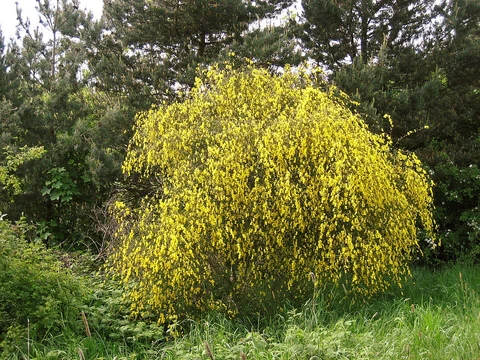
Gossypium hirsutum
The most widely planted cotton species, dominating global production.
Last updated
Gossypium hirsutum, commonly called upland cotton or Mexican cotton, is the planet's most planted cotton species. Cultivars from this plant account for roughly 90% of global cotton output. In the United States—the top cotton exporter worldwide—this species makes up about 95% of production. Its native range stretches from Mexico down to Ecuador and northeastern Brazil, and also includes the Leeward Antilles in the Caribbean.
Scientists believe this species originated as an allotetraploid from hybridization between a New World diploid species (related to Gossypium raimondii) and an Old World diploid species (related to Gossypium herbaceum or Gossypium arboreum) some 1–2 million years ago. That hybridization produced a new species with 26 pairs of chromosomes (52 total) through polyploidy. The original wild range centers on the Yucatán Peninsula, where researchers have found the greatest genetic diversity among wild samples. The earliest known evidence of cotton cultivation in the Americas comes from the Tehuacan Valley in Mexico, where archaeological remains show G. hirsutum was grown as far back as 3,500 BC, though exactly where it was first domesticated remains unknown.
The species includes many varieties and cross-bred cultivars, which differ in fiber length and tolerance to various growing conditions. Longer-fiber types are called "long staple upland," while shorter-fiber ones are "short staple upland"; the long staple varieties dominate commercial farming.
Beyond fiber, G. hirsutum and G. herbaceum are the main sources of cottonseed oil. The Zuni people use this plant to make ceremonial garments, and its fuzz is twisted into cords for ceremonial purposes. The plant also produces extrafloral nectar.
Scientific classification
- CladeTracheophytes
- CladeAngiosperms
- CladeEudicots
- CladeRosids
- OrderMalvales
- FamilyMalvaceae
- GenusGossypium
- SpeciesGossypium hirsutum
Named by L.
Close relatives
Other species of Gossypium with a Codexery entry.
- Gossypium arboreum Gossypium arboreum
Sources: Wikipedia taxobox: Gossypium hirsutum (CC BY-SA 4.0)
Conservation status
Vulnerable (VU)
- LC
- NT
- VU▲ this species
- EN
- CR
- EW
- EX
Source: IUCN Red List assessment · GBIF copy of the Red List category
Where the gossypium hirsutum has been recorded
Each dot is a place where the species has been observed and reported (9,599 records, half-degree grid) — not a modelled range. 404 inland records left out (institution coordinates).
Map: drawn by Codexery. Data: GBIF occurrence search (records CC0 / CC BY) · Natural Earth basemap (public domain) · place coordinates: Wikipedia (CC BY-SA 4.0)
Quick Facts
- Species
- hirsutum
Facts from the source article.
Lore & Background
Gossypium hirsutum is an allotetraploid that arose from hybridization between a New World diploid species (related to Gossypium raimondii) and an Old World diploid species (related to Gossypium herbaceum or Gossypium arboreum) around 1–2 million years ago, resulting in 26 pairs of chromosomes (52 total) via polyploidy. Its original native range centers on the Yucatán Peninsula, where researchers have found the greatest genetic diversity among wild samples. Archaeological evidence from the Tehuacan Valley in Mexico shows cultivation as long ago as 3,500 BC, though the exact location of first domestication remains unknown.
Reader's Guide
Gossypium hirsutum is of paramount significance as the dominant cotton species in global agriculture, accounting for approximately 90% of all cotton production worldwide. Its cultivars form the backbone of the textile industry, particularly in the United States, which is the world's largest cotton exporter and relies on this species for about 95% of its cotton output. The species' long staple varieties are especially valued in commercial production for their fiber length.
Its hybrid origin, involving a cross between a wild Mexican species and the African Gossypium herbaceum around 5–10 million years ago, highlights the role of polyploidy in plant evolution. The earliest evidence of its cultivation in the Americas dates to 3,500 BC in the Tehuacan Valley, Mexico, though the exact domestication site remains unknown. Beyond textiles, the species is a key source of cottonseed oil.
Its cultural importance is seen in its ceremonial use by the Zuni people. The species' extrafloral nectar production is a notable biological trait. Overall, Gossypium hirsutum is a cornerstone of modern agriculture and a species with deep historical and ecological roots.
More in Trees & Shrubs
Sources
Compiled from Wikipedia and the sources listed below. Text from Wikipedia is available under CC BY-SA 4.0; this entry is adapted from it.
- Wikipedia: Gossypium hirsutum (CC BY-SA 4.0).
- Conservation status: IUCN Red List assessment.
- Occurrence records: GBIF (CC0 / CC BY). Basemap: Natural Earth (public domain).
Spotted an error? Know more?
Reader corrections go straight into our review queue. Suggest an edit · How this site is sourced