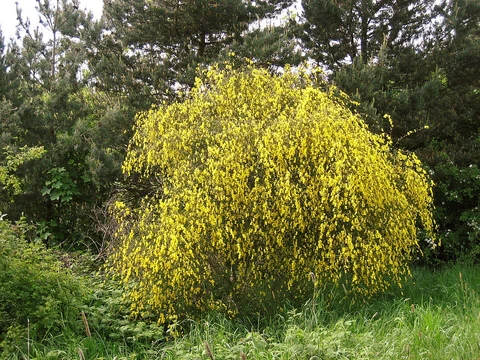
Juniperus communis
Evergreen conifer with the largest range of any woody plant.

Juniperus communis, known as common juniper, is a small tree or shrub that belongs to the cypress family. This evergreen conifer boasts the widest natural range of any woody plant, growing across the cool temperate regions of the Northern Hemisphere in a Holarctic distribution. Its form varies greatly: it can reach up to 10 meters tall (rarely 16 meters), or in exposed areas, it grows as a low, sprawling shrub. The needle-like leaves are arranged in whorls of three, are green, and have a single white stomatal band on the underside. While primarily retaining juvenile foliage, some mature individuals—especially in certain subspecies or under specific conditions—can develop scale-like leaves. The species is dioecious, meaning male and female cones grow on separate plants, relying on wind to carry pollen from male to female cones. Contrary to some claims, there is no widely accepted scientific evidence that male trees or shrubs consistently outlive females, nor are there verified records of individuals exceeding 2,000 years. Male cones are yellow, 2–3 millimeters long, and drop soon after releasing pollen in March or April. The fruit are berry-like cones called juniper berries. They start green and ripen over 18 months to a purple-black color with a blue waxy coating. These berries are spherical, 4–12 millimeters in diameter, and usually contain three (sometimes six) fleshy, fused scales, each holding a single seed. Birds eat the cones, digest the fleshy scales, and disperse the hard, wingless seeds in their droppings. Dendrochronological studies in the tundra have uncovered exceptionally old specimens, though the oldest reliably dated Juniperus communis are generally much younger than some unverified claims. A widely cited but unconfirmed record from Lapland, Finland, inside the Arctic Circle, suggests an age of 1,647 years, but this lacks authoritative citation in established dendrochronological literature. The oil from juniper berries is mostly made up of monoterpene hydrocarbons, including α-pinene, myrcene, sabinene, limonene, and β-pinene. Given its vast range, *J. communis* is highly variable, with several infraspecific taxa. However, the boundaries between these taxa remain uncertain, as genetic data do not align well with morphological traits. - subsp. communis – Common juniper.
Quick Facts
- Genus
- Juniperus
- Parent
- Juniperus subsect. Juniperus
- Species
- communis
Facts from the source article.
Lore & Background
Juniperus communis is dioecious, with male and female cones on separate plants, requiring wind pollination. Claims that male trees or shrubs naturally live longer than females, with some exceeding 2,000 years, are not supported by established botanical canon. A widely repeated but unverified dendrochronological report from Finland's Arctic Circle suggests a 1,647-year-old specimen, but this is not a confirmed record in scientific literature. The fruit are berry-like cones known as juniper berries, ripening in 18 months to purple-black with a blue waxy coating; they are dispersed when birds eat them.
Reader's Guide
Juniperus communis is significant for its vast Holarctic distribution, making it the most widespread woody plant. Its berries are used to flavor gin, beer, and traditional farmhouse ales across northern Europe, with archaeological evidence of use in brewing dating to the 3rd–6th centuries AD. The wood, though too small for general lumber, is valued in Scandinavia and Estonia for containers, butter knives, and decorative items, and in French pocketknife handles. In traditional medicine, Native American tribes used the berries as a female contraceptive and in herbal teas. The species is also cultivated ornamentally, with several cultivars receiving the Royal Horticultural Society's Award of Garden Merit in 1993.
More in Trees & Shrubs 1-24
Spotted an error? Know more?
Reader corrections go straight into our review queue. Suggest an edit · How this site is sourced