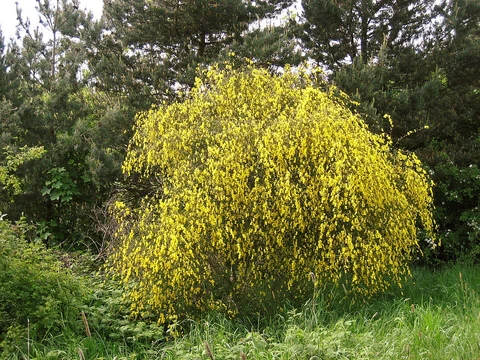
Cupressaceae
Conifer family including redwoods, cypresses, and junipers.

Cupressaceae, the cypress family, is a family of conifers that includes 27–30 genera (17 monotypic), such as cypresses, junipers, and redwoods, with about 130–140 species total. They are monoecious, subdioecious, or rarely dioecious trees and shrubs up to 116 m tall, with bark that is often orange- to red-brown and stringy. The family reached its peak of diversity during the Mesozoic era.
Quick Facts
- Taxon
- Cupressaceae
Facts from the source article.
Lore & Background
Cupressaceae is a widely distributed conifer family, found on all continents except Antarctica, from 70°N in arctic Norway (Juniperus communis) to 55°S in southernmost Chile (Pilgerodendron uviferum). Juniperus indica reaches 4930 m altitude in Tibet. Most habitats are occupied except polar tundra and tropical lowland rainforest, though several species are important in temperate rainforests and tropical highland cloud forests; few species tolerate severe drought, notably Cupressus dupreziana in the central Sahara. Many genera and species show restricted relictual distributions, and many are endangered. The earliest confirmed fossils of Cupressaceae date to the Late Triassic.
Reader's Guide
Cupressaceae is significant for containing the world's largest tree (Sequoiadendron giganteum) and current tallest tree (Sequoia sempervirens), as well as six of the ten longest-lived tree species. Many species are important timber sources, including Calocedrus, Chamaecyparis, Cryptomeria, Cunninghamia, Cupressus, Sequoia, Taxodium, and Thuja. Calocedrus decurrens is the main wood for wooden pencils. Juniperus virginiana heartwood is fragrant and used in clothes chests to repel moths, and its oil is used in perfumes and medicines. Several genera are important in horticulture, with hundreds of cultivars of junipers, Chamaecyparis, and Thuja. Some species have cultural significance: Taxodium mucronatum is the national tree of Mexico; coast redwood and giant sequoia are jointly the state tree of California; bald cypress is the state tree of Louisiana. The fleshy cones of Juniperus communis flavor gin. Native Americans and early European explorers used Thuja leaves as a cure for scurvy.
Did You Know?
- The earliest confirmed fossils of Cupressaceae are from the Late Triassic, not the Early Jurassic.
- Juniperus virginiana (eastern redcedar) is the main wood used to make wooden pencils.
Morphological Architecture & Life Cycle
The cypress family encompasses roughly 130 to 140 species spread across 27 to 30 genera, seventeen of which contain only a single species. These trees and shrubs can reach extraordinary heights of up to 116 meters, and they display a range of reproductive strategies, from monoecious and subdioecious arrangements to the rarer dioecious condition. Mature bark typically presents an orange to red-brown hue with a stringy texture that peels away in vertical strips, though certain species exhibit smooth, scaly, or hard square-cracked surfaces instead. Foliage arrangement varies by genus—spirally, in decussate pairs offset at right angles, or in whorls of three or four. Young plants often bear needle-like leaves that transition to small scale-like forms on mature individuals, while a few genera retain their needle shape indefinitely. Rather than dropping leaves one by one, most species shed them in small sprays through a process called cladoptosis. Leaves generally persist for two to ten years, yet three genera—Glyptostrobus, Metasequoia, and Taxodium—include deciduous members. Seed cones range from woody and leathery to the fleshy, berry-like structures seen in Juniperus, and the seeds themselves vary from small and two-winged to larger and entirely wingless.
Near-Global Reach & Ecological Breadth
Few conifer families match the geographic span of Cupressaceae, whose members occupy every continent except Antarctica. At the northern extreme, Juniperus communis thrives at 70°N in arctic Norway, while at the southern limit, Pilgerodendron uviferum pushes to 55°S in the far south of Chile—further south than any other conifer species on Earth. Elevation tolerance is equally remarkable: Juniperus indica climbs to 4,930 meters in the Tibetan plateau. The family claims nearly every terrestrial habitat, with the notable exceptions of polar tundra and tropical lowland rainforest, though several species serve as key components of temperate rainforests and tropical highland cloud forests. Deserts pose a particular challenge, and only a handful of species tolerate severe drought, with Cupressus dupreziana standing out as a survivor in the central Sahara. Despite this broad overall distribution, the family harbors a troubling pattern: many genera and species occupy very restricted relictual ranges, and a significant number are classified as endangered, making conservation a pressing concern for this group.
Deep Roots: Fossil Record & Taxonomic Revision
The evolutionary story of Cupressaceae stretches back to the Mesozoic era, when the family reached its peak of diversity. The oldest definitive fossil record is Austrohamia minuta, recovered from Early Jurassic deposits in Patagonia, whose reproductive structures closely resemble those of the primitive living genera Taiwania and Cunninghamia. By the Middle to Late Jurassic, cypress relatives were abundant across warm temperate and tropical regions of the Northern Hemisphere, and diversity continued climbing through the Cretaceous. The non-taxodiaceous clade first appears in the mid-Cretaceous, represented by Widdringtonia americana from the Cenomanian of North America, before diversifying further in the Late Cretaceous and early Cenozoic. Modern molecular and morphological research has dramatically reshaped the family's taxonomy: the once-separate Taxodiaceae was absorbed into Cupressaceae because no consistent distinguishing characteristics could be found, while Sciadopitys was extracted into its own monotypic family. The family is now organized into seven subfamilies, with five forming a basal grade leading to the core group. Molecular evidence places Cupressaceae as the sister group to the yews, with their lineages diverging in the early to mid Triassic, and the combined clade splitting from Sciadopityaceae even earlier, in the early to mid Permian.
Giants of the Forest & Human Partnership
Among the superlatives of the plant kingdom, Cupressaceae holds a commanding position. The world's largest tree, Sequoiadendron giganteum, and the current tallest, Sequoia sempervirens, both belong to this family. Remarkably, six of the ten longest-lived tree species on Earth are also cypress family members, underscoring a lineage defined by extraordinary longevity and massive growth. Beyond their awe-inspiring physical dimensions, these trees have been deeply intertwined with human civilization as vital timber sources. Genera such as Calocedrus, Chamaecyparis, Cryptomeria, Cunninghamia, Cupressus, Sequoia, Taxodium, and Thuja have all been important providers of wood, with Calocedrus decurrens singled out as a particularly significant timber species. The family's ecological versatility—spanning arctic regions, alpine elevations, temperate rainforests, and even the driest stretches of the central Sahara—has made its members available to human communities across an astonishing range of climates, cementing their role as both ecological keystone species and practical resources for generations.
Frequently Asked Questions
What is Cupressaceae?
Cupressaceae is the botanical family that unites conifers commonly known as cypresses, junipers, and redwoods. It is distinguished by its scale-like or fine needle-like foliage, woody seed cones, and often stringy orange- to red-brown bark.
Which are the most famous members of Cupressaceae?
The family holds two planetary superlatives: the giant sequoia (Sequoiadendron giganteum), the largest tree by trunk volume, and the coast redwood (Sequoia sempervirens), the tallest living tree. It also accounts for six of the ten longest-lived tree species on Earth.
How diverse is the Cupressaceae family?
The family encompasses roughly 27 to 30 genera and about 130 to 140 species in total, with 17 of those genera being monotypic (containing a single species). Its peak of diversification took place during the Mesozoic era.
Where do Cupressaceae trees and shrubs grow?
Their range is nearly global, extending from arctic Norway at around 70°N down to southernmost Chile near 55°S. Members of the family can be found in temperate, subtropical, and even some arid environments across multiple continents.
Why is Cupressaceae considered important in botany?
Beyond producing the world's tallest and largest trees, the family includes some of the oldest living organisms known, making it central to studies of tree longevity. Its varied reproductive strategies—monoecious, subdioecious, and rarely dioecious—also make it a key group for understanding conifer evolutionary biology.
More in Trees & Shrubs 1-24
Spotted an error? Know more?
Reader corrections go straight into our review queue. Suggest an edit · How this site is sourced