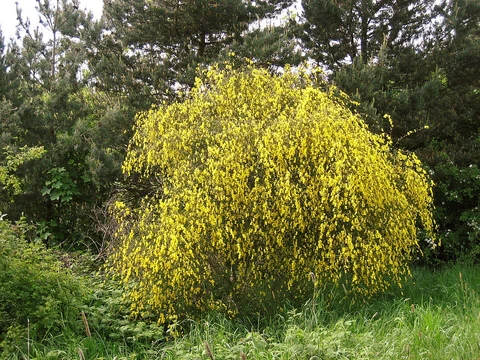
Conifer
Woody, cone-bearing plants dominant in northern forests.

Conifers are a type of vascular plant and a subgroup of gymnosperms. They are woody trees or shrubs, mostly evergreen, with a consistent branching pattern. They reproduce using male and female cones, typically both on the same tree. Pollination happens through the wind, and the seeds are usually carried by the wind as well. Taxonomically, they form the division Pinophyta, also called Coniferae. All living conifers are perennials that undergo secondary growth. There are more than 600 species alive today.
The earliest conifer fossils date back over 300 million years to the Carboniferous period. They became the dominant land plants during the Mesozoic era, but lost that dominance when flowering plants spread across many ecosystems in the Cretaceous. Today, many conifers are relict species, meaning they survive only in small portions of their former ranges. Examples include Wollemia, found only in a small area of New South Wales, Australia, and Metasequoia glyptostroboides, known from Cretaceous fossils and now living in a small region of China.
Even though the number of conifer species is relatively low, they are ecologically crucial. They dominate the taiga of the Northern Hemisphere. Boreal conifers have several adaptations for surviving winter: a conical shape that helps shed snow, strong tracheid vessels that withstand ice pressure, and a waxy coating on their needle-like leaves to reduce water loss. Many fungi form ectomycorrhizal associations with conifers, while other fungi cause diseases like needle cast, which is especially damaging to young trees. Conifers are also attacked by pest insects, such as wood-boring longhorn beetles and bark beetles, which create galleries just under the bark. As of 2025, 94 conifer species are listed as endangered, and 30 as critically endangered. Conifers are highly valuable economically for timber and paper production.
All living conifers are woody plants; most are trees with narrow, often needle-shaped leaves. Each conifer produces separate male and female cones. Pollination is always by wind, and the seeds are mostly winged, though they are not samaras—a type of fruit unique to flowering plants. The trees have a regular branching pattern, and many produce a distinctly scented resin. The world’s tallest and oldest living trees are conifers.
Quick Facts
- Taxon
- Pinopsida
Facts from the source article.
Lore & Background
Conifers are woody plants, mostly trees, with narrow, often needle-shaped leaves. They produce separate male and female cones on the same tree, and pollination is always by wind. The seeds are mostly winged, but they are not samaras—those are a type of fruit found only in flowering plants. Many conifers have distinctly scented resin. The world's tallest living tree is a coast redwood (Sequoia sempervirens) at 116.07 meters, and the oldest non-clonal living tree is a Great Basin bristlecone pine (Pinus longaeva) at 4,700 years old. Among the smallest is the pygmy pine (Lepidothamnus laxifolius) of New Zealand, seldom taller than 30 cm when mature.
Reader's Guide
Conifers are ecologically important despite their relatively small number of species. They are the dominant plants over the taiga of the Northern Hemisphere. Boreal conifers have multiple adaptations to survive winters, including a conical shape to shed snow, strong tracheid vessels to tolerate ice pressure, and a waxy covering on needle leaves to minimize water loss. Many fungi form ectomycorrhizal associations with conifers, while others cause diseases such as needle cast. Conifers are affected by pest insects like wood-boring longhorn beetles and bark beetles. Conifers are of great economic value for timber and paper production. Their wood contains tracheids making up over 90% of timber volume, and they secrete oleoresin that traps insects and blocks fungi. Conifers reproduce via cones, with most species monoecious and wind-pollinated. Some produce nut-like seeds dispersed by birds, and fire-adapted pines store seeds in closed cones released only by fire.
Evolutionary Depth and Relict Lineages
Conifers represent one of the oldest lineages of vascular plants still thriving on Earth. Their fossil record stretches back more than three hundred million years to the Carboniferous period, and they went on to dominate terrestrial ecosystems throughout the Mesozoic era. That supremacy ended when flowering plants expanded into many habitats during the Cretaceous, squeezing conifers into narrower ecological niches. Today, over six hundred living species remain, all classified within the division Pinophyta (also called Coniferae), and nearly all are perennials capable of secondary growth. A striking consequence of their long history is that several modern conifers are relicts—species clinging to tiny fragments of once-vast ranges. Wollemia, for instance, is known only from a restricted stretch of New South Wales in Australia, while Metasequoia glyptostroboides, long familiar from Cretaceous fossils, survives in a small pocket of China. These living fossils underscore how dramatically the plant world has shifted over geological time, leaving conifers as both ancient survivors and ecological workhorses.
Boreal Survival and Ecological Interactions
In the vast taiga of the Northern Hemisphere, conifers are the undisputed dominant vegetation, and their success in harsh winters rests on a suite of specialized adaptations. The classic conical crown shape allows snow to slide off rather than accumulate and snap branches. Beneath the bark, robust tracheid cells withstand the pressure of ice forming in cold tissue, while a waxy cuticle on needle-shaped leaves sharply reduces transpiration during frozen months. These trees do not exist in isolation, however. Many fungi form beneficial ectomycorrhizal partnerships with conifer roots, extending the tree's access to soil nutrients. Other fungi are destructive, causing needle cast that is particularly lethal to young trees. Insect pressures are equally significant: wood-boring longhorn beetles tunnel into the wood, and bark beetles carve galleries just beneath the surface, girdling the tree. As of 2025, ninety-four conifer species are listed as endangered and thirty as critically endangered, a sobering reminder that even these hardy lineages face serious threats.
Morphological Extremes and Foliage Diversity
Conifers span an extraordinary range of sizes and forms. The tallest living tree on Earth is a coast redwood reaching 116.07 metres, while the smallest is New Zealand's pygmy pine, rarely exceeding thirty centimetres at maturity. In terms of age, the Great Basin bristlecone pine holds the record as the oldest non-clonal living organism at roughly four thousand seven hundred years. Foliage varies widely: pines, firs, and cedars bear long needle-like leaves, whereas cypresses carry flat, triangular scales. Most species arrange their leaves spirally, though many Cupressaceae place them in opposite pairs or whorls. In species like Abies grandis, leaf bases twist to present a flat, light-catching plane. Needle length ranges from two millimetres in scale-leaved species to six hundred millimetres in longleaf pine. Stomata can close during drought or cold, and leaf colour shifts from deep green at high latitudes to yellow-green or even blue-silver in UV-reflective species. Five genera—Larix, Pseudolarix, Glyptostrobus, Metasequoia, and Taxodium—are deciduous, shedding foliage each autumn, while most retain leaves for two to forty years.
Wood Architecture and Chemical Defense
The internal structure of conifer wood is remarkably uniform, composed almost entirely of two cell types: oval parenchyma cells and strongly elongated tracheids, the latter accounting for over ninety percent of timber volume. Each annual growth ring follows a consistent pattern: earlywood tracheids with large lumens and thin walls give way through a transition zone to latewood tracheids with small lumens and thick walls. Medullary rays, made of parenchymal cells, facilitate radial gas exchange and serve as conduits for stored water and nutrients. Latewood also houses resin canals lined with specialised epithelial cells that secrete oleoresin—a blend of turpentine and rosin. This chemical is a critical defence: when an insect or fungus breaches the bark, oleoresin floods the wound, trapping invaders and blocking fungal spread before the rosin component hardens to seal the injury. Beyond biology, conifer wood is of immense economic importance for timber and paper production, and indigenous communities such as the Gitxsan harvest conifer rosin during wet weather as a practical fire-starting material.
Frequently Asked Questions
What is a conifer?
A conifer is a woody, cone-bearing plant that belongs to the gymnosperm group and is classified under the division Pinophyta. Most species are evergreen trees or shrubs with a regular branching structure, and they make up the dominant vegetation in northern boreal forests.
How do conifers reproduce?
Conifers use both male and female cones, which are typically found on the same individual tree. Pollination is carried out by wind rather than insects, and the resulting seeds are also generally dispersed by wind currents.
What is the tallest living conifer?
The coast redwood (Sequoia sempervirens) holds the record as the tallest known conifer, reaching a height of 116.07 meters. It is a species native to the foggy coastal forests of California.
How long have conifers existed?
The earliest known conifer fossils date back more than 300 million years to the Carboniferous period. Today, over 600 living species still thrive across the globe, making them one of the longest-surviving plant lineages.
Why are conifers ecologically and economically important?
Conifers dominate the taiga biome and serve as a primary source of timber and paper for human industry. They also include the oldest non-clonal living tree on Earth, the Great Basin bristlecone pine, which is approximately 4,700 years old.
More in Trees & Shrubs 1-24
Spotted an error? Know more?
Reader corrections go straight into our review queue. Suggest an edit · How this site is sourced