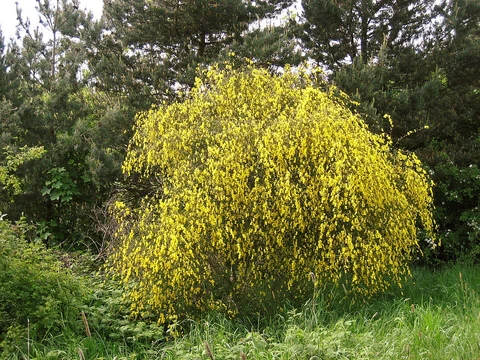
Juniperus californica
A drought-tolerant juniper native to southwestern North America.

Juniperus californica, called the California juniper, is a juniper species native to the southwestern part of North America. It grows as a multi-stemmed shrub or a small tree with a rounded crown, typically reaching 3–8 meters tall, though it can occasionally hit 10 meters. Its bark is gray and peels off in thin strips, while smaller branchlets stay smooth. The shoots are fairly thick for a juniper, measuring 1.5 to 2 millimeters across. The foliage is bluish-gray and scale-like; seedlings produce needle-like juvenile leaves 5 to 10 millimeters long. Adult leaves are scale-like, arranged in opposite pairs or whorls of three, and range from 1 to 5 millimeters long on lead shoots and 1 to 1.5 millimeters wide. The berrylike cones are 7 to 13 millimeters across, blue-brown with a whitish waxy coating that turns reddish-brown, and usually contain a single seed (rarely two or three). Seeds mature in about 8 or 9 months. Male cones are 2 to 4 millimeters long and release pollen in early spring. This juniper is mostly dioecious, with cones of only one sex per plant, but about 2% of plants are monoecious, bearing both sexes. It differs from western juniper by having 1–2 seeds per cone (versus 2–3), cones that mature in one year, and a multi-stemmed habit instead of a single trunk. Compared to Utah juniper (*J. osteosperma*), *J. californica* is dioecious with noticeable glands on the leaf undersides, while Utah juniper is monoecious with inconspicuous, embedded glands.
The species is mainly found across many California habitats, but its range also extends through most of Baja California, a short way into the Great Basin in southern Nevada, and into northwestern Arizona. In California, it occurs in the Peninsular Ranges, Transverse Ranges, Coast Ranges, Sacramento Valley foothills, Sierra Nevada, and higher-elevation sky islands in the Mojave Desert ranges. It also grows off the continental shelf on Guadalupe Island in the Pacific Ocean, where fewer than 10 individuals remain. It thrives at moderate altitudes of 750–1,600 meters, in habitats like pinyon–juniper woodland with single-leaf pinyon (*Pinus monophylla*), Joshua tree woodland, and foothill woodlands within montane and interior chaparral and woodlands sub-ecoregions.
The International Union for Conservation of Nature lists it as least concern and not globally threatened.
Quick Facts
- Genus
- Juniperus
- Parent
- Juniperus sect. Sabina
- Species
- californica
Facts from the source article.
Lore & Background
Juniperus californica grows at moderate altitudes of 750–1,600 meters in habitats such as pinyon–juniper woodland, Joshua tree woodland, and foothill woodlands. Its bark is gray and exfoliates in thin strips, while its shoots are fairly thick compared to most junipers. The foliage is bluish-gray and scale-like, with juvenile leaves needle-like and adult leaves arranged in opposite decussate pairs or whorls of three.
The species is largely dioecious, with about 2% of plants being monoecious. Its berrylike cones mature in about 8 or 9 months and contain a single seed (rarely two or three). The California juniper can be distinguished from western juniper by its multi-stemmed habit and 1–2 seeds per cone, and from Utah juniper by its dioecious nature and conspicuous abaxial glands.
Historically, the plant was used by Native American peoples including the Cahuilla, Kumeyaay, Serrano, and Ohlone. They gathered berries to eat fresh or grind into meal, and the wood was used for sinew-backed bows. The Ohlone also made decoctions of the leaves to relieve pain and cause sweating.
Reader's Guide
Juniperus californica is significant as a keystone species in several California ecosystems, providing food and shelter for wildlife such as turkeys and deer, though it becomes too tall for ground animals as it matures. It is a larval host for the sequoia sphinx moth. The species is listed as least concern by the IUCN, but one southern population on Guadalupe Island was nearly destroyed by feral goats in the late 19th century, with fewer than 10 individuals remaining.
Cultivation of the California juniper is valued in habitat gardens, heat- and drought-tolerant landscapes, and for erosion control on dry slopes. It is highly tolerant of alkali soil and is also a popular species for bonsai. Its traditional uses by indigenous peoples highlight its role as both a food source and medicinal plant, though the Ohlone reportedly considered the taste of the berries poor. The species' ability to thrive in harsh, arid conditions makes it an important component of pinyon–juniper and Joshua tree woodlands across its range.
Did You Know?
- The California juniper is largely dioecious, but about 2% of plants are monoecious, with both sexes on the same plant.
- The species is found on Guadalupe Island in the Pacific Ocean, where fewer than 10 individuals remain after near destruction by feral goats.
More in Trees & Shrubs 1-24
Spotted an error? Know more?
Reader corrections go straight into our review queue. Suggest an edit · How this site is sourced