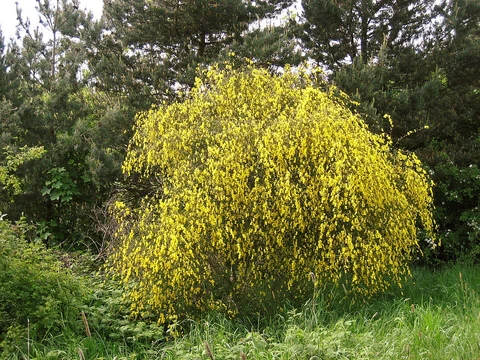
Hesperocyparis lusitanica
A conifer native to Mexico and Central America, widely cultivated.

Hesperocyparis lusitanica, known as Mexican cypress, cedar-of-Goa, or Goa cedar, is a species of conifer in the cypress family Cupressaceae. It is native to Mexico and Central America (Guatemala, El Salvador, and Honduras) and has been introduced to Belize, Costa Rica, and Nicaragua, growing at altitudes of 1,200–3,000 meters. Its scientific name refers to its early cultivation in Portugal, where plants imported from Mexico were grown at the monastery at Buçaco near Coimbra around 1634; these trees were over 130 years old when the species was botanically described by Philip Miller in 1768.
Quick Facts
- Genus
- Hesperocyparis
- Species
- lusitanica
Facts from the source article.
Lore & Background
Hesperocyparis lusitanica was first scientifically named Cupressus lusitanica by botanist Philip Miller in 1768, based on collections made in Portugal. The species has many synonyms, and Hesperocyparis benthamii has been treated as a variety or subspecies. In 2009, a paper moved this species and most New World Cupressus to the new genus Hesperocyparis; as of 2024, this is the accepted name with no subspecies or varieties according to Plants of the World Online, World Flora Online, and the Gymnosperm Database. In Mexico, it is also called cedro blanco (white cedar) or teotlate.
Reader's Guide
Hesperocyparis lusitanica is significant for its wide cultivation as an ornamental tree and for timber production in warm, temperate, and subtropical regions worldwide. It is fast-growing and drought-tolerant but only slightly frost-tolerant. It has been introduced to New Zealand, and planted commercially at high altitudes in Colombia (up to 3,300 m), Bolivia, Ethiopia, and South Africa, as well as near sea level in New Zealand. In Colombia, it is used for windbreak hedges and soil erosion prevention; Tanzanian mountain farmers have planted it for soil preservation and commercial use since the 1990s. It has also been planted ornamentally near sea level in Portugal, Buenos Aires Province in Argentina, Austin, Texas, and the British Isles, where it can reach 30 meters. In San Luis, Argentina, it is planted at 1,500 m to create artificial forests in a climate similar to its native habitat. Its cultivation in southern Asia has caused confusion with native Cupressus species, with nurseries sometimes selling it under Asian species names like Cupressus torulosa.
Did You Know?
- The scientific name lusitanica (of Portugal) refers to its early cultivation at the monastery at Buçaco, near Coimbra, Portugal, around 1634.
- Unlike some cypress species, the seed cones of Hesperocyparis lusitanica generally open upon maturity and are not typically serotinous.
- In Mexico, the tree is also known as cedro blanco (white cedar) or teotlate.
- Trees from northern Mexico populations have not been selected for cultivation due to their heavy drought endurance.
More in Trees & Shrubs 1-24
Spotted an error? Know more?
Reader corrections go straight into our review queue. Suggest an edit · How this site is sourced